Expansion of US LPG Supply and Canada's Production Increase Plan Announced
Germany and Hungary, Highly Dependent, Continue to Oppose Embargo Measures
G20 Expulsion Also Difficult... Opposition from Non-Western Countries
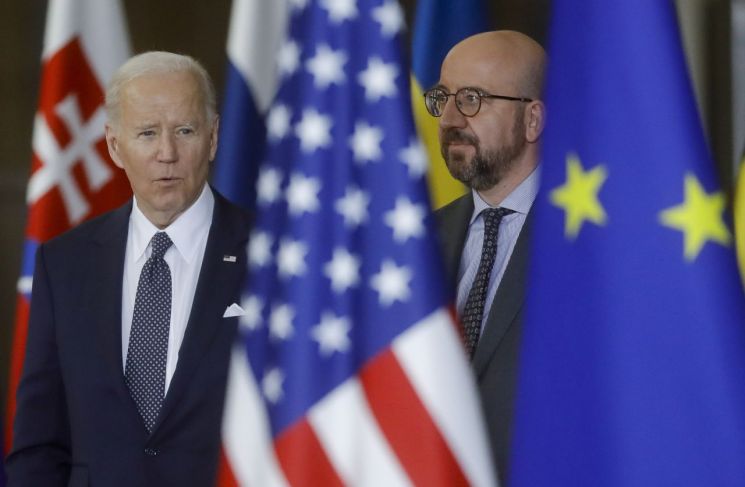
[Asia Economy Reporter Hyunwoo Lee, New York=Special Correspondent Seulgina Cho] The European Union (EU), the United States, Canada, and other Western countries have announced that they will actively reduce their dependence on Russian energy. The Western countries aim to fundamentally block Russia's resource weaponization and completely isolate Russia, which invaded Ukraine, from the international community.
However, within the EU, voices opposing a full import ban remain strong, especially from countries with high dependence on Russian energy such as Germany and Hungary. There are also forecasts that the issue of Russia's expulsion from the Group of Twenty (G20), announced by U.S. President Joe Biden, will not be realized immediately as non-Western countries have expressed negative views.
On the 24th (local time), EU member state leaders held a summit in Brussels, Belgium, attended by President Biden, focusing on measures to reduce dependence on Russian energy. President Biden also attended the consecutively held North Atlantic Treaty Organization (NATO) summit and G7 summit on the same day.
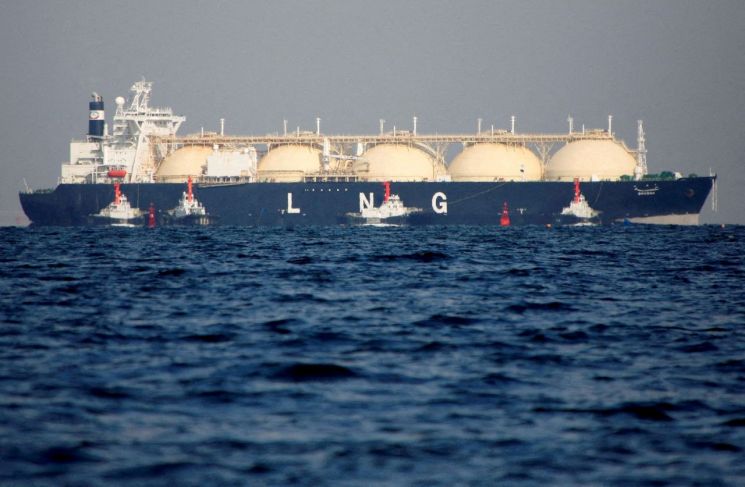
President Biden reportedly announced that the United States will increase liquefied natural gas (LNG) supplies to Europe. Major foreign media, citing sources, reported, "The U.S. side conveyed plans to supply an additional 15 billion cubic meters of LNG to the EU by the end of this year," and "President Biden hopes that Ursula von der Leyen, President of the European Commission, will announce an agreement to reduce dependence on Russian energy."
The Canadian government also announced a production increase plan to reduce Europe's dependence on Russian energy. According to AFP, Jonathan Wilkinson, Canada's Minister of Natural Resources, stated in a press release that "European allies have requested help to reduce dependence on Russian energy, so oil and natural gas production will be increased by 5% each." Accordingly, the Canadian government plans to increase daily crude oil production by 200,000 barrels and natural gas by 100,000 barrels, totaling a 300,000-barrel increase.
This is interpreted as a judgment that Russia's resource weaponization must be prevented to strengthen isolation and sanctions, such as Russia's expulsion from the G20, which the U.S. and Western countries are pursuing. President von der Leyen also strongly criticized, saying, "The era when Russia could threaten us with energy is over," and "Russia's claim to receive energy export payments in rubles is an attempt to evade EU sanctions, and we will not allow it."
However, concerns remain that the effectiveness will be limited as many European countries, centered on Germany and Hungary, which still have high dependence on Russian energy, oppose the embargo. According to the BBC, German Chancellor Olaf Scholz opposed a full embargo agreement on Russian energy at the EU summit and requested easing it to a limit on import volumes.
This is reportedly due to strong opposition from German companies. The Federation of German Industries (BDI) warned earlier this month in a statement that "the EU still depends on Russia for over 40% of natural gas and 28% of oil, and if an embargo on Russian energy is imposed, major German and EU companies will close one after another due to the energy price burden."
The strategy to expel Russia from the G20 also faces strong opposition from non-Western countries, making it unlikely to succeed easily. To expel Russia from the G20, the consent of all member countries' finance ministers or higher is essential, but non-Western countries oppose Russia's expulsion.
Russia faced moves to be expelled from the G20 after forcibly annexing Ukraine's Crimea Peninsula in 2014. Although Russia was expelled from the G8 (Group of Eight), it remained in the G20 until the end. This was due to opposition mainly from so-called BRICs countries such as Brazil, India, China, and South Africa. At that time, these countries issued a statement with Russia saying, "All members are equal."
President Biden's mention at the NATO press conference that "if other countries such as Indonesia, the chair country, do not agree, he proposed allowing Ukraine to attend the G20 summit as an observer" is also interpreted as a remark considering this situation.
China has already publicly opposed, stating, "No member country has the right to expel another member country." Brazil has declared it will not take sides regarding the Ukraine situation. India abstained from a UN statement condemning Russia, considering its relationship with Russia.
President Biden stated on the day that the U.S. would respond if Russia uses chemical weapons. When asked by reporters whether the response would mean NATO's military intervention, he avoided a direct answer, saying, "The nature of the response depends on how chemical weapons are used."
© The Asia Business Daily(www.asiae.co.kr). All rights reserved.
![Clutching a Stolen Dior Bag, Saying "I Hate Being Poor but Real"... The Grotesque Con of a "Human Knockoff" [Slate]](https://cwcontent.asiae.co.kr/asiaresize/183/2026021902243444107_1771435474.jpg)


















