Observed Shift in Regulatory Focus Toward Ne·Ka
Last Year, KCC and Fair Trade Commission Experienced Inter-Agency Conflicts
President-Elect Yoon Emphasizes Principle of Minimal Regulation on Companies
Legislation Expected to Gain Momentum Following Public Debates Including National Assembly Forums
[Asia Economy Reporter Cha Min-young] In line with President-elect Yoon Seok-yeol's policy of easing corporate regulations, it is expected that the regulatory focus on domestic IT companies such as Naver and Kakao will shift towards 'self-regulation.' After public discussions such as National Assembly forums, legislative progress is also anticipated.
National Assembly Holds Forum with KCC and Ministry of Science and ICT
According to related industries on the 25th, Kim Young-sik, the senior member of the People Power Party in the Science, Technology, Information and Broadcasting and Communications Committee, plans to hold a forum titled "Yoon Seok-yeol Government, Online Platform Introduction Plan" on the 28th. Panelists include Director-General Jeong Chang-rim of the Ministry of Science and ICT's Telecommunications Policy Bureau, Kim Jae-cheol, Director of the User Policy Bureau at the Korea Communications Commission, and industry representatives from the Internet Enterprise Association and Korea Startup Forum. However, the Fair Trade Commission did not respond to the request to attend the forum from the lawmaker's office.
The online platform market was a 'hot potato' last year. As various platforms such as Naver, Kakao, and Baedal Minjok emerged as essential goods and the related market continued to grow, platform disputes persisted. During this time, the Korea Communications Commission and the Fair Trade Commission engaged in a year-long battle over regulatory authority as the main IT regulatory body and fair competition authority, respectively, but it seemed that the issue was ultimately leaning towards the Fair Trade Commission.
Fair Trade Commission vs. Korea Communications Commission, Tense Standoff
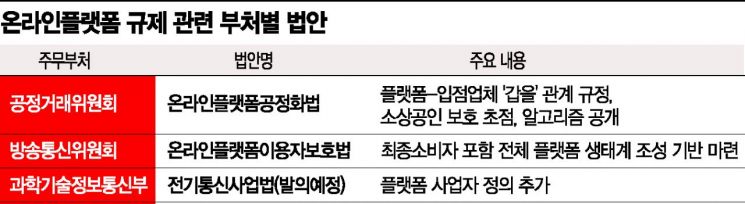
Led by Chairman Cho Sung-wook, the Fair Trade Commission has strongly asserted the necessity of platform regulation both domestically and internationally. The FTC's draft Online Platform Act defines platform tenants as 'subordinate' and focuses on protecting individual small business owners. It includes provisions requiring disclosure of criteria for commission fees and product exposure order algorithms, which led to criticism from the platform industry, saying it was like "asking to reveal secret recipes of popular restaurants." After revisions, the draft narrowed the scope to platforms with intermediary revenues exceeding 100 billion KRW or intermediary transaction amounts over 1 trillion KRW, but industry concerns remained high.
The Korea Communications Commission's draft emphasized 'self-correction.' It did not define the platform-tenant relationship as a one-sided dominant-subordinate relationship but focused on encompassing the entire market, including end consumers. Through discussions in the National Assembly's Science, ICT, Broadcasting and Communications Committee, the KCC deleted the review clause on business operators' self-regulatory agreements and reduced the scope to a level similar to the FTC's draft. The clause requiring disclosure of exposure criteria excluded algorithms that the industry feared might be leaked.
Transition to 'Self-Regulation' by the Transition Team
A variable factor was President-elect Yoon Seok-yeol and the People Power Party's policy of 'easing corporate regulations.' During his presidential campaign, Yoon emphasized a 'minimal regulation' policy direction, stating that platform regulations should not hinder the dynamism and innovation of the platform industry. While pledging to prevent unfair practices by platform companies, he clearly expressed that legislative regulations were premature. He announced plans to establish an organization for corporate self-regulation and to have internal self-dispute resolution committees within platform companies.
At the transition team's briefing on related ministries including the Korea Communications Commission, Ministry of Science and ICT, and Fair Trade Commission the day before, a changed atmosphere was sensed. There was cautious speculation that this year might become a three-way battle with the Ministry of Science and ICT joining in. The Ministry of Science and ICT reportedly stated in its briefing that it plans to propose the Telecommunications Industry Act to acquire regulatory authority. It is also considering establishing a Digital Platform Bureau or changing the Telecommunications Policy Bureau to a Digital Platform Bureau.
Internet companies have consistently expressed opposition to the government's plan to strengthen legal regulations. There is strong concern that even startups, which differ greatly in scale from internet giants like Naver and Kakao, could be included as regulation targets. Choi Sung-jin, CEO of the Korea Startup Forum, said, "We have consistently opposed the government's view that even small startups, which are not big tech companies, should be subject to regulation," adding, "There needs to be a change in perspective within government ministries."
© The Asia Business Daily(www.asiae.co.kr). All rights reserved.
!["The Woman Who Threw Herself into the Water Clutching a Stolen Dior Bag"...A Grotesque Success Story That Shakes the Korean Psyche [Slate]](https://cwcontent.asiae.co.kr/asiaresize/183/2026021902243444107_1771435474.jpg)
















