[Seoul District News] Seongdong-gu Releases Total 10,053 Commercial Building Rental Areas and Jeonse Prices per Pyeong by Dong Unit for Entire District · Enhances Objectivity with Time-Series Data Collection Reflecting Practical Information to Provide High-Quality Commercial Area Information for Small Business Owners... Dongjak-gu Recruits Participants for Village-Style Shared Office · Up to 3.5 Million KRW Support
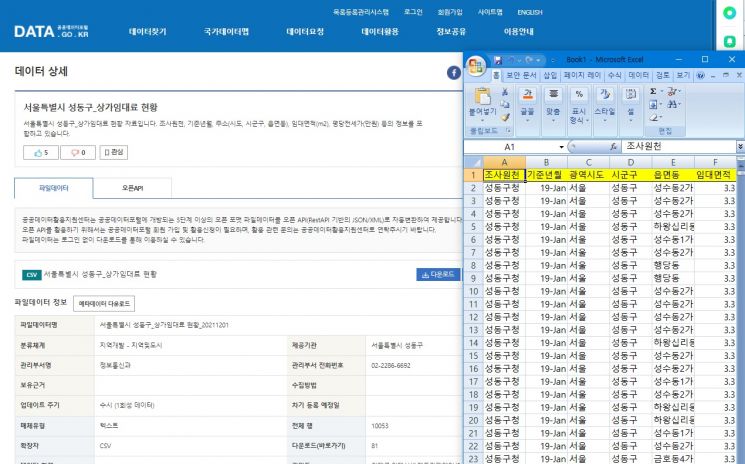 The commercial rent big data of Seongdong-gu, the first to be established by a basic local government, is available for viewing on the Public Data Portal.
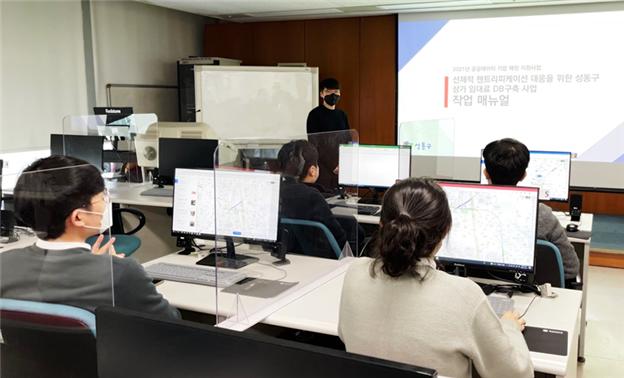
[Asia Economy Reporter Park Jong-il] Seongdong-gu (Mayor Jung Won-oh) announced that it will build and publicly provide big data on commercial rent, becoming the first basic local government to do so.
The disclosed information includes rental data for a total of 10,053 commercial properties in the area, focusing on the period from 2019 to 2021, detailing monthly rental area (㎡) by neighborhood and the rent per pyeong (10,000 KRW) for jeonse (long-term deposit lease).
Data was collected for all 17 neighborhoods in Seongdong-gu, allowing users to see the rent per pyeong according to rental area by neighborhood and compare monthly changes by neighborhood.
This big data project was conducted using 20 youth interns through a non-face-to-face survey as part of the Ministry of the Interior and Safety’s Digital New Deal project, the ‘2021 Public Data Enterprise Matching Support Project.’
Rental data was collected in a time series manner, repeatedly measured at regular intervals over time. Actual rental data was actively reflected by receiving commercial rent data from the Seoul Credit Guarantee Foundation (Seongdong branch) and the Korea Association of Realtors, enhancing objectivity.
The district plans to continue collaborating with institutions such as the Seoul Credit Information Foundation to regularly update related data and provide high-quality commercial district information to help reduce the information gap for small business owners and prospective entrepreneurs.
Seongdong-gu, which enacted the nation’s first ordinance to prevent gentrification in 2015 and has continuously monitored commercial rent status and increases, confirmed the rent increase suppression effect in all indicators, including rent increase rates, through a seven-year sustainable development zone (Sangwon-gil, Seoul Forest-gil, and Broadcasting University-gil) coexistence agreement.
By establishing a separate big data center (March 2019) and actively utilizing the ‘Seongdong-gu Big Data Platform’ for analyzing frequent illegal dumping areas and other purposes, the district was recognized as an excellent case and was the only local government to receive the ‘2021 Data-Based Administrative Activation Minister of the Interior and Safety Commendation.’ Accordingly, it plans to actively implement smart policies using various big data such as commercial rent.
Jung Won-oh, Mayor of Seongdong-gu, said, “We hope the newly built commercial rent big data will be of great help to small business owners and early-stage entrepreneurs. We will continue to actively strive to provide various digital services that can revitalize the local economy, including preventing gentrification.”
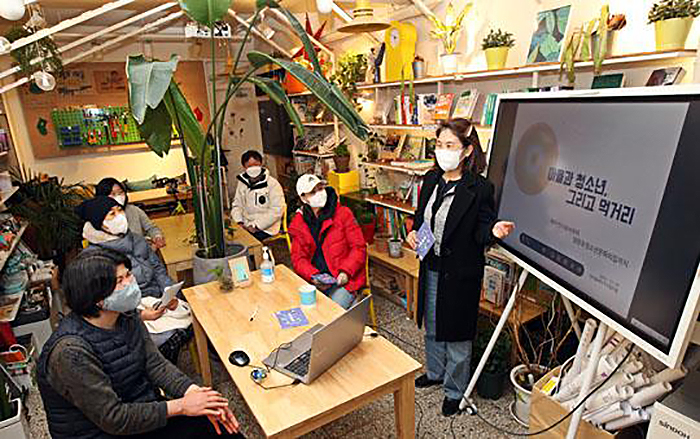
Dongjak-gu (Mayor Lee Chang-woo) announced that it will publicly recruit participants (startup teams) for the ‘2022 Village-Type Shared Office Utilizing Local Bookstores’ from March 25 to April 22 to continuously revitalize local bookstores.
This project was promoted to solve the economic difficulties faced by local bookstores and youth employment and entrepreneurship issues due to the prolonged COVID-19 pandemic and the expansion of large and online bookstores, and it was selected as a Dongjak cooperative project for two consecutive years.
The ‘Village-Type Shared Office Project’ operates shared office spaces within three local bookstores?Cheongmaek Salon (Heukseok-dong), Daeryuk Bookstore (Sangdo-dong), and ‘Jigeum-ui Sesang’ (Sadang-dong)?and runs youth startup support programs and local resident book culture programs.
Especially this year, to promote youth entrepreneurship, mentoring services will be provided to help teams carry out startup projects, including startup portfolio planning and guidance, and a project presentation event called ‘Pitching Day’ will be held.
The main bookstore, Cheongmaek Salon, was once famous as a humanities and social sciences specialty bookstore, Cheongmaek Bookstore, and has been reborn as a space for communication with people through culture and exhibition planning, becoming a local landmark.
Eligibility for participation in this project is for those aged 18 to 39, who are either prospective startup teams including at least one resident of Dongjak-gu or teams (companies or individuals) working at companies located in the area or who have started a business within the last three years. The district plans to select a total of five teams (about 20 people, four per team).
Selected teams will receive support such as up to 3.5 million KRW per team for capacity development including information activities, promotion, and portfolio production; meeting spaces and office equipment rental; dedicated mentor matching and education for capacity development and project activities; and educational programs according to employment and startup preparation stages.
Youth wishing to participate can submit an application form, created content, or portfolio via email to the person in charge.
The district will conduct a comprehensive evaluation based on the specificity of activities, feasibility of plans, and creativity, and make the final selection by the end of April. For more details, contact the Job Policy Division.
Jeon Hye-young, head of the Job Policy Division, said, “Through this project, we hope local bookstores will establish themselves as complex spaces for jobs and culture in the community, helping to revitalize the local economy and create quality jobs.”
© The Asia Business Daily(www.asiae.co.kr). All rights reserved.



















