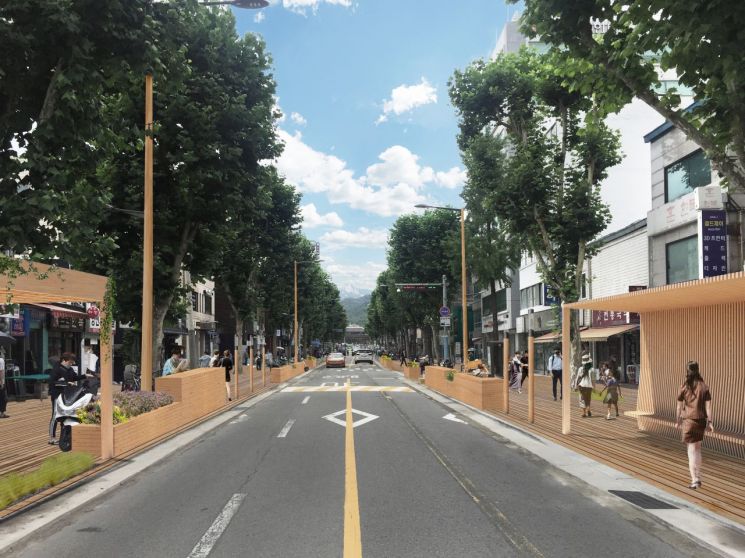
 An aerial perspective rendering of the 'Wood Specialty Street,' which will be primarily constructed using wood materials. Provided by the Korea Forest Service
[Asia Economy (Daejeon) Reporter Jeong Il-woong] The Korea Forest Service is redesigning urban areas by creating wood-friendly cities (hereinafter referred to as wood-friendly cities). The main goal of creating wood-friendly cities is to transform concrete-centered urban environments into wood-centered eco-friendly spaces, thereby achieving carbon neutrality and establishing a sustainable wood circulation system in each city.
◆ Creation of Wood-Friendly Cities in Five Regions Including Chuncheon, Gangwon Province = According to the Korea Forest Service on the 25th, five regions?Chuncheon in Gangwon, Bonghwa in Gyeongbuk, Yuseong in Daejeon, Gangjin in Jeonnam, and Muju in Jeonbuk?were selected as final project sites in the ‘2022 Wood-Friendly City Creation Project’ contest held for local governments.
From this year until 2025, these five project sites will each receive 5 billion KRW (50% national and 50% local government matching funds) over four years to create wood-specialized streets using local timber, promote wood education and culture through public woodworking experience centers, and stimulate the local economy by fostering the regional wood industry and creating jobs.
Previously, the wood-friendly city project was included in the government’s Urban Regeneration New Deal Project (new type of regional specialized regeneration program) in 2020, laying the groundwork for project implementation.
The regional specialized regeneration program is designed such that the Korea Forest Service selects five regions among metropolitan cities and small to medium-sized cities to create wood-specialized streets, while relevant ministries implement housing environment improvement projects and wooden living SOC (social overhead capital) construction projects linked to the Urban Regeneration New Deal Project.
Recently, the Korea Forest Service’s selection of five project sites through a public contest marks the starting point of the project. Among them, Bonghwa County in Gyeongbuk will promote various wood utilization projects, including public wooden architecture, in connection with the Ministry of Land, Infrastructure and Transport’s Urban Regeneration New Deal Project (wood-friendly wooden city model).
◆ Activation of ‘Wood’ as a Carbon Sink and Job Creation = The creation of wood-friendly cities is expected not only to reorganize urban environments but also to contribute to establishing a virtuous cycle by realizing carbon neutrality and creating jobs through the wood industry.
The Korea Forest Service estimates that while approximately 6.4 billion tons of carbon are emitted annually worldwide, only about 3 billion tons are naturally absorbed. Without securing an additional 3.4 billion tons of carbon sinks, humanity will find it difficult to be free from global warming and other climate crises.
The Korea Forest Service’s effort to replace and expand concrete buildings with wooden buildings through the creation of wood-friendly cities aligns with this goal. Their strategy is to fully utilize wood, one of the main carbon sinks, to contribute to carbon neutrality. In fact, wooden buildings can store 250 kg of carbon per cubic meter through photosynthesis, and constructing one wooden building (189㎡) is known to reduce carbon emissions by 50 tons.
Efforts to expand carbon sinks using wood are also evident overseas. For example, Japan enacted and implemented the ‘Act on Promotion of Use of Wood in Public Buildings’ in 2010, raising the wooden structure ratio of all central government public buildings to 13.4% by 2017. British Columbia, Canada, has enforced the ‘Wood First Act’ since 2009, mandating the preferential use of wood in all new public buildings.
The Korea Forest Service’s wood-friendly city project is meaningful in that it uses locally produced wood to connect primary forestry, secondary wood industries, and tertiary wood city creation, thereby promoting job creation and revitalizing the local economy in each project area.
Kim Yong-gwan, Director of the Forest Industry Policy Bureau at the Korea Forest Service, said, “Through the wood-friendly city project, the Korea Forest Service will activate domestic wooden architecture culture from a long-term perspective and create a turning point for Korea to become a carbon-neutral country. Above all, we will ensure that this project contributes to establishing a virtuous resource circulation system by producing wood from locally grown trees, processing it in local factories, constructing buildings, and creating wooden architecture streets.”
© The Asia Business Daily(www.asiae.co.kr). All rights reserved.

















