Domestic Infant Food Production Value
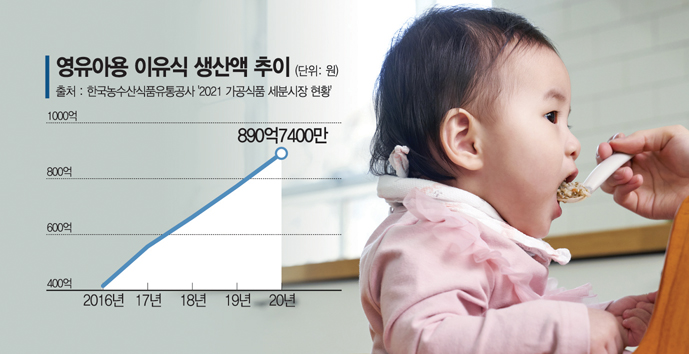
415 Billion KRW in 2016 → 890 Billion KRW in 2020
Market Size More Than Doubled in 4 Years
Demand Expands as Dual-Income Couples Increase
[Asia Economy Reporter Eunmo Koo] "I still feel sorry and uneasy that I can't make it myself, but seeing my child eat well without any rejection for several months makes me feel relieved."
A, a working mom raising an 18-month-old son, has been using delivery baby food for three months. When she first started baby food, she diligently made various foods by referring to related books, but it became increasingly difficult. Her husband, who watched A struggle with work and childcare, suggested buying and feeding prepared baby food, and A, also taking advice from acquaintances, now feeds delivery baby food.
Although the low birthrate trend continues, the convenient baby food market for infants and toddlers is rapidly growing. According to the '2021 Processed Food Submarket Status' published by the Korea Agro-Fisheries & Food Trade Corporation on the 24th, domestic production of baby food for infants and toddlers was only about 41.5 billion KRW in 2016, but increased to 55.6 billion KRW the following year, then grew to 66.2 billion KRW in 2018, 77.3 billion KRW in 2019, and reached about 89 billion KRW in 2020, more than doubling in size over four years. It is estimated to have exceeded 100 billion KRW last year.
The domestic baby food market continues to grow despite the continuous decline in the infant and toddler population, which is interpreted as due to the increase in dual-income families and the rising demand for convenient baby food. As more parents find it difficult to make baby food themselves, the perception that commercial baby food is reasonable considering ingredient costs and cooking time is influencing this trend.
Companies are actively producing and selling handmade baby food, moving away from traditional powdered or instant baby food. Currently, the domestic baby food market involves both large corporations and small and medium-sized enterprises competing without a dominant leader. Since Maeil Dairies launched the baby food brand 'Mamma Meal' in 2016, Lotte Foods Pasteur's 'I Saenggak', Namyang Dairy's 'Care B', and Pulmuone's 'Baby Meal' have introduced their own brands and entered the related market.
The progress of small and medium-sized companies is also notable. Bebecook is targeting the market with segmented services tailored to the baby's age. Recently, they have been selling 'DIY baby food' ingredients such as rice powder and beef bone broth that can be made at home without preparing ingredients. Jjangjuk is expanding its consumer base by promoting room-temperature baby food that can be stored at room temperature for up to three months.
Although the infant and toddler population is decreasing, the trend of consumers not sparing investment in their children is forming, leading to the premiumization of the baby food market, and the related market growth is expected to continue. Professor Eunhee Lee of Inha University's Department of Consumer Studies said, "As products purchased for children are generally becoming premium, the baby food market, which requires daily health considerations, will steadily grow by meeting MZ generation (Millennials + Generation Z) parents who have a convenience-oriented tendency."
© The Asia Business Daily(www.asiae.co.kr). All rights reserved.

















