On the 23rd, the City Urban and Architectural Joint Committee approved amendments to the 590,000㎡ district unit plan for the Seocho-daero area... Expansion of Gangnam downtown axis by newly incorporating Jinheung Apartment site... Adjustment of special planning zones for large-scale site development including Lotte Chilsung site, securing potential for zoning upgrades... Relaxation of dual regulations in the court complex area with maximum height zone at 28m and zoning limit under 7 floors (only 28m applied)... ‘Dongjak Commercial Renaissance’ progressing smoothly... Boosting commercial area revitalization... Gangdong-gu creates street gallery using public facilities along Yangjae-daero... Gwangjin-gu on the 24th upcoming...
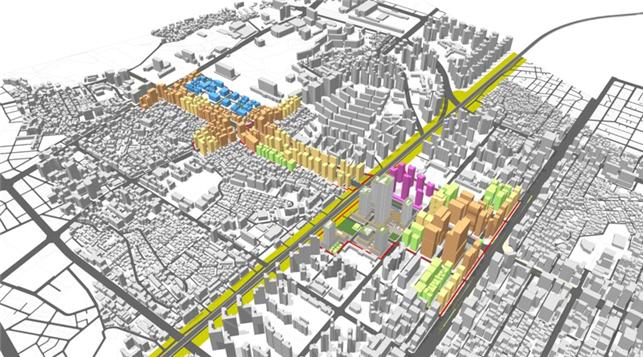
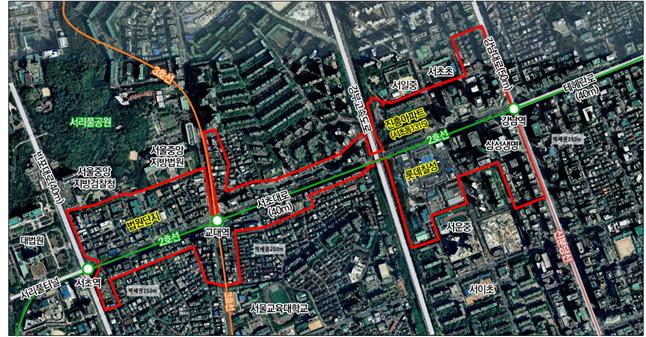
[Asia Economy Reporter Park Jong-il] Seocho-gu announced that on the 23rd, the Seoul Metropolitan City Urban and Architectural Joint Committee approved a revised version of the ‘Seocho-ro District Unit Plan Decision (Amendment) (Draft)’ for the Seocho-daero area, spanning 596,277㎡ from Gangnam Station through Gyodae Station to Seocho Station.
The ‘Seocho-ro District Unit Plan’ is a collaborative work between Seoul City and Seocho-gu, created after five years of efforts starting with a reorganization service in 2017, including three joint city-district reporting meetings and numerous discussions and consultations.
The main points of this district unit plan include ▲new inclusion of the Jinhung Apartment site (Seocho-daero 385) to expand the Gangnam downtown area and strengthen connectivity along Seocho-daero ▲division of special planning zones considering the characteristics of large-scale landowners such as Lotte Chilsung ▲relaxation of dual height regulations in the court complex area.
First, to strengthen the function of Seocho-daero as a central street and expand urban functions, the Jinhung Apartment site was newly included in the district unit plan area. This allows for creative development such as upgrading land use zones when establishing redevelopment plans for reconstruction.
Also, the Lotte Chilsung site, which had remained undeveloped for a long time due to disagreements among landowners, was subdivided into special planning zones according to land ownership status, securing the possibility of upgrading land use zones to commercial and semi-residential areas through prior negotiations or detailed development plans.
Additionally, the land use zone in the court complex area was upgraded from the second-class general residential area (up to 7 floors) to the second-class general residential area, easing the existing dual regulation of the second-class general residential area (up to 7 floors) and the maximum height district (up to 28m) to only the 28m height regulation.
With the revised approval of the ‘Seocho-ro District Unit Plan,’ it is expected to create synergy effects with the ‘Naebang Station District Unit Plan’ decided in 2020 and the ‘Seoripul District Unit Plan Detailed Development Plan’ decided in 2021, potentially developing into a symbolic landmark in the southeastern region of Seoul.
Moreover, through public contributions, various cultural and convenience facilities that meet residents’ diverse needs can naturally be introduced, which is expected to help revitalize the streetscape of the currently stagnant Seocho-daero.
Cheon Jeong-wook, Acting Mayor of Seocho-gu, said, “With the revised approval of this district unit plan (draft), we hope the Seocho-daero area will emerge as a new growth engine at the center of Seocho-gu.”
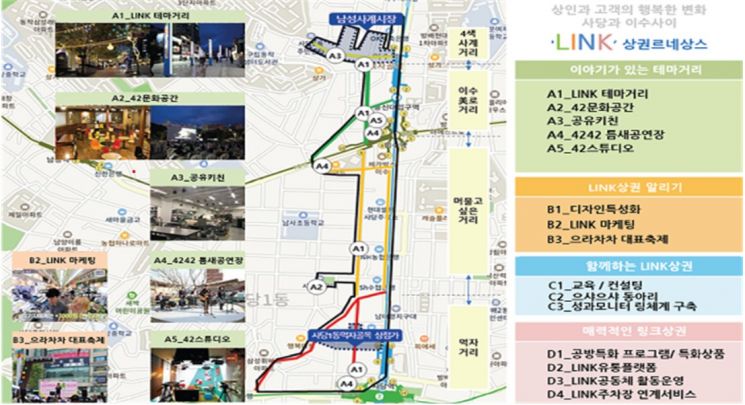
Dongjak-gu (Mayor Lee Chang-woo) is set to fully launch the second year of the ‘Dongjak Commercial District Renaissance’ project.
The Dongjak LINK Commercial District Renaissance project designates the section connecting ‘Sadang Station’ and ‘Isu Station’ as a ‘commercial district revitalization zone’ to breathe new life into the alleyway commercial districts.
By 2025, 10 billion KRW will be invested to brand the local commercial district and secure sustainable competitiveness.
Launched last year, the first year of the ‘Dongjak Commercial District Renaissance Project’ established a Commercial District Revitalization Council, completed the development of the commercial district brand ‘42 Brand,’ and laid the foundation for building the project identity, including signing a ‘Local Commercial District Win-Win Project’ business agreement with representatives of merchants, residents, and Lotte Chilsung Beverage.
This year, the focus is on organizing the promotion team and specializing content to accelerate project implementation.
First, recruitment will begin for the project team leader (Town Manager), who will oversee the overall planning and management of the commercial district revitalization project. One position is available, and applications must be submitted via email by 6 p.m. on March 29. The recruitment schedule may be extended, and inquiries should be directed to the Dongjak Commercial District Renaissance Project Team.
Additionally, 2.7 billion KRW will be invested this year alone to implement projects such as ▲paving the design road of Namseong Four Seasons Market ▲opening a ‘shared studio’ capable of live commerce ▲creating a ‘complex cultural space’ ▲developing design products ▲establishing shared unmanned stores ▲creating a smart commercial district ▲improving the shopping environment.
In the second half of the year, the ‘Dongjak-gu Economic Promotion Foundation,’ dedicated to the Commercial District Renaissance project, will be launched. In February, the Seoul Institute completed a feasibility study for establishing the foundation, analyzing that the industrial production inducement effect within Dongjak-gu from the foundation’s establishment is approximately 13.2 billion KRW, with an added value inducement effect of 6.3 billion KRW.
Yang Hye-young, Director of the Economic Promotion Division, said, “In the first year, we reached consensus on direction through communication with local merchants, residents, and companies. In the second year, we will focus on producing content that practically contributes to revitalizing the local economy. We will do our best to bring a spring of resurgence to merchants who have endured difficult times due to COVID-19.”
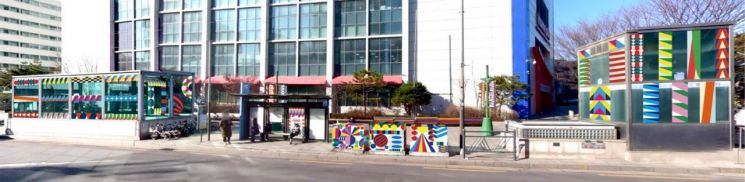
Gangdong-gu (Mayor Lee Jung-hoon) will create a street gallery using public facilities along Yangjae-daero (a pedestrian section of about 600m from Gubeundari Intersection to the entrance of Cheondong Elementary School Intersection).
This Yangjae-daero street gallery project combines the designs of public facilities that disrupt the urban landscape, such as KEPCO ground equipment, bus stops, and subway ventilation shafts, with artworks by artists that harmonize with these facilities to create a distinctive street.
Seven young artists gaining attention in Korea?Vakki, Kim Ji-hye, Anikun, Sung Tae-jin, Jung Jin-kyung, Shin Je-hyun, and Stereo Type?will participate in creating the street gallery. These artists focus on Gangdong-gu’s historical and cultural resources such as comb-patterned pottery and Gildong Natural Ecology Park, aiming to rediscover new aspects of Gangdong and present works that symbolize and visualize hidden attractions of Gangdong.
The artworks combined with public facilities will start around Gubeundari Station in front of Gangdong-gu Community Center and extend to Cheondong Elementary School Intersection. The completed Yangjae-daero street gallery will be unveiled by the end of April this year.
Lee Jung-hoon, Mayor of Gangdong-gu, said, “The artists’ works, which reinterpret Gangdong-gu’s historical and cultural assets, combined with urban space facilities, will make everyday spaces special and breathe new vitality into the streets. Additionally, a specialized street garden will be created along Yangjae-daero from Gildong Station to Dunchon Intersection. We hope for much interest and expectations for the transforming Yangjae-daero street.”
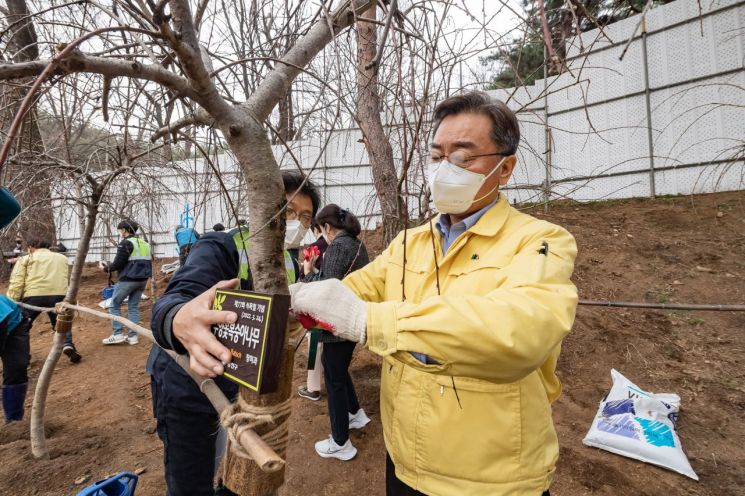
Gwangjin-gu (Mayor Kim Sun-gap) held a tree planting event on the 24th at the green space behind the Achasan Forest Library building in celebration of the upcoming 77th Arbor Day.
This event was organized to effectively respond to fine dust and abnormal climate and to decorate the landscape of the Achasan Forest Library, scheduled to open in June this year, together with residents.
About 20 people attended the event, including Mayor Kim Sun-gap of Gwangjin-gu, representatives of local small libraries, kindergarten and daycare center staff, and local historians. The event was held on a small scale considering the COVID-19 situation.
Mayor Kim planted trees with residents and spent time communicating while attaching nameplates.
Mayor Kim Sun-gap said, “The Achasan Forest Library will be a resting place for residents, so it seemed meaningful to hold a commemorative tree planting with residents. If you have any ideas about how to utilize the Achasan Forest Library, please feel free to share them anytime.”
Kwon Jong-hyung, Chairman of the Saemaeul Library Gwangjin-gu Branch, who participated in the event, said, “The Achasan Forest Library will be a place where people can enjoy natural scenery and read books in the city, becoming a landmark of Gwangjin-gu. I am happy to plant trees in such a place and feel rewarded to have contributed even a little.”
A total of 30 trees were planted during the event, including 9 crape myrtles, 6 fragrant lilacs, and 15 weeping peach trees. Later, shrubs such as three-colored spirea and forsythia will be planted to create an outdoor community resting area where visitors can heal with flowers and fragrance.
The weeping peach tree blooms from April to May, with red flowers on drooping branches, also called weeping red peach. The fragrant lilac blooms from May to July, known as tall lilac, with a strong flower scent that can be smelled from afar and abundant nectar. The crape myrtle blooms from July to September, with flowers lasting for a hundred days, hence called the hundred-day flower.
By planting tree species with different blooming periods, visitors to the Achasan Forest Library can enjoy flowering trees for a long time.
Mayor Kim Sun-gap of Gwangjin-gu said, “Tree planting is a small but significant act that helps reduce greenhouse gases and fine dust. It was good to spend time communicating with residents while touring the Achasan Forest Library and planting trees.”
© The Asia Business Daily(www.asiae.co.kr). All rights reserved.



















