KMA Holds Roundtable on Pediatric COVID-19 Cases and Solutions
Most Cases End with Fever or Mild Symptoms
Oral Antipyretics Recommended with Monitoring
Seek Emergency Care Immediately for Respiratory Distress, Croup, Myocarditis, or Altered Consciousness
"Severe Shortage of Pediatric Emergency Medical Staff... Compensation and Support Needed"
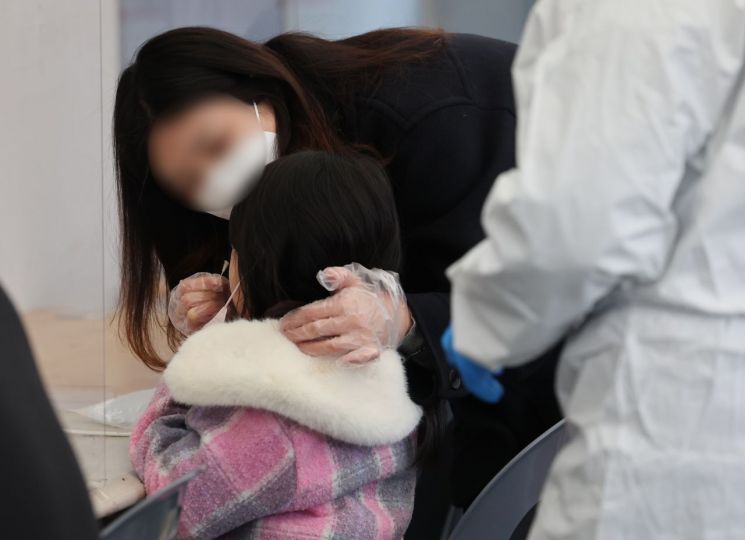 On the morning of the 23rd, a child is undergoing a rapid antigen test at the screening clinic of the Songpa-gu Public Health Center in Seoul. [Image source=Yonhap News]
[Asia Economy Reporter Lee Gwan-joo] As COVID-19 pediatric cases surge, experts emphasize that "there is no need to be overly anxious." Healthy children generally experience mild symptoms, so home treatment while monitoring their health condition can lead to improvement. However, they advise seeking emergency care immediately if emergency situations such as breathing difficulties, myocarditis, or decreased consciousness occur.
At a pediatric COVID-19 patient discussion held on the 24th by the Korean Medical Association via YouTube, experts first pointed out that excessive concern from guardians is causing disruptions in emergency care. Professor Lee Ji-sook, Department of Emergency Medicine at Ajou University Hospital (Training Director of the Korean Society of Pediatric Emergency Medicine), said, "Recently, reports of infant deaths in the media have led to a flood of emergency room phone inquiries even for just fever, causing significant disruptions in care," adding, "The increase in emergency room visits by guardians anxious about simple fever is preventing truly critical patients from entering the emergency room, resulting in worsening conditions at the door."
Experts explain that most pediatric COVID-19 cases experience mild symptoms. Professor Ryu Jeong-min, Pediatric Emergency Center at Seoul Asan Medical Center (Vice President of the Korean Society of Pediatric Emergency Medicine), said, "Since symptoms are mostly mild, home treatment is the principle for previously healthy pediatric patients who can be closely monitored," adding, "However, in infants, even high fever alone can cause feeding difficulties and dehydration leading to worsened condition, so medical management may be necessary."
Professor Ryu advised that if fever occurs, administering antipyretics twice over 8 hours and observing the progress is recommended. In most cases, body temperature returns to normal after taking antipyretics. However, he urged prompt hospital visits if specific symptoms appear. He said, "If the child continues to be lethargic or unwell, or if symptoms such as breathing difficulties, croup (acute obstructive laryngitis), myocarditis, or decreased consciousness occur, immediately call 119 and visit the nearest emergency room, pediatric emergency center, pediatric clinic, or children's hospital."
Regarding the misconception that pediatric fever always requires intravenous fluids, he drew a clear line, calling it "an unfounded blind belief." Professor Lee said, "While intravenous fluids are certainly helpful for patients with severe dehydration or shock symptoms, the procedure of securing an intravenous line itself is difficult and can place a significant burden on pediatric patients." He added, "Guardians often request antipyretic injections, which can reduce fever slightly faster than oral antipyretics, but the timing of fever recurrence is similar,” emphasizing that this is not a fundamental treatment for infection.
Experts cited infrastructure shortages as the cause of the recent increase in pediatric patient deaths. COVID-19 policies have been focused on adult patients, leading to pediatric emergency medical staff handling adult patients or reducing pediatric emergency beds. When pediatric patients rapidly increased with the Omicron variant, many medical sites lacked isolation beds or specialized personnel, causing delays in emergency treatment. Professor Lee criticized, "This is not a new problem that suddenly appeared during the COVID era. The reality is that preparation for pediatric critical care, which can occur unexpectedly, is still insufficient."
They also unanimously called for improvements in the pediatric emergency medical system, pointing out issues such as workforce shortages on the front lines. Professor Ryu proposed, "Establish a treatment system by effectively utilizing pediatric specialists nationwide, including private clinics, employed doctors, and children's hospitals, similar to designating COVID treatment institutions or base hospitals. For nursing staff, secure personnel by utilizing idle nurses who have pediatric treatment experience but have transferred to other departments or retired.” He added, “Pediatric emergency care is difficult and demanding, with many night and late-night shifts, so many avoid it. Adequate compensation must follow to resolve this issue in the long term.”
Professor Lee also said, “Pediatric emergency care combines two areas that everyone avoids: pediatric treatment and night/late-night care. Until now, pediatricians and emergency medicine doctors have endured these difficulties out of a sense of duty and pride,” adding, “However, if an emergency center capable of treating pediatric critical patients disappears within the next 1-2 years, it could lead to increased mortality due to untreated children and a decline in birth rates. The government must take this seriously and respond immediately.” He appealed, “I earnestly request that the central government and local governments establish pediatric emergency centers regionally and actively support medical institutions operating pediatric emergency rooms, which can never be profitable, with sufficient personnel and facilities.”
© The Asia Business Daily(www.asiae.co.kr). All rights reserved.

















