Yoon, "Cheongwadae Opens from May 10 at 0:00"... Firm Commitment to 'Yongsan Relocation'
Sudden Decision Sparks Criticism of 'Hasty Implementation' over Costs and Security Gaps
Reexamination of YS's Poor 'Communication' with Joseon Governor-General Office Demolition and MB's US Beef Promotion
Experts: "Yoon's Leadership Faces First Test... Must Actively Communicate with the Public"
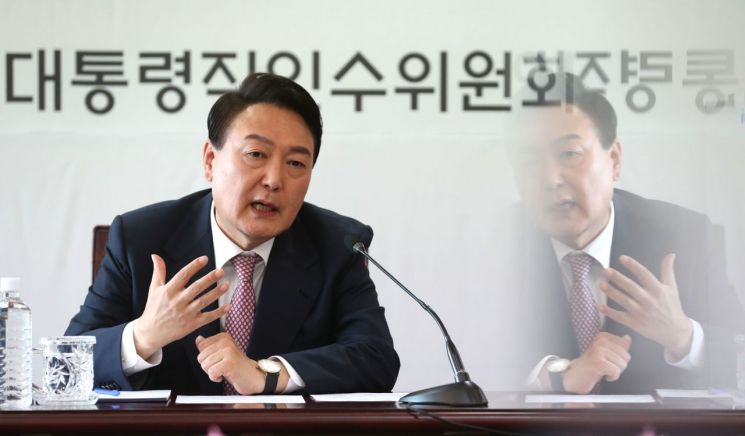 President-elect Yoon Seok-yeol is presiding over the transition committee secretariat meeting on the morning of the 22nd at the Presidential Transition Committee office in Tongui-dong, Jongno-gu, Seoul.
 [Image source=Yonhap News]
[Asia Economy Reporter Yoon Seul-gi] President-elect Yoon Seok-yeol's plan to relocate the presidential office has hit a roadblock. While the Blue House has expressed reluctance due to security concerns, public opinion is also against the 'Yongsan relocation.' However, it is reported that President-elect Yoon is strongly determined to "return the Blue House to the people." He has firmly stated, "We will open the Blue House as of midnight on May 10."
As the 'Yongsan relocation' issue has emerged as a core political matter, the leadership of past presidents who chose to 'break through head-on' despite strong opposition during their terms is being reexamined. Former President Kim Young-sam (YS) pushed for the demolition of the Joseon Government-General building, and former President Lee Myung-bak promoted the import of U.S. beef.
President-elect Yoon has declared the opening of the 'Yongsan presidential era.' Initially, he pledged to open the 'Gwanghwamun era,' but after concluding that resolving security and communication issues would be difficult, he announced plans to relocate the presidential office to the Ministry of National Defense building in Yongsan, Seoul.
At his first press conference on the 20th, President-elect Yoon personally announced the 'Blue House presidential office relocation plan,' explaining, "This is a promise to break away from the closed nature of the Blue House space and to always communicate with the people and properly heed their will," adding, "The Blue House will be opened on May 10, the start of the term, and returned to the people."
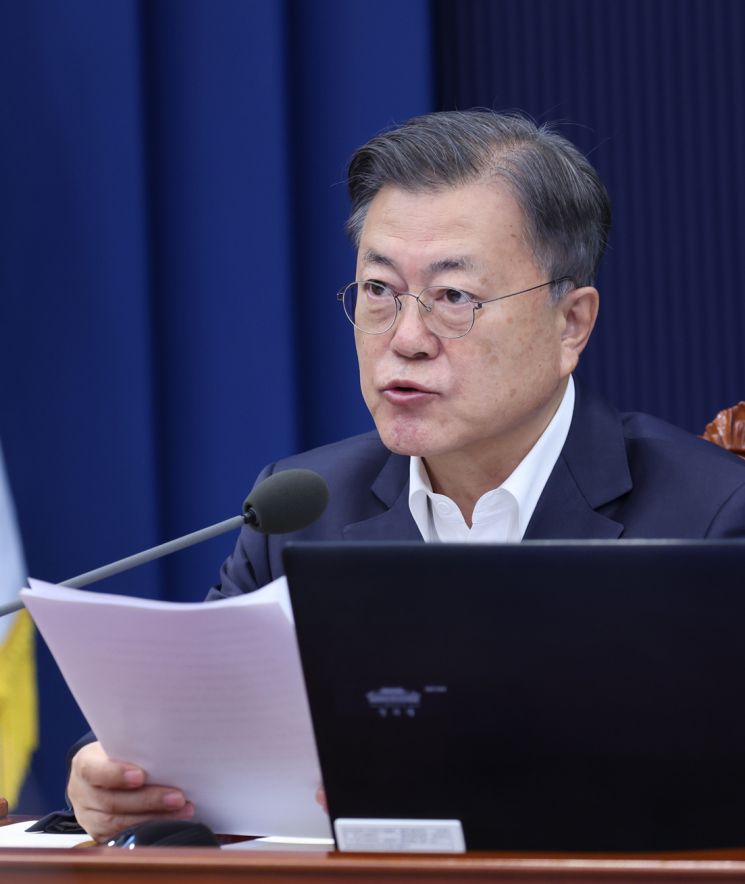 President Moon Jae-in is speaking at the video Cabinet meeting held at the Yeomin Hall of the Blue House on the morning of the 22nd. [Image source=Yonhap News]
However, there are voices criticizing the plan as hasty. The Democratic Party of Korea pointed out that there was insufficient time for the decision to relocate the Blue House and a lack of communication with the Ministry of National Defense. On the 22nd, at a full meeting of the National Defense Committee in the National Assembly, Representative Kang Byung-won questioned Defense Minister Suh Wook, saying, "If the decision to relocate the Blue House had been made with enough time, after sufficient discussions with the Ministry of National Defense, residents, and the National Assembly, would there have been controversy? Polls show high opposition to the hasty push; why do you think that is?" Minister Suh responded, "There are many concerns about the deployment and adjustments being made without review in such a short time."
The Blue House also expressed concerns about a security gap. President Moon Jae-in emphasized at the Cabinet meeting held at the Blue House on the 22nd, seemingly addressing President-elect Yoon, "Although the government's term is nearing its end, I consider it my final mission to fulfill the duties as the head of state, head of administration, and commander-in-chief as prescribed by the Constitution," adding, "Especially, national security, the economy, and public safety must not have any gaps even for a moment."
The cost of relocation is also controversial. Since no budget for relocating the presidential office was allocated in the 2022 budget, and considering the sequential relocation of the Ministry of National Defense and the Joint Chiefs of Staff, costs could increase.
Spokesperson Kim Eun-hye initially stated that the relocation would cost 49.6 billion won but later changed her statement at the Presidential Transition Committee briefing on the 21st, saying, "If the Joint Chiefs of Staff move to Namtaeryeong, the new building might be possible for about 120 billion won." However, this estimate has also been criticized as underestimating the costs.
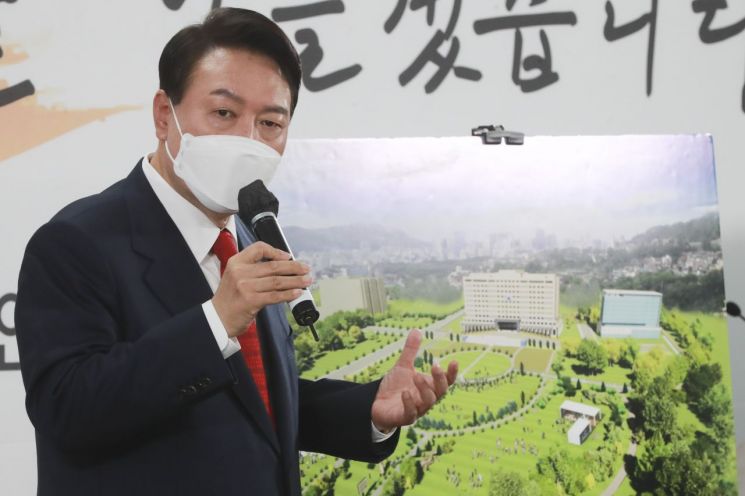 President-elect Yoon Suk-yeol is holding a press conference on the morning of the 20th at the Presidential Transition Committee press room in Samcheong-dong, Jongno-gu, Seoul, regarding the relocation of the presidential office to Yongsan. [Image source=Yonhap News]
Despite concerns about security gaps and costs, President-elect Yoon's firm determination to relocate the office to Yongsan has led to complaints such as "Who asked to return the Blue House?" While President-elect Yoon is pushing forward with the relocation plan, calling for an end to the imperial presidency, criticism arises that he is instead following the footsteps of an imperial presidency.
Among past presidents, there have been cases where plans or policies with evenly split or stronger opposition public opinion were pursued, resulting in negative consequences. In 1995, YS declared the clearing of past history and setting history straight, deciding to demolish the Joseon Government-General building, which had been the subject of prolonged debate over demolition and preservation. At the time, political and academic circles strongly opposed, arguing that the site should be used as a place for history education, but YS pushed the plan through, and the demolition of the building was broadcast live to the public.
Early in his term in 2008, Lee Myung-bak pushed forward with the import of U.S. beef despite the mad cow disease controversy, which sparked large-scale candlelight protests opposing the move. The protests lasted over 100 days, causing political turmoil. As a result, Lee's approval rating plummeted to the 20% range, and he is widely regarded as having lost momentum in governance thereafter.
However, YS is positively evaluated from the perspective of clearing pro-Japanese remnants. In contrast, Lee is still criticized for erecting barricades known as the 'Myungbak Fortress' and violently suppressing citizens with water cannons mixed with tear gas.
Experts explain that President-elect Yoon is facing his first leadership test. Choi Jin, director of the Presidential Leadership Research Institute, said, "President-elect Yoon seems to perceive the office relocation issue as a signal for restructuring the power system. As he says, 'space governs consciousness,' this is not simply about relocating space but about changing the governance system," adding, "He believes that if this plan proceeds smoothly, subsequent governance and reform can be carried out swiftly, which is why he is pushing forward despite some burden."
Director Choi also predicted that the key will be how much consensus is formed with the public. He said, "President-elect Yoon is on a test stage to demonstrate communication, political skills, and national unity," adding, "He needs to actively communicate with the people and listen to public sentiment."
© The Asia Business Daily(www.asiae.co.kr). All rights reserved.
![Clutching a Stolen Dior Bag, Saying "I Hate Being Poor but Real"... The Grotesque Con of a "Human Knockoff" [Slate]](https://cwcontent.asiae.co.kr/asiaresize/183/2026021902243444107_1771435474.jpg)













