Employment Market Expected to Recover to or Surpass Pre-COVID-19 Levels This Year
Number of Employed in Jan-Feb 2022 Increases by Over 2 Million Compared to Same Period Last Year
Job Seekers "Still Don't Feel the Improvement... Dissatisfied with Companies' Hiring Methods"
Experts "Companies Should Clearly Disclose Hiring Criteria and Methods"
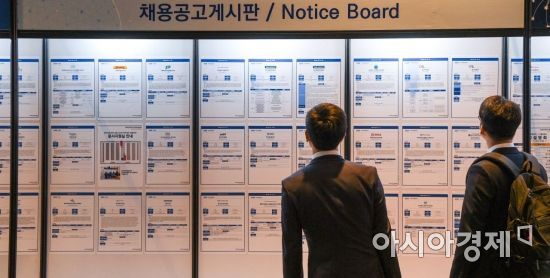 Young job seekers are looking at a recruitment bulletin board. The photo is unrelated to specific expressions in the article. Photo by Asia Economy DB.
[Asia Economy Intern Reporter Kang Wooseok] "Honestly, I still just sigh." , "I am not expecting much."
Although there are forecasts that the hiring market will recover, survey results also indicate that the scale of new hires will not be large, so the sighs of job seekers (chwijunsaeng) are expected to continue this year as well. Among some job seekers, there are complaints about the so-called precarious last-minute employment situations such as recruitment-linked internship programs.
The Korea Chamber of Commerce and Industry announced on the 22nd of last month that in a survey on '2022 Corporate Hiring Trends' conducted among 302 companies out of the top 1,000 domestic companies by sales, 79.8% of the responding companies answered that the employment market outlook this year would recover to pre-COVID-19 levels or increase further.
69.2% responded that it would recover to pre-COVID-19 levels, and 10.6% said it would increase further. Responses indicating that employment levels reduced due to COVID-19 would be maintained (15.9%) or further reduced (4.3%) accounted for only 20.2%.
According to recent statistics released by Statistics Korea, the number of employed persons in February 2022 increased by 1.04 million compared to the same period last year. The number of employed persons in January this year also increased by 1.14 million compared to the same month last year, marking an increase of over one million for two consecutive months.
President-elect Yoon Seok-yeol is also encouraging companies to create jobs. On the 21st of last month, Yoon met with the heads of six economic organizations (Federation of Korean Industries, Korea Chamber of Commerce and Industry, Korea International Trade Association, Korea Federation of SMEs, Korea Employers Federation, Korea Federation of Medium-sized Enterprises) and said, "I have a strong belief in free market economy," adding, "The government will build infrastructure to support companies from behind, and companies, whether large or small, will take the lead in creating jobs and making investments. As companies grow, the country grows."
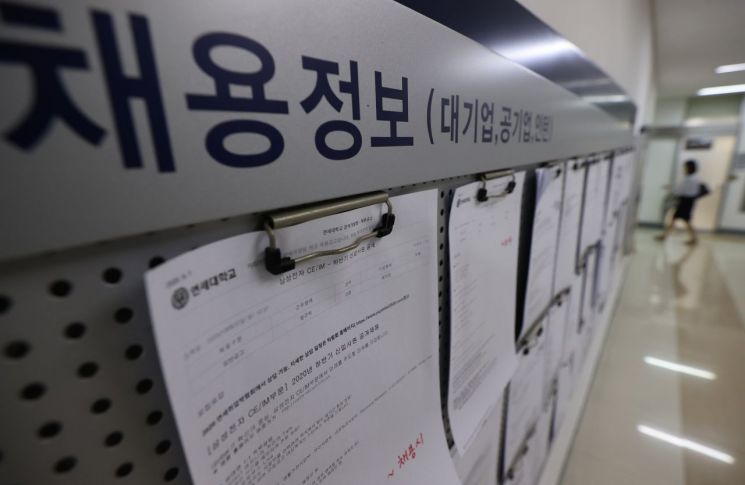 There is a forecast that a 'job market boom' will occur this year, but job seekers do not actually feel it.
 [Image source=Yonhap News]
However, not all outlooks are positive. According to the '2022 New Hiring Status Survey' released by the Korea Employers Federation on the 29th of last month, only 30.6% of companies planning to hire new employees this year intend to increase the scale of hiring.
59.6% said they would maintain hiring at levels similar to last year, and even 9.8% of companies said they would reduce hiring. Ultimately, even if the number of companies hiring new employees increases this year, it is expected to be at the level of filling vacancies.
Given this situation, some job seekers express that they cannot personally feel whether hiring has actually increased. Jo (26), a university student preparing for employment, said, "There are statistics saying hiring and the number of employed persons have increased, but honestly, I don't really know. I can't feel it," adding, "I am just trying to do my best where I am."
Voices expressing dissatisfaction with companies' hiring methods are also diverse. Job seeker A in their 20s sharply criticized the recruitment-linked internship program. This program hires interns first and then decides on regular employment based on work evaluations.
A said, "The recruitment-linked internship program does not consider job seekers at all," pointing out, "It is advantageous for companies, but job seekers have to give up alternative plans in case they are not hired and part-time jobs that support their current lives." They continued, "I personally participated in the recruitment-linked internship process, and the mental stress during the internship was very severe," raising their voice, saying, "(The recruitment-linked internship) is, in short, a selfish system."
There is also significant dissatisfaction with companies switching to frequent hiring and preferring experienced workers. Another job seeker B said, "Recently, frequent hiring has increased a lot. I can't help but feel that the job market has become even narrower," adding, "Also, since qualifications have all been leveled up, it seems companies prefer experienced workers. Since everyone prefers experienced workers, it is difficult to gain experience. I feel a sense of limitation."
Experts say companies need to clarify their hiring criteria more clearly. Professor Gu Jeong-woo of the Department of Sociology at Sungkyunkwan University analyzed, "Currently, companies are conducting continuous hiring rather than standardized exams. This increases uncertainty for young people preparing for employment," adding, "Because of this uncertainty, the cost of preparing for employment rises, causing young people to express frustration and dissatisfaction."
He continued, "Companies need to transparently disclose predictable hiring criteria and procedures," and said, "(For example) clearly stating what kind of talent they want to select, what kind of ideal candidate they desire, and what qualifications are needed for that is the most certain way to resolve young people's dissatisfaction."
© The Asia Business Daily(www.asiae.co.kr). All rights reserved.
![Clutching a Stolen Dior Bag, Saying "I Hate Being Poor but Real"... The Grotesque Con of a "Human Knockoff" [Slate]](https://cwcontent.asiae.co.kr/asiaresize/183/2026021902243444107_1771435474.jpg)

















