Samsung Electronics Caught Attempting to Leak Core Semiconductor Technology
[Asia Economy Reporter Park Sun-mi]In 2010, partner company B, which supplies semiconductor equipment to domestic semiconductor company A, was caught leaking A's core semiconductor technology, designated as a national core technology, overseas by stealing trade secret documents under the pretext of A/S and using personal connections to extract A's trade secrets.
In 2020, two researchers from C Display Company colluded with domestic equipment company D and others, attempting to leak the world's first large OLED mass production inkjet printing technology to China. The court sentenced the two main culprits to two years in prison in February last year, and a total of five people were found guilty.
Despite the government's efforts to nurture national strategic technologies and prevent technology leakage, the battle for confidential information between the state and companies is severe. As governments worldwide intensify support for core technology development and competition for talent heats up, opportunities for confidential information theft and leakage have increased. Companies are defenseless without clear countermeasures, raising urgent calls for strong response strategies.
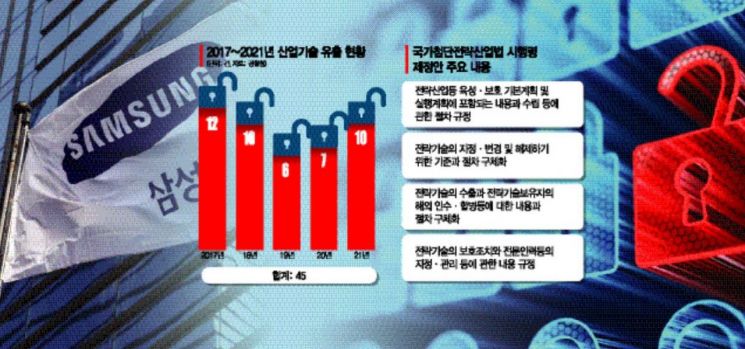
◆Era of technological hegemony competition... Increasing technology leakage that determines corporate survival= According to the National Police Agency and related industries on the 23rd, the number of domestic industrial technology leakage cases reached 45 over the past five years (2017?2021). Following the 2019 industrial technology leakage eradication measures and the introduction of stricter punishments for leakage, the cases dropped to single digits with 6 and 7 cases in 2019 and 2020 respectively, but rose again to 10 cases last year. When expanding the types of leaked technology to include trade secrets beyond industrial technology, the situation becomes more serious. During the same period, the number of leakage incidents and the scale of damage reached a total of 593 cases and 22 trillion won.
The government is responding by strengthening related legislation, but progress is slow. According to the Ministry of Trade, Industry and Energy, the government currently designates 73 technologies across 12 fields as national core technologies essential to national competitiveness. National core technologies refer to industrial technologies designated under Article 9 of the “Act on the Prevention and Protection of Industrial Technology Leakage,” which have high technical and economic value in domestic and international markets or high growth potential in related industries, and whose leakage overseas could seriously harm national security and the development of the national economy.
As Samsung Electronics is determined to achieve the 'No. 1 system semiconductor' position by 2030, the leakage of technology in the foundry sector is particularly troublesome. A semiconductor industry insider expressed concern, saying, "In the worst case, if information related to advanced fine processes such as 5 nanometers or below is leaked, the problem could become even more serious." Globally, only Samsung Electronics and TSMC mass-produce 5-nanometer semiconductors.
The government belatedly decided at the end of last year to additionally designate major domestic technologies with global competitiveness in semiconductors, displays, and batteries as national core technologies and is currently working on related tasks. However, it has been confirmed that the semiconductor sector was largely excluded from the national core technologies to be additionally designated in the first half of this year. With the upcoming enforcement of the “Special Measures Act on Strengthening and Protecting National Advanced Strategic Industry Competitiveness” in August, additional designation of semiconductor national core technologies is expected only after the law takes effect. This law, also called the Semiconductor Special Act, had its subordinate legislation draft announced for public comment until May 2 and is just beginning the opinion-gathering process.
◆Global severe penalties for technology leakage= Meanwhile, countries worldwide are taking swift action to strengthen penalties for leakage of core technologies, including semiconductors. Japan is accelerating the enactment of the Economic Security Promotion Act, which punishes researchers who leak advanced technology with imprisonment of up to two years. This reflects the government's direct intervention to prevent technology and information leakage amid serious inter-state technology theft.
Taiwan, home to the world's No. 1 semiconductor foundry company, passed an amendment to the National Security Act last month, establishing the crime of economic espionage related to national core critical technologies and increasing penalties. This measure was taken as technology leakage and talent poaching have continued in countries like China, which is focusing on semiconductor industry development. In Taiwan, leaking national core critical technologies results in imprisonment from 5 to 12 years and fines up to 100 million New Taiwan dollars (approximately 4.3 billion KRW). Taiwan also tightly manages national core technologies by imposing strict government screening procedures when its advanced technology personnel seek employment in China.
International hacker groups are also aggressively stealing confidential information, making government-level responses urgent. The international hacker group Lapsus, which previously stole confidential data from semiconductor companies Nvidia and Samsung Electronics, recently announced that it had extracted internal information from LG Electronics, Microsoft, and others, causing companies to be on edge. Although Lapsus claims no political motives behind the hacking, concerns are growing that even highly secure technology companies are vulnerable to hacker attacks, which could be exploited in the battle for confidential information between nations and companies.
© The Asia Business Daily(www.asiae.co.kr). All rights reserved.

















