Common + Elective Subjects, 50% EBS Linkage Rate
Exam Schedule Extended by 2 Days, Objection Review Extended by 1 Day
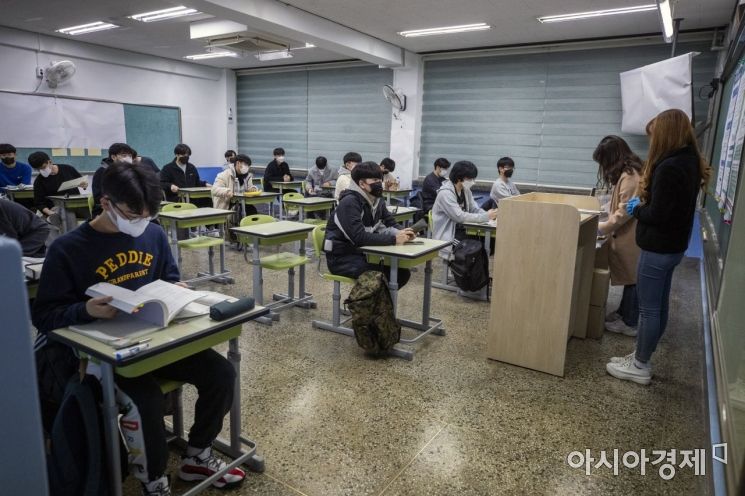 On the morning of the 18th, when the 2022 College Scholastic Ability Test was held, examinees were waiting for the exam at the test site set up at Yeouido High School in Seoul. Photo by Joint Press Corps
[Asia Economy Reporter Han Jinju] This year's College Scholastic Ability Test (CSAT) will be held on November 17. With the exam preparation period extended by 2 days and the objection review period extended by 1 day, the announcement date for the CSAT answers will also be delayed by one day from the original schedule.
The Ministry of Education announced the basic plan for the 2023 CSAT on the 22nd.
This year’s CSAT will maintain the 'common + elective subjects' system in the Korean language, mathematics, and vocational inquiry areas, consistent with last year, based on the 2015 revised curriculum. Among the 17 social and science inquiry subjects, students can choose 2 subjects.
The EBS CSAT textbooks and lectures will maintain a 50% linkage rate with the CSAT questions, but English will be tested through indirect linkage. Since the Korean history section is mandatory, those who do not take it will have their entire score invalidated. For the Korean history and inquiry sections, answer sheets for Korean history and inquiry will be provided separately to examinees.
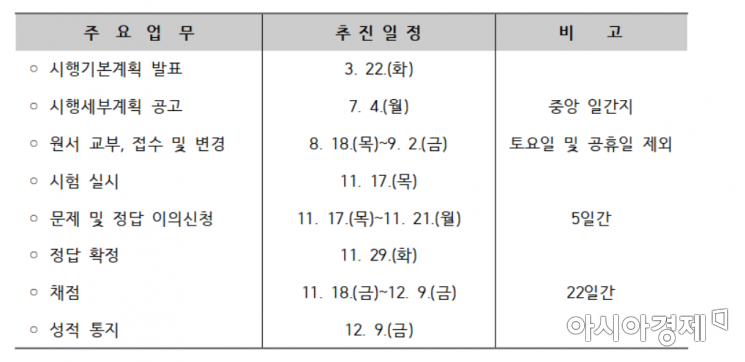
The Korean Institute for Curriculum and Evaluation will conduct the June mock test on June 9 and the September mock test on August 31. CSAT registration will be open from August 18 to September 2.
The period for filing objections to questions and answers is from November 17 to 21. The answer announcement will be on November 29, and score notification on December 9. Reflecting improvements in the CSAT question setting and objection review system, the answer announcement schedule has been delayed by one day compared to previous years.
Following the answer error in Life Science II in last year’s CSAT, improvements to the CSAT question setting and objection review system will be applied starting this year. After submitting the highly refined second draft of questions, a review process for high-difficulty questions will be newly established.
A permanent consultation room for errors in CSAT questions and EBS-linked textbooks will be set up, and case education will be strengthened through workshops for question setters, reviewers, and advisory committee members.
To enhance the quality of the question setting and review process, the question setting period will be extended from 36 to 38 days (2 days), and the objection review period will be extended from 12 to 13 days (1 day). The number of question setting and review advisory committee members will increase from 8 to 12, focusing on social and science inquiry subjects.
A second objection review working committee will be held to verify dissenting or minority opinions, and the objection review working committee for social and science inquiry areas will be subdivided into 8 subject groups, with external members increasing from 2 to 5.
The criteria for selecting academic societies to advise on objections will be systematized, and the contents of academic society consultations will be disclosed. The chairperson of the objection review committee will be appointed from external members.
© The Asia Business Daily(www.asiae.co.kr). All rights reserved.
![Clutching a Stolen Dior Bag, Saying "I Hate Being Poor but Real"... The Grotesque Con of a "Human Knockoff" [Slate]](https://cwcontent.asiae.co.kr/asiaresize/183/2026021902243444107_1771435474.jpg)

















