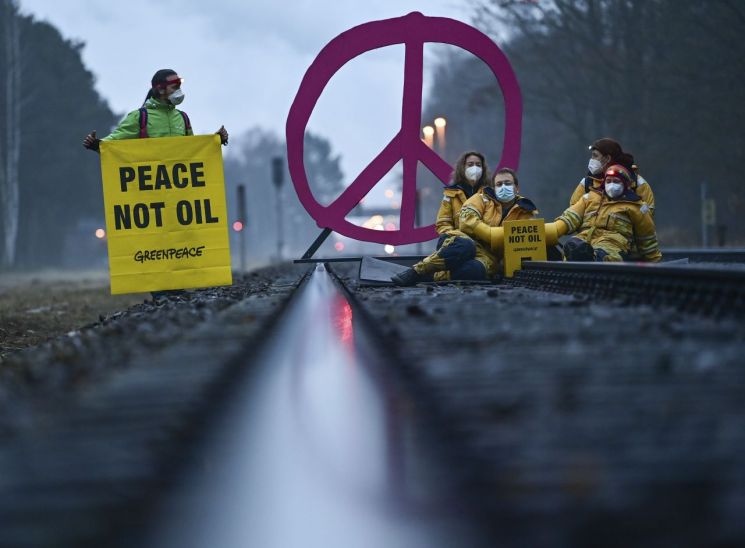
 On the 15th (local time), activists from the international environmental organization Greenpeace protested in Schwedt, eastern Germany, holding placards that read "Peace, not Oil" and a sculpture symbolizing peace, blocking the railway leading to the PCK refinery. They demanded a ban on imports, arguing that importing Russian crude oil indirectly supports the invasion of Ukraine.
 The European Union (EU) is reportedly considering a ban on Russian oil imports following the United States, according to major foreign media on the 20th (local time).
According to foreign media, a senior EU diplomat said, "We are preparing the fifth round of sanctions, and many new measures are being discussed."
Since Russia invaded Ukraine, the EU has consecutively imposed sanctions over the past three weeks, including freezing assets of the Russian central bank, but Russia has not slowed its offensive against Ukraine. This is the background behind the EU's deliberation on whether to join the U.S. in sanctioning Russian oil imports.
While the U.S. and the U.K. have banned Russian oil imports, the EU, which is highly dependent on Russian energy, has been reluctant to expand sanctions to include energy.
EU diplomats have predicted that if Russia attacks Ukraine with chemical weapons or heavily bombs the capital Kyiv (Kiyev), it could trigger energy sanctions.
Speculation that the EU will join the U.S. in sanctioning Russian oil, along with news that Saudi Arabian oil facilities were attacked by Yemeni rebels, caused international oil prices to rise by about $3 per barrel during trading on the 21st.
Brent crude futures rose above $110 per barrel. As of 3:50 p.m. Korean time, Brent crude was trading at $111.21, up $3.28 (3.04%). West Texas Intermediate (WTI) crude rose $3.39 (3.24%) to $108.09 per barrel.
© The Asia Business Daily(www.asiae.co.kr). All rights reserved.

















