Domestic Stealth Omicron Detection Rate
Rises from 26.3% to 41.4% in One Week
Concerns Over Delayed Peak and Increased Scale
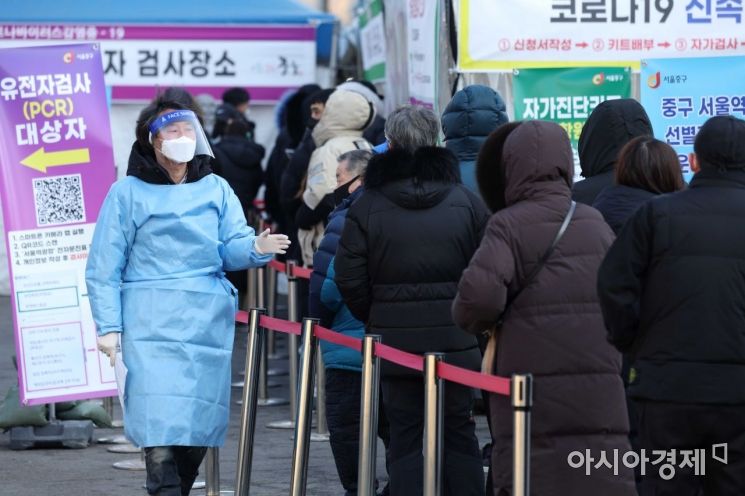
[Asia Economy Reporter Ki Ha-young] As the domestic share of BA.2, one of the Omicron variants, also known as 'Stealth Omicron,' rapidly increases, health authorities have projected that the peak of the outbreak may be delayed beyond initial expectations.
On the 21st, Jung Eun-kyung, Commissioner of the Korea Disease Control and Prevention Agency (KDCA), stated at the regular briefing of the Central Disease Control Headquarters, "The share of BA.2 among Omicron variants is increasing, and with the recognition of positive cases confirmed by (professional) rapid antigen tests, the period until the peak of the outbreak may be delayed, and the scale could become larger."
Commissioner Jung explained, "Most domestic and overseas infection cases have been confirmed as Omicron variants, and genetic analysis of detailed lineages shows that the detection rate of BA.2, which has higher transmissibility, has increased to 41.4% in domestic cases and 56.9% in imported cases."
According to the Central Disease Control Headquarters, the detection rate of major variants in Korea during the third week of March is 99.99% Omicron. Among Omicron variants, the detection rate of BA.2 has been increasing over the past four weeks from 10.3% → 22.9% → 26.3% → 41.4%. The detection rate of BA.2 among imported cases has also surpassed half during the same period, rising from 18.4% → 47.3% → 45.7% → 56.9%.
According to initial analyses by the World Health Organization (WHO) and overseas health agencies, BA.2 shows approximately 30% higher transmissibility than BA.1. However, clinical severity and hospitalization rates between BA.1 and BA.2 are reported to have little difference.
Commissioner Jung said, "With the increasing share of BA.2, transmissibility may be somewhat higher, and since the generation time for transmission is about 0.5 days shorter, there is a risk of faster spread," adding, "This could partially affect the scale and peak of the outbreak."
She further stated, "In Korea, the change in share is occurring during the ongoing Omicron outbreak rather than a re-outbreak caused by BA.2 after the Omicron wave. We believe this aspect could influence the outbreak and are conducting close monitoring."
Meanwhile, the COVID-19 risk level for the third week of March was assessed as 'very high' nationwide, including both the metropolitan area and non-metropolitan regions, for the third consecutive week. Health authorities judged that not only the rapid increase in the share of the BA.2 Omicron variant but also the relaxation of social distancing, full return to in-person schooling, and waning immunity over time after vaccination would influence the outbreak. In particular, they expressed concern over the increase in cluster infections in nursing hospitals and nursing homes, the continuous occurrence of severe cases and deaths among unvaccinated individuals aged 60 and over and those with underlying conditions, stagnant vaccination rates, and the many limitations in prescribing and administering antiviral drugs.
© The Asia Business Daily(www.asiae.co.kr). All rights reserved.
![Clutching a Stolen Dior Bag, Saying "I Hate Being Poor but Real"... The Grotesque Con of a "Human Knockoff" [Slate]](https://cwcontent.asiae.co.kr/asiaresize/183/2026021902243444107_1771435474.jpg)
















