Recognized by Samsung for Technology and Supplied
Market Share Reaches 40% in 2 Years
CEO Kim Won-kyung Founded Company After Leaving Daewoo Heavy Industries Robot Development
Next Goal: Pharmaceutical and Bio Robots
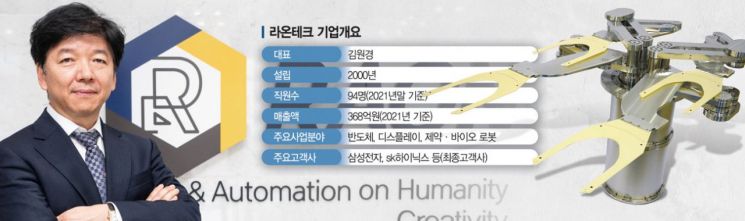
[Suwon=Asia Economy Reporter Kwak Min-jae] Semiconductor wafer vacuum robots are the core of semiconductor processes. When semiconductor raw material wafers are etched (cut) in a vacuum state, thin films are deposited, or conductive paths are created (metal wiring), vacuum robots play the role of precisely moving the wafers to the correct positions. If an error occurs during this process, the semiconductor being manufactured must be discarded. If a problem arises with the vacuum robot, the chamber (wafer processing space) surrounding it cannot be used for at least two days. In such cases, semiconductor manufacturing facilities suffer losses of about 100 million KRW per day. This is why the market entry barrier is high. Raontech CEO Kim Won-kyung (photo) said, "Semiconductor wafer vacuum robots must operate 24 hours without generating particles (dust) in a high-temperature environment of around 700 degrees Celsius and a vacuum environment equivalent to the atmosphere," adding, "Among domestic companies, we are the only ones capable of producing vacuum robots with such technological capabilities."
◆ Gear and link-type robotic arms... No. 1 domestic market share = Raontech specializes in semiconductor wafer vacuum robots and transfer module equipment. The 7-axis vacuum robot is representative. Unlike existing products with a single arm, it has two arms, and each arm can be precisely controlled, doubling the accuracy compared to previous products. Using both arms simultaneously shortens the process time, increasing productivity by 25%. Last year, with sales of 36.8 billion KRW and operating profit of 5.3 billion KRW, the company moved from KONEX to KOSDAQ listing. Samsung Electronics and SK Hynix are its final customers.
Raontech holds the No. 1 market share domestically in this field. According to the industry, since American and Japanese companies dominated the domestic market, the market share was only 17% in 2019, but it rose to 40% in two years. By using a 'gear and link structure' instead of a 'belt system' for the robot arms, technological differentiation from competitors was possible. CEO Kim said, "The product of the No. 1 American supplier to Samsung Electronics also used a belt system, which repeatedly caused vibration and error problems," adding, "Samsung replaced the American supplier with our product from early last year to solve these issues, which was the background for the market share increase." The belt system has a fatal drawback in that tension changes when used for a long time or at high temperatures, reducing precision.
Raontech plans to mass-produce a 'direct drive motor' that integrates parts such as motors, reducers, and vacuum seals by the end of this year. CEO Kim said, "We are focusing on technology development with 8 billion KRW support from the Ministry of Trade, Industry and Energy," adding, "The motor to be released at the end of this year will have more than twice the precision and half the vibration."
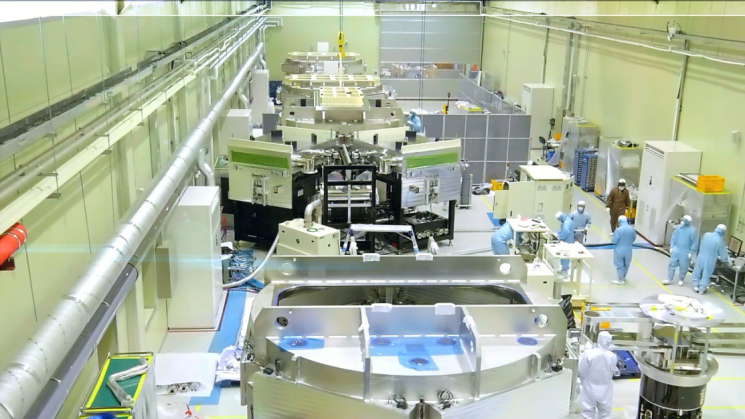
◆ Aggressively exploring overseas markets and new businesses such as bio robots = CEO Kim co-founded Raontech in 2000 with Vice President Oh Jin-ho. CEO Kim had been developing robots at Daewoo Heavy Industries for 10 years and decided to start a business after the company withdrew from the robot business. Initially, the company worked on maintenance robots for nuclear power plants but shifted to the semiconductor and display fields where demand is high. CEO Kim explained, "Samsung Electronics requested display robot development, and developing related products from 2003 to 2006 over three years was an opportunity to accumulate the company's technology and experience."
Raontech was selected as a top company in materials, parts, and equipment (SoBuJang) in January. SoBuJang top companies are selected in six fields: semiconductors, displays, electrical and electronics, machinery and metals, automobiles, and basic chemicals, and receive up to 25 billion KRW (5 billion KRW annually) in R&D funding from the Ministry of Trade, Industry and Energy. CEO Kim said, "The global semiconductor market is more than 10 times larger than the domestic market," adding, "We plan to target semiconductor equipment companies in the U.S. and China based on the domestic reliability of our vacuum robot products."
Raontech views pharmaceutical and bio robots as future new businesses. CEO Kim expressed, "There are similarities between creating a vacuum environment in semiconductors and a sterile environment in pharmaceuticals and bio," adding, "Based on the experience and know-how of semiconductor vacuum robots, we will grow into a global comprehensive robot company."
© The Asia Business Daily(www.asiae.co.kr). All rights reserved.


















