Professor Kim Jae-kyung's KAIST Research Team
[Asia Economy Reporter Kim Bong-su] Domestic researchers have identified the cause of antibiotic and anticancer drug resistance phenomena using mathematical models. They uncovered the fundamental reason why individual cells respond differently to the same external stimulus, providing a clue for developing new treatments.
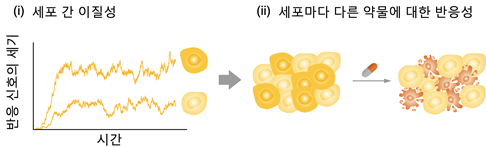
The Korea Advanced Institute of Science and Technology (KAIST) announced on the 21st that Professor Kim Jae-kyung's research team from the Department of Mathematical Sciences discovered that the magnitude of cell-to-cell heterogeneity in response to external stimuli is proportional to the number of rate-limiting steps in the intracellular signal transduction process.
The reason why cells with identical genes respond differently to the same external stimulus has long been a mystery. In particular, heterogeneity in response to external stimuli can prevent the complete eradication of cancer cells during chemotherapy. Therefore, this study, which proposes rate-limiting steps as factors causing cell-to-cell heterogeneity, is expected to be used to improve the effectiveness of chemotherapy treatments.
Cells in our body have signal transduction systems that respond to various external stimuli such as antibiotics and osmotic pressure changes. These signal transduction systems play a crucial role in how cells interact with their external environment.
When the same external stimulus is applied to cells, the degree of response varies, leading to heterogeneous drug responses and the emergence of persister cells that exhibit strong drug resistance. Many attempts have been made to identify the causes of this cell-to-cell heterogeneity. In particular, it has been suggested that many intermediate processes in the signal transduction system influence this phenomenon, but experimentally observing all intermediate processes is currently impossible with existing technology, leaving it a challenging problem.
To solve this challenge, Professor Kim's research team developed a queueing model describing the intracellular signal transduction system. Based on this queueing model, they combined statistical estimation methods?a Bayesian model and a mixed-effects model?to create computer software (MBI; Moment-based Bayesian Inference method) capable of analyzing the signal system without direct observation of intermediate processes. Using this software, the team revealed that cell-to-cell heterogeneity in response to external stimuli is proportional to the number of rate-limiting steps in the signal transduction system. Not only did they establish a theoretical foundation for mathematical model analysis, but they also validated their theoretical results using experimental data on antibiotic responses of Escherichia coli (E. coli). These findings are expected to present a new paradigm in antibiotic-resistant bacteria research.
Professor Kim stated, "We confirmed that as the number of rate-limiting steps in the signal transduction system increases, even genetically identical cell populations can exhibit more diverse signal transmissions," adding, "This study enhances understanding of cell-to-cell heterogeneity, which is critically considered in cancer treatment, through mathematical modeling. We hope this achievement will lead to improved anticancer therapies."
The research results were published online on the 18th in the international academic journal Science Advances.
© The Asia Business Daily(www.asiae.co.kr). All rights reserved.
![Clutching a Stolen Dior Bag, Saying "I Hate Being Poor but Real"... The Grotesque Con of a "Human Knockoff" [Slate]](https://cwcontent.asiae.co.kr/asiaresize/183/2026021902243444107_1771435474.jpg)
















