Energy Price Surge and Supply Chain Instability
Exports Increased by 10.1%, but Imports Rose by 18.9%
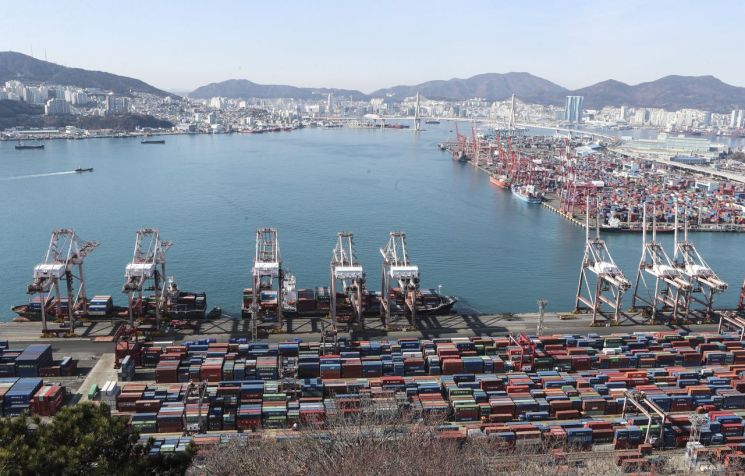
[Asia Economy Sejong=Reporter Kwon Haeyoung] Due to the sharp rise in international oil prices, the trade balance recorded a deficit of 2.1 billion dollars from the 1st to the 20th of this month. Although export volume increased compared to a year ago, the invasion of Ukraine by Russia caused energy prices such as crude oil and gas to surge, resulting in a greater increase in import volume.
According to the Korea Customs Service on the 21st, the trade deficit from the 1st to the 20th of this month was calculated at 2.078 billion dollars. During the same period a year ago, there was a surplus of 754 million dollars. Accordingly, the cumulative trade balance from January to the 20th of this month showed a deficit of 5.977 billion dollars.
Imports from the 1st to the 20th of this month amounted to 39.334 billion dollars, an increase of 18.9% compared to the same period last year. This was due to the sharp rise in global energy prices and supply chain instability caused by the Ukraine crisis, which significantly increased energy import volume.
As a result, the trade balance, which had turned briefly to a surplus last month, is likely to return to a deficit after two months. The trade balance recorded a deficit of 430 million dollars in December last year, a deficit of 4.89 billion dollars in January this year, and then turned to a surplus of 840 million dollars in February.
This trade deficit is due to the sharp rise in raw material prices centered on energy sources such as crude oil, liquefied natural gas (LNG), and coal, which rely on imports. Although exports performed well, the increase in energy import volume continues in line with rising oil prices. From the 1st to the 20th of this month, crude oil imports amounted to 5.313 billion dollars, an increase of 57.8% compared to the same period last year. Gas imports were 3.563 billion dollars, petroleum 1.744 billion dollars, and coal 1.165 billion dollars, with import volumes surging by 114.3%, 52.5%, and 68.7% respectively compared to a year ago.
On the other hand, exports amounted to 37.3 billion dollars, an increase of 10.1% compared to the same period last year. Considering the number of working days, the average daily export volume increased by 26.4%. During this period, the number of working days was 13.5, two days fewer than last year.
Concerns are growing that if the trade deficit trend, which is the growth engine of our economy, continues, the so-called "twin deficits," where both the fiscal balance and the current account balance fall into deficit simultaneously this year, could become a reality. According to the provisional international balance of payments statistics for 2022 announced by the Bank of Korea earlier this month, South Korea's current account surplus in January this year was 1.81 billion dollars, nearly 5 billion dollars less than a year ago.
© The Asia Business Daily(www.asiae.co.kr). All rights reserved.
![Clutching a Stolen Dior Bag, Saying "I Hate Being Poor but Real"... The Grotesque Con of a "Human Knockoff" [Slate]](https://cwcontent.asiae.co.kr/asiaresize/183/2026021902243444107_1771435474.jpg)
















