Increase in 1t Porter and Bongo Purchases
[Asia Economy Reporter Choi Dae-yeol] Last month, the proportion of electric vehicles (EVs) among newly registered freight vehicles exceeded 20%. Although the spread of EVs has increased, considering that less than one out of every ten vehicles is an EV, this is a remarkable achievement. This is due to the strong sales of domestic 1-ton electric truck models.
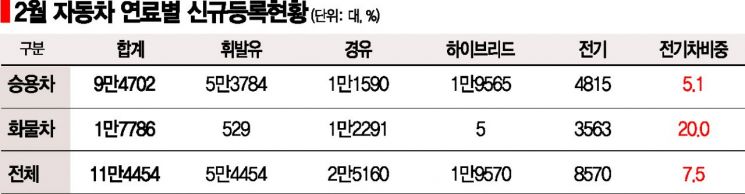
According to the February domestic vehicle registration data compiled by the Korea Automobile Manufacturers Association on the 21st, out of a total of 17,786 registered freight vehicles, 3,563 (20.0%) were electric vehicles. This means that one out of every five newly sold freight vehicles is an EV.
Freight vehicles have traditionally been perceived as using diesel fuel, which provides strong power for carrying heavy loads or for work purposes, but this has changed with the increase in EV adoption. The proportion of EVs among freight vehicles is significantly higher compared to the EV proportion among passenger cars (5.1%) or the overall vehicle proportion (7.5%). However, the proportion of EVs among all registered freight vehicles remains minimal at 1.3%.
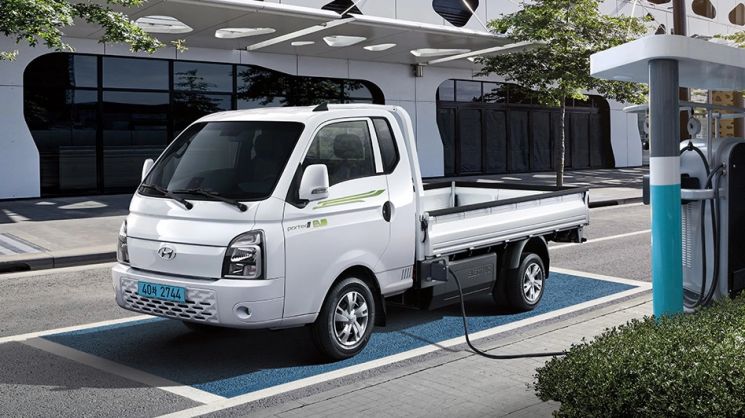
Among the newly registered electric freight vehicles last month, 96.9% were Hyundai and Kia vehicles. Most of these were the 1-ton truck models Porter EV and Bongo EV. Both Porter and Bongo have no clear domestic competitors and consistently rank among the top-selling models, with the EV proportion rapidly increasing within these models.
In 2020, the year following their release, EVs accounted for about 9% of total sales of 157,100 units, doubling to 18% the following year. Last month alone, the Porter and Bongo accounted for 41% of total sales (14,225 units), showing a sharp increase. Even considering that demand tends to concentrate in February due to the delay in confirming EV subsidies at the beginning of each year, this is a significant rise.
Although the Porter and Bongo EVs are priced in the low 40 million KRW range, which is over 20 million KRW higher than the existing diesel models (starting from 18.15 million KRW), after deducting government subsidies (1.4 million KRW this year) and local government subsidies worth several million KRW, the price difference is almost negligible. Freight vehicles typically have long operating distances, so if the current high oil price trend continues, demand is expected to increase further. Additionally, since the issuance of commercial license plates for small electric trucks is scheduled to end in April this year, it is believed that last-minute demand has also surged.
© The Asia Business Daily(www.asiae.co.kr). All rights reserved.
![Clutching a Stolen Dior Bag, Saying "I Hate Being Poor but Real"... The Grotesque Con of a "Human Knockoff" [Slate]](https://cwcontent.asiae.co.kr/asiaresize/183/2026021902243444107_1771435474.jpg)












