Park Kwang-on, Park Hong-geun, Ahn Kyu-baek, Lee Won-wook
Factional conflict replayed during presidential primary
Conclave-style voting without candidates
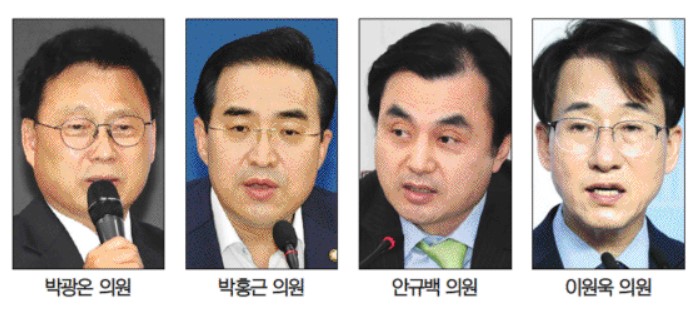
[Asia Economy Reporter Koo Chae-eun] With just three days left (on the 24th) until the election of the first floor leader of the '172-seat giant opposition party' to face the 'Yoon Seok-yeol government,' the Democratic Party's floor leader election is heating up. The contest is shaping up as a four-way battle among factions: pro-Lee Jae-myung (Rep. Park Hong-geun), pro-Lee Nak-yeon (Rep. Park Kwang-on), and pro-Jeong Se-gyun (Reps. Lee Won-wook and Ahn Kyu-baek). However, the race has a clear 'proxy faction war' tone reminiscent of the presidential primary aftermath, and there is considerable speculation that the newly elected floor leader may face a 'poisoned chalice' as they will also be held accountable for the results of the June local elections.
According to the Democratic Party on the 21st, the Emergency Committee approved the election date and procedures decided by the Floor Leader Election Management Committee last week during a morning meeting. The main candidates for floor leader include Rep. Park Hong-geun (3rd term, Seoul Jungnang-gu Eul), Rep. Park Kwang-on (3rd term, Gyeonggi Suwon-si Jeong), Rep. Lee Won-wook (3rd term, Gyeonggi Hwaseong-si Eul), and Rep. Ahn Kyu-baek (4th term, Seoul Dongdaemun-gu Gap).
To prevent election overheating, the floor leader will be chosen through a so-called 'conclave' voting method, similar to the papal election, meaning there will be no separate candidacy or election campaigning, but behind-the-scenes lobbying is intense. With the June local elections and the August party convention approaching, factions are engaged in an all-out battle to seize party leadership. Rep. Park Hong-geun, close to the Lee Jae-myung faction, and Rep. Park Kwang-on, a core figure of the pro-Moon faction and leader of the Lee Nak-yeon faction, are considered the two leading candidates, while Rep. Lee Won-wook of the Jeong Se-gyun faction is gaining attention by emphasizing a practical and moderate approach. Whether Rep. Ahn Kyu-baek, who gave up running for floor leader last year to support former Prime Minister Jeong Se-gyun's presidential bid, will unify with Rep. Lee is also a key point to watch.
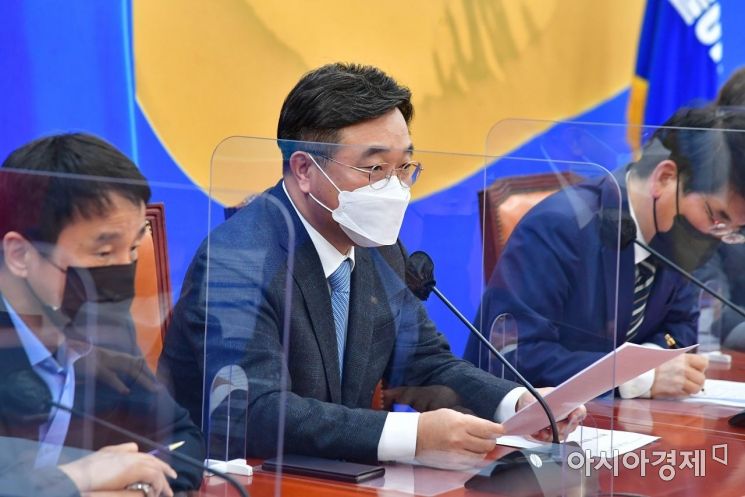 Yoon Ho-jung, the floor leader of the Democratic Party of Korea, is attending the policy coordination meeting held at the National Assembly on the 10th and delivering an opening remark. Photo by Yoon Dong-ju doso7@
A first-term Democratic Party lawmaker said, "To win, one must secure an additional 20 to 30 votes beyond factional support, so first-term lawmakers with less factional color will be swing voters," but added, "Many first-term lawmakers have been included in the Lee Jae-myung faction after the presidential election, which is a variable." Another second-term lawmaker from the metropolitan area told this outlet, "Those tired of factions or who do not want hardliners may prefer a moderate floor leader to prevent factional division. I will decide after hearing their policy statements."
Meanwhile, the newly elected floor leader may also be influenced by responsibility for candidate nominations and the outcome of the June local elections. Based on this presidential election, candidate Lee Jae-myung led over President-elect Yoon in Honam, Gyeonggi, Incheon, Sejong, and Jeju, but lagged behind in Yeongnam as well as Seoul and Chungcheong regions. If this pattern continues into the local elections, the Democratic Party will hold only 7 out of 17 metropolitan and provincial governors. Considering that the party currently holds 10 metropolitan governors, this would mean a loss of 3 more seats.
© The Asia Business Daily(www.asiae.co.kr). All rights reserved.


















