Ministry of Science and ICT to Invest 37.5 Billion KRW by 2025
Korea Aerospace Research Institute Project Team Selected
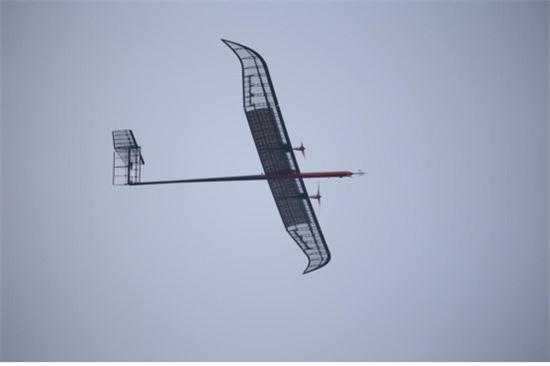 ▲The high-altitude solar-powered unmanned aerial vehicle EAV-3 successfully completed a 14km stratospheric flight. [Photo by Korea Aerospace Research Institute]
[Asia Economy Reporter Kim Bong-su] A solar-powered unmanned aerial vehicle (UAV) development project capable of carrying mission equipment weighing over 20kg and operating long-term for more than 30 days in the stratosphere, enabling continuous monitoring of disasters such as wildfires, is being actively promoted.
The Ministry of Science and ICT announced on the 21st that it will invest a total of 37.5 billion KRW over four years from this year to 2025 to develop stratospheric drone technology for continuous disaster monitoring. The project lead was selected as the Korea Aerospace Research Institute’s “Stratospheric Drone Technology Development Project Group.”
Stratospheric drones can remain airborne for extended periods in the stable atmosphere of the stratosphere, allowing continuous monitoring of the ground from high altitudes like satellites. They have low introduction, operation, and maintenance costs, and do not generate the “space debris” problem that has recently become an issue. Currently, the world’s best stratospheric drone performance allows for 26 consecutive days of flight and carrying mission equipment weighing 5kg. In contrast, this project aims to develop drones capable of continuous flight for over 30 days and carrying mission equipment weighing more than 20kg. It is expected to secure a leading position in related drone markets, including abnormal climate and wildfire monitoring, marine pollution surveillance, seawater changes, real-time precise weather observation, and maritime border monitoring.
Lee Chang-yoon, Director of Basic and Fundamental Research Policy at the Ministry of Science and ICT, said, “Stratospheric drones are a highly promising field that can complement existing observation systems such as satellites,” adding, “Although this is a very challenging project aiming for world-class performance, we expect the project group at KARI, which possesses the best flight-related personnel and facilities in Korea, to successfully develop it.”
© The Asia Business Daily(www.asiae.co.kr). All rights reserved.
















