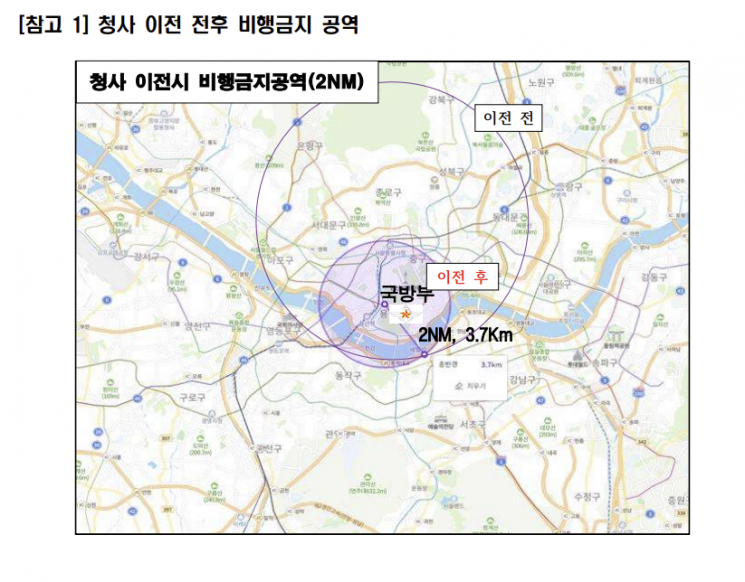
 The Presidential Transition Committee stated in an explanatory document distributed immediately after President-elect Yoon Seok-yeol's press conference on the 20th, "The existing flight routes south of the Han River can continue to be used, and the no-fly zones in the Gangbuk area will be reduced by more than half compared to before," adding, "In other words, the no-fly zones lifted in the Gangbuk area will expand, allowing for more efficient use of airspace." / Photo by Transition Committee
[Asia Economy Reporter Ki-min Lee] If the presidential office moves to the Ministry of National Defense in Yongsan, Seoul, the no-fly zone in the Gangbuk area is expected to be reduced by more than half compared to the current size.
In an explanatory document distributed immediately after President-elect Yoon Seok-yeol's press conference on the 20th, the Presidential Transition Committee stated, "The existing flight route south of the Han River can still be used as is, and the no-fly zone in the Gangbuk area will be reduced by more than half compared to before," adding, "In other words, the no-fly zone lifted area in Gangbuk will expand, allowing for more efficient use of airspace."
The Transition Committee emphasized, "The current P-73 no-fly zone (radius 8.4 km) was established in the 1960s and has been applied for 60 years," and added, "Now, the P-73 airspace should be revised to reflect the current era, considering the improvements in various equipment, weapon performance, and the capabilities of the Republic of Korea Air Force."
Although aerial threats such as missiles, drones, and unmanned aerial vehicles are increasing, the committee explained that due to the military's air superiority, improved radar detection capabilities, and enhanced anti-aircraft weapon performance, the aerial threats to aircraft have been significantly reduced, making it acceptable to drastically reduce Seoul's no-fly zone.
Accordingly, they explained, "The no-fly zone has been reduced to a radius of 3.7 km, considering the response range to the increasing threat of drones (SS equipment approximately 2 km)."
Regarding concerns that moving the presidential office to Yongsan would require installing anti-aircraft artillery batteries in apartments around Yongsan and Gangnam areas, the committee dismissed this by stating, "The Yongsan area already has an air defense system in place to protect military facilities such as the Ministry of National Defense and the Joint Chiefs of Staff," and added, "There will be no additional installation of anti-aircraft artillery batteries in surrounding apartments due to the move to Yongsan."
They also added, "Since the area is already designated as a military facility protection zone, there will be no additional regulations in Yongsan and nearby areas."
© The Asia Business Daily(www.asiae.co.kr). All rights reserved.

















