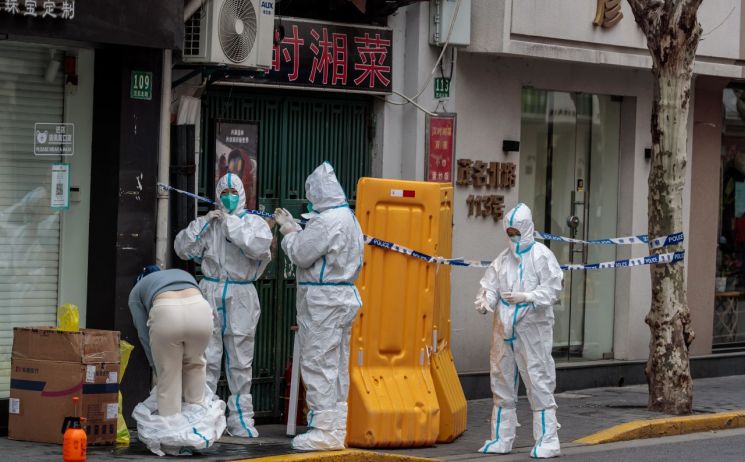
 On the 19th (local time), disinfection supplies are being organized in front of a quarantined house in Shanghai, China.
 [Asia Economy Reporter Choi Dae-yeol] As signs of economic recovery become clear worldwide with the transition to With-Corona, there is a growing outlook that Russia's invasion of Ukraine and the resulting raw material market instability could act as significant threats to the global economy. In the U.S., where rapid inflation has led to anticipated monetary tightening, China faces increased downward pressure on its economy due to the war and a resurgence of COVID-19. Experts point out the need for measures to minimize side effects as these overseas situations impact the domestic economy.
On the 20th, the Hyundai Research Institute released a report titled "Recent Global Economic Trends and Implications," analyzing the economic conditions inside and outside major regions including the U.S., Europe, Japan, and China. In the U.S., the influence of COVID-19 is waning, and recovery continues, but inflation is rising at the fastest pace since the 1980s, potentially delaying consumer recovery. The pace of monetary policy normalization by the Federal Reserve Board is also a key factor. Europe also shows clear signs of economic recovery but faces a high possibility of slowdown due to high inflation and the Ukraine situation.
China is diagnosed with increased downward economic pressure due to the Ukraine crisis and the resurgence of COVID-19. The report states, "China shows a concurrent recovery in domestic and external demand supported by eased monetary policy," but notes, "uncertainties remain, such as the possibility of renewed real estate-related defaults." It further adds, "With prolonged Ukraine-Russia conflict and COVID-19 resurgence, domestic and international risks are spreading, leading to continued weakening of supply chains and rising import prices, which will maintain downward pressure for the time being."
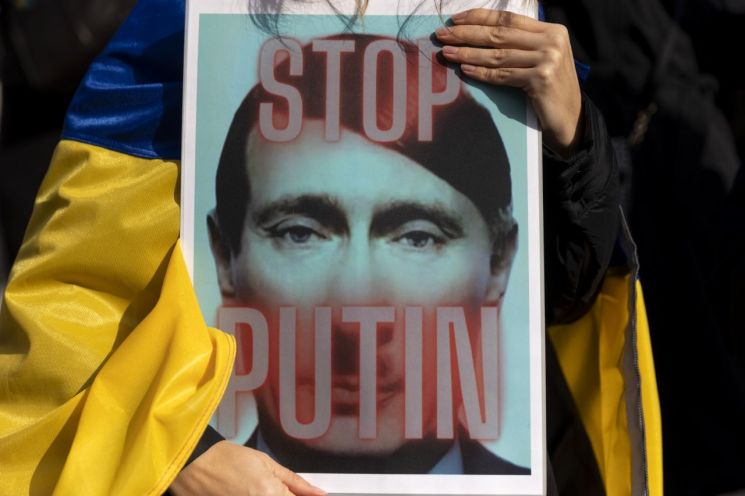 On the 19th (local time), at a rally held in Athens, Greece, a woman is holding a photo condemning Russia's invasion.
 The report explains, "It is important to proactively address side effects that may arise from the transmission of external risks to the domestic economy," and emphasizes, "To respond to supply instability of energy and raw materials caused by the war and the intensification of global supply chain bottlenecks, strengthening energy and resource diplomacy is necessary to manage short-term supply-demand imbalances."
It continues, "Thorough preparation is required during the remaining period to ensure that political issues such as policy gaps or changes following the new government's inauguration do not amplify economic volatility," stressing, "Especially this year, as major external risks continue to emerge, policy efforts to stabilize the macroeconomy need to be strengthened more than ever."
Considering that monetary policies in major countries are focused on stability, the report adds that the need to supplement with government fiscal measures has increased compared to the past. It also highlights the necessity of presenting a reasonable roadmap in advance and executing policies flexibly to reduce confusion among private economic actors such as companies during the transition to an endemic phase.
The report argues, "Companies should first implement countermeasures such as expanding inventories of key raw materials and diversifying import sources, and if individual corporate capabilities are insufficient, the government or public sector should actively support these efforts," adding, "In the mid to long term, innovation and productivity improvements are essential to enhance resilience against similar risks if they recur."
© The Asia Business Daily(www.asiae.co.kr). All rights reserved.


















