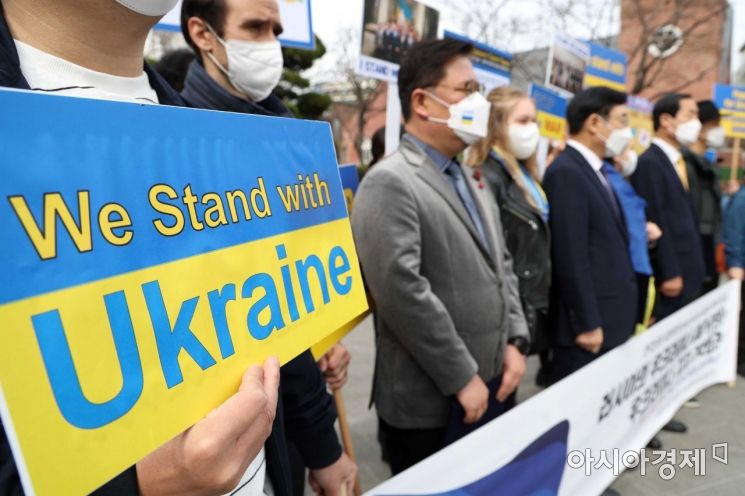
 On the 17th, a "Press Conference Condemning Russia's Invasion of Ukraine and Supporting Ukraine," hosted by the Korean Human Rights Cities Council, is being held in front of Jeongdong First Methodist Church near the Russian Embassy in Jung-gu, Seoul. Photo by Moon Honam munonam@
[Asia Economy Reporter Junho Hwang] "If Russia and Ukraine succeed in negotiations, can the economic situation return to what it was before?"
In the securities industry, despite recent progress in negotiations between the two countries, there are forecasts that economic pressure due to geopolitical factors will continue.
Hyojin Kim, a researcher at KB Securities, stated, "Although international oil prices recently approached $130 per barrel and then fell back to the mid-$90s, seemingly reducing the impact of the Russia-Ukraine conflict, even if oil prices no longer rise, the effects of the Russia-Ukraine war that shook the financial markets will persist."
First, it is necessary to pay close attention to the soaring food prices. Unlike other raw materials such as crude oil, the rise in food prices occurred due to concerns about supply shortages. Even after a ceasefire or armistice, the possibility of supply disruptions remains high. Since food prices account for about 8-10% of the overall consumer price index, the burden of inflation due to rising food prices is likely to increase.
In particular, even if a ceasefire agreement is reached between the two countries, economic sanctions against Russia may continue. On Wall Street, there are even claims that Russia will follow in the footsteps of Argentina, which was unable to return to the global financial market for 15 years. This suggests that along with food prices, the upward trend in prices of other raw materials such as crude oil may continue, strengthening the outlook for increased inflationary pressure.
Researcher Kim also observed that alongside rising food prices, the US-China trade dispute, which has been re-highlighted due to the Russia-Ukraine conflict, should be closely watched. Although it was expected that US-China tensions would resurface ahead of the US midterm elections in November this year, the conflict between China and the US may proceed earlier and more sharply than anticipated due to the Russia-Ukraine conflict.
Especially when looking at recent trade balances by country, China recorded the largest trade surplus ever, while the US is experiencing the largest trade deficit ever, showing a stark contrast. The surplus in China, where global supply chains are located, is not favorable from the US perspective. Since the US has gained almost no real benefits from the US-China conflict, including tariff increases since 2018, the nature of the dispute may differ. However, Kim's analysis suggests that the potential for future US-China disputes has increased.
Researcher Kim said, "Although the recent expansion of the US trade deficit is largely due to a surge in energy imports, China's record trade surplus is not welcome," and “future US-China conflicts will proceed differently from the tariff-centered pattern of 2018.”
© The Asia Business Daily(www.asiae.co.kr). All rights reserved.

















