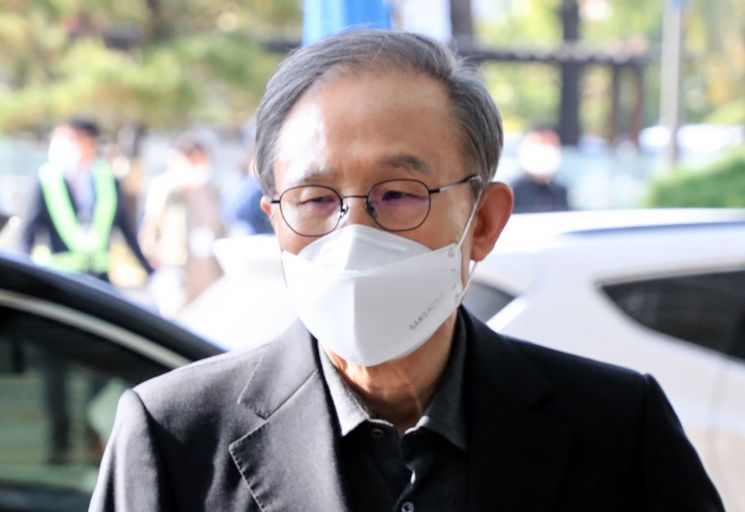
[Asia Economy Reporter Choi Seok-jin, Legal Affairs Specialist] Former President Lee Myung-bak has won the final verdict in a lawsuit seeking to cancel the tax authorities' imposition of taxes on rental income from real estate held under a borrowed name.
According to the legal community on the 18th, the Supreme Court's 2nd Division (Presiding Justice Cheon Dae-yeop) dismissed the appeal without oral argument yesterday in the comprehensive income tax and local income tax imposition cancellation lawsuit filed by former President Lee against the head of the Gangnam Tax Office and the Gangnam District Office in Seoul. Accordingly, the lower court ruling partially in favor of the plaintiff was upheld as is.
An appeal dismissal without oral argument is a system in appellate cases excluding criminal cases where the appeal is dismissed without substantive review if there are no specific legal grounds such as constitutional violations in the lower court's ruling.
Former President Lee was indicted in October 2018 on charges related to the actual ownership of DAS and was sentenced to prison. At that time, the court judged that former President Lee had held assets under borrowed names, including those of his late brother-in-law Kim Jae-jung.
The tax authorities, in November of the same year, determined that rental income generated from real estate held under the name of Lee's late elder sister, Lee Gui-seon, was excluded from taxable income and imposed comprehensive income tax of approximately 125 million KRW and local income tax of 12 million KRW.
At that time in November 2018, former President Lee was incarcerated at the Seoul Eastern Detention Center, and the tax authorities delivered the tax-related notices to Lee's son, Lee Si-hyung, and former Blue House security staff.
In response, former President Lee's side claimed they were unaware of the tax imposition due to being in detention and filed an administrative appeal with the Tax Tribunal, but it was dismissed due to the expiration of the objection period, leading to a lawsuit filed in February 2020.
The first trial court rejected former President Lee's claim that proper delivery was not made, citing that Lee Si-hyung had received the notice and signed the receipt.
The court stated, "It is reasonable to consider that former President Lee explicitly or implicitly authorized his eldest son to receive the relevant documents, including the notice," and "Since Lee Si-hyung received and was delivered the documents on November 19, 2018, it should be regarded as legally delivered to former President Lee."
However, the court ruled that the statute of limitations for tax imposition is five years and that imposing taxes in 2018 on rental income from real estate generated between 2008 and 2011 was invalid.
The Framework Act on National Taxes sets the statute of limitations for tax imposition at five years but allows up to ten years if the taxpayer evaded taxes through fraud or other wrongful acts or received refunds or deductions improperly.
The tax authorities argued that the ten-year statute of limitations should apply because former President Lee maintained the trust status of the real estate under another's name with the intent to evade taxes.
However, the court did not accept this, stating, "The mere fact that the borrowed name trust violated the Real Name Real Estate Act does not constitute 'fraud or other wrongful acts.'"
Furthermore, the court added, "There is no evidence to suggest that the plaintiff's borrowed name trust was intended to evade property tax or income tax on rental income," and "It appears that the income tax on rental income was fully paid under the name of the trustee, Mr. Lee."
This judgment was upheld in the second trial, and the Supreme Court also concluded that there was no problem with the lower court's ruling.
© The Asia Business Daily(www.asiae.co.kr). All rights reserved.

















