All Judges Including Chief Judge Yun Nam-seok to Retire Within Yoon's Term... Progressive Influence Expected to Fade
Constitutional Petitions on 'Youth Quarantine Pass, Corruption Investigation Office Communication Checks, and Criminal Case Non-Disclosure'
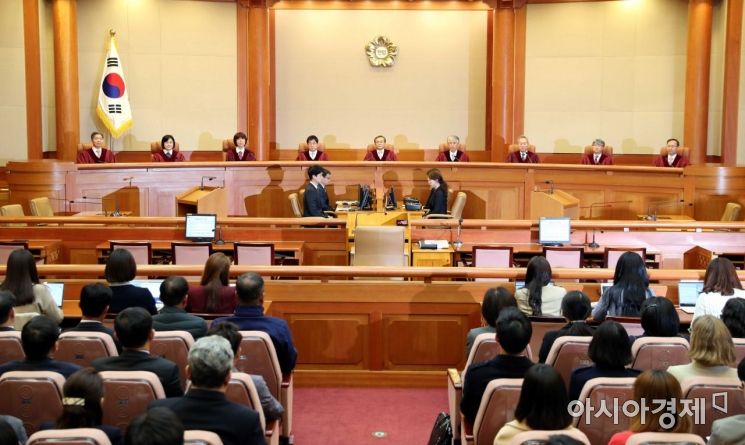
[Asia Economy Reporter Heo Kyung-jun] The composition of the Constitutional Court will change as all the justices, including the Chief Justice, will be replaced during President-elect Yoon Seok-yeol's term. This shift is expected to impact the ongoing "Comprehensive Real Estate Tax (Jongbu-se) Unconstitutionality Lawsuit," which is linked to Yoon's campaign promise of the long-term abolition of the Jongbu-se.
According to the legal community on the 17th, Chief Justice Yoo Nam-seok and all eight justices will retire between March 2024 and April 2025. Of the nine justices, including the Chief Justice, three are directly appointed by the president, three are elected by the National Assembly, and three are nominated by the Chief Justice of the Supreme Court and appointed by the president. In effect, the president can shape the Constitutional Court. It is highly likely that six of the nine justices will be appointees nominated by the new government and ruling party.
Ultimately, the conclusion of the Jongbu-se unconstitutionality lawsuit could change depending on how President-elect Yoon exercises his appointment authority, which includes appointing all the constitutional justices, including the Chief Justice.
So far, the Constitutional Court has ruled the Jongbu-se itself constitutional. The fourth Constitutional Court, which had a strong centrist orientation, ruled in 2008 that the provisions on "aggregation by generation" and "long-term homeowners of a single house" were unconstitutional and constitutionally incompatible, respectively, but judged that the Jongbu-se was introduced for public interest and was reasonable in its method. It also found that the tax burden was not excessive.
However, under the Moon Jae-in administration, the number of Jongbu-se payers increased sharply due to rising official land prices, and many ordinary citizens owning a single house have expressed dissatisfaction over paying substantial Jongbu-se amounts.
Currently, all justices of the sixth Constitutional Court were appointed by President Moon Jae-in, so the prevailing analysis is that they will not make decisions deviating from the Jongbu-se policy direction pursued by the government and ruling party. There is growing speculation that the court, composed of strongly progressive justices, will maintain the current Jongbu-se law as is. Chief Justice Yoo Nam-seok, a founding member and former president of the Uri Law Research Association, Justice Moon Hyung-bae and Justices Kim Ki-young and Lee Mi-sun are from the International Human Rights Law Research Association, and Justice Lee Seok-tae is a former president of the Lawyers for a Democratic Society (Minbyun).
If the Jongbu-se unconstitutionality lawsuit prolongs, the verdict is likely to change depending on the shift in the Constitutional Court's composition. Since the outcome depends on the justices' orientations, the direction of the unconstitutionality lawsuit essentially hinges on how President-elect Yoon exercises his appointment authority.
President-elect Yoon has pledged to reform the real estate tax system in a way that aligns with tax principles rather than market management objectives, including a long-term plan to integrate the Jongbu-se with property tax, signaling a revision of the Jongbu-se itself.
The Constitutional Court is also reviewing a constitutional complaint related to the "Youth Quarantine Pass." While it is highly likely to dismiss the case citing no practical benefit due to the suspension of the quarantine pass, it may recognize the benefit of the complaint and make a substantive ruling.
A constitutional complaint has also been filed arguing that the High-ranking Officials' Crime Investigation Unit (Gongsoocheo) unconstitutionally conducted indiscriminate communication surveillance on politicians and journalists.
Additionally, the Constitutional Court is reviewing the procedural requirements to determine whether to hear a constitutional complaint case regarding the Ministry of Justice's directive on "Prohibition of Disclosure in Criminal Cases" before a full bench of all nine justices.
© The Asia Business Daily(www.asiae.co.kr). All rights reserved.

















