Vice Premier Liu He Holds Special Meeting of the Financial Committee, Mentions "Active Response to Monetary Policy"
Chinese Experts Confident in 5% Growth in Q1... Possibility of Reserve Requirement Ratio and Benchmark Interest Rate Cuts Raised
[Asia Economy Beijing=Special Correspondent Jo Young-shin] Unlike the United States, which raised its benchmark interest rate, China is expected to cut its interest rates. Inside China, there is an analysis that the likely move will be a cut in the reserve requirement ratio (RRR) rather than the loan prime rate (LPR), which is the benchmark interest rate.
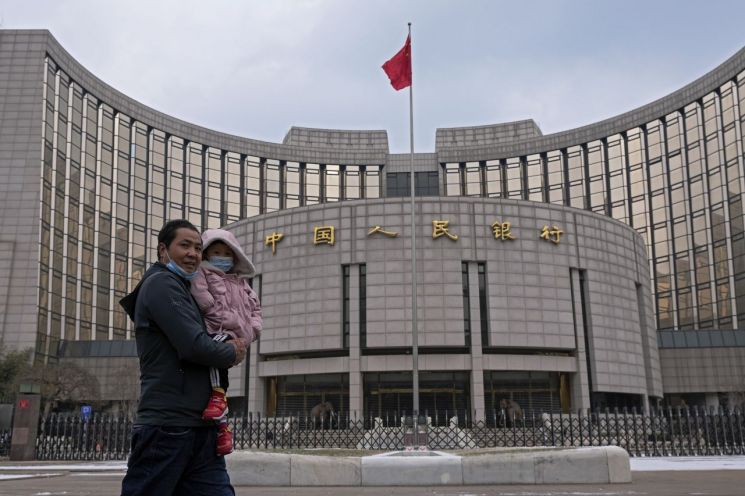
On the 17th, Chinese state media including Xinhua News Agency reported that the State Council held a special meeting of the Financial Committee (Finance Committee) chaired by Vice Premier Liu He the day before to discuss measures to stabilize the capital market.
At the meeting, Vice Premier Liu said that under the current complex situation, the top priority is economic revitalization and that reform and opening-up need to be expanded. He added, "We must effectively activate the economy in the first quarter, actively respond to monetary policy, and maintain moderate growth in new loans."
Immediately after the meeting, the People's Bank of China, the central bank, issued a notice titled "Conveying the Spirit of the State Council Financial Committee Special Meeting," stating that it will proactively respond to the financial (monetary) market and firmly support the development of the real economy through credit loans, operating the economy within a reasonable range.
It appears that the State Council held the emergency special meeting of the Financial Committee in response to domestic and international adverse factors that emerged this month, such as Russia's invasion of Ukraine and the nationwide spread of COVID-19.
Following the special meeting of the Finance Committee, the Chinese financial market expects that the financial authorities will soon implement an interest rate cut. In particular, there is a growing atmosphere favoring a cut in the reserve requirement ratio rather than the LPR.
The reserve requirement ratio refers to the mandatory cash reserve ratio that banks must hold at the central bank from the deposits received from customers. Therefore, when the RRR is lowered, the liquidity supply capacity of commercial banks increases. Typically, a 0.5 percentage point cut creates an additional capacity of 1.2 trillion yuan (approximately 233 trillion won). The People's Bank of China cut the RRR by 0.5 percentage points in both July and December last year.
The reason why an RRR cut is strongly discussed inside China is that new yuan loans in the Chinese financial sector decreased last month. New loans in February stood at 1.23 trillion yuan, down 125.8 billion yuan from the same period last year. Meanwhile, new loans in the non-bank sector increased by 179 billion yuan. Most notably, new medium- to long-term loans decreased by 37%, and among these, medium- to long-term loans to households showed negative growth.
Zhou Maohua, a researcher at Guangda Bank, analyzed, "The slowdown in new yuan loans in February means that the increase in market credit loans fell short of expectations, indicating that loan demand in the real economy has contracted."
Chinese media Pengpai predicted a high possibility of additional interest rate cuts, considering the low financing demand in the real economy and the fact that the debt risk of commercial banks is not high, and anticipated an RRR cut.
Global Times reported that the special meeting of the Finance Committee sent a sufficient signal from Chinese financial authorities to supply ample liquidity not only to the financial market but also to the securities market.
Dong Shaofeng, chief researcher at the Chongyang Institute for Financial Studies at Renmin University, said, "If the market feels uneasy and there is demand for liquidity, the central bank must take corresponding measures," evaluating that this meeting explained various policy tools of the Chinese government to lead the economy stably.

Some in China also expect that the People's Bank of China may cut the benchmark interest rate, the LPR, on the 20th to demonstrate a firm commitment to economic stimulus.
Wang Qing, chief analyst at Dongfang Jincheng, a major Chinese credit rating agency, said, "It is necessary to note the current lack of credit loan demand and the low willingness of banks to lend," suggesting that the People's Bank of China could cut the benchmark interest rate.
Won Bin, chief researcher at Minsheng Bank, said, "Downward pressure on the economy is still considerable," adding, "Considering the scale and structure of monetary policy, it is time to cut the benchmark interest rate, and there is sufficient room to do so," raising the necessity of a benchmark interest rate cut.
Meanwhile, despite overseas forecasts predicting '0%' growth due to the Ukraine crisis and the nationwide resurgence of COVID-19 in China, there are claims within China that the Chinese economy will grow by 5% in the first quarter of this year.
Liu Xuezhe, chief researcher at China Communications Bank, forecasted, "Considering basic data such as industrial production, fixed asset investment, and consumer sales from January to February, China's gross domestic product (GDP) will grow by 5%."
China Zhongxin Securities stated in a report that although the nationwide spread of COVID-19 in March may pressure the consumption sector, considering economic data from January to February, it maintains the previous judgment that the Chinese economy will grow by 5.3% in the first quarter.
Tian Yun, vice chairman of the Beijing Economic Operation Association, said, "If there had been no resurgence of COVID-19, China's first-quarter economic growth rate could have reached 6%," adding that the first-quarter GDP will post a minimum of 5%.
© The Asia Business Daily(www.asiae.co.kr). All rights reserved.
![Clutching a Stolen Dior Bag, Saying "I Hate Being Poor but Real"... The Grotesque Con of a "Human Knockoff" [Slate]](https://cwcontent.asiae.co.kr/asiaresize/183/2026021902243444107_1771435474.jpg)

















