Pandemic Vulnerability Assessment for 1,482 Commercial Districts in Seoul
Peripheral and Newly Adjacent Central Districts Show Low Adaptability to Pandemics
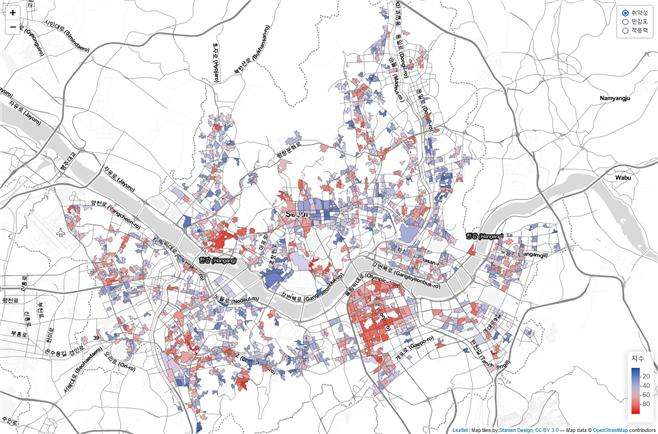
[Asia Economy Reporter Lim Cheol-young] Commercial districts with a high influx of external population are sensitive to infectious disease pandemics, whereas small-scale commercial districts in residential areas are relatively less sensitive. Additionally, alleyway commercial districts adjacent to Seoul’s outskirts or central commercial districts were found to have low adaptability to infectious disease pandemics.
On the 17th, the Seoul Credit Guarantee Foundation announced the analysis results of the study titled “Diagnosis of Infectious Disease Pandemic Vulnerability and Countermeasures by Commercial District in Seoul.” This study was conducted to analyze commercial districts more vulnerable to the COVID-19 pandemic and to propose customized countermeasures according to the characteristics of each commercial district. The foundation used big data to establish an infectious disease pandemic vulnerability index for 1,482 commercial districts in Seoul.
The analysis showed that commercial districts with a high influx of population were sensitive to infectious disease pandemics, while small-scale commercial districts in residential areas were relatively less sensitive. Business districts with many office workers such as Gwanghwamun and Gangnam Teheran-ro, university commercial districts, and station-area commercial districts were found to be more sensitive to infectious disease pandemics compared to residential area commercial districts in Eunpyeong-gu, Gangseo-gu, and Yangcheon-gu.
Alleyway commercial districts adjacent to Seoul’s outskirts or central commercial districts showed low adaptability to infectious disease pandemics. These low adaptability commercial districts tended to be spread across the outskirts of Seoul, and alleyway commercial districts such as Mangridan-gil, which emerged as central commercial districts expanded their influence, were also found to have low pandemic adaptability.
By integrating sensitivity and adaptability, the foundation established an infectious disease pandemic vulnerability index and concluded that vulnerable commercial districts are not concentrated in specific areas but are spread throughout Seoul. In particular, among station-area commercial districts, Yeonsinnae Station, Sillim Station, Mia Station, and Cheonho Station were identified as more vulnerable; among university commercial districts, Hongdae, Sinchon, Ewha Womans University, Sungshin Women’s University, Daehangno, and Konkuk University Entrance were noted; and among commercial districts highly dependent on foreign tourists, Myeongdong, Gyeongbokgung, and Itaewon were analyzed as more vulnerable to infectious disease pandemics.
Based on the analysis results, the foundation emphasized the need for a preventive strategy that prioritizes support for commercial districts vulnerable to infectious disease pandemics while proactively strengthening commercial district immunity. To reduce sensitivity, policies such as establishing commercial district-level quarantine systems and supporting ventilation facility installation were proposed. To improve adaptability, countermeasures including spreading management know-how, promoting digital transformation, and fostering merchant networks were suggested.
Joo Cheol-soo, Chairman of the Seoul Credit Guarantee Foundation, stated, “It is necessary to actively consider ways to enhance the crisis response capabilities of commercial districts according to their characteristics and situations,” adding, “We hope this study will help small business owners who have suffered severe difficulties due to the COVID-19 pandemic and contribute to policy efforts to strengthen the self-sustainability of commercial districts.”
© The Asia Business Daily(www.asiae.co.kr). All rights reserved.
![Clutching a Stolen Dior Bag, Saying "I Hate Being Poor but Real"... The Grotesque Con of a "Human Knockoff" [Slate]](https://cwcontent.asiae.co.kr/asiaresize/183/2026021902243444107_1771435474.jpg)
















