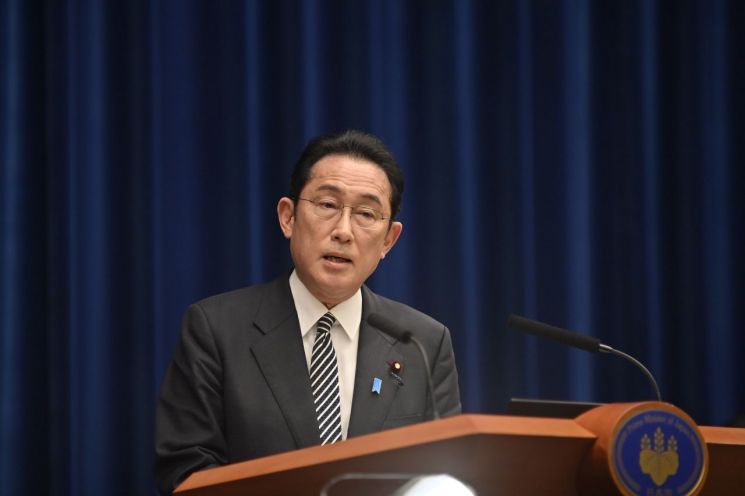
[Asia Economy Reporter Kwon Jae-hee] Japanese Prime Minister Fumio Kishida announced on the 16th that Japan will withdraw the "Most-Favored-Nation (MFN)" trade status for Russia, which invaded Ukraine.
At a press conference that day, Prime Minister Kishida said, "Russia's military invasion of Ukraine is a heinous act that must be recorded in history, and we strongly condemn it," adding, "In coordination with the Group of Seven (G7), we will consider dynamic and strict sanctions according to the development of the situation."
Kishida also stated that to further strengthen export and import controls on Russia, Japan has banned the export of luxury goods and the import of certain items.
The Most-Favored-Nation status means providing treatment that is no less favorable than any conditions granted to third countries under the World Trade Organization (WTO) regulations between two countries.
The G7 has already announced additional sanctions on Russia, including the termination of MFN status, and Japan, as a G7 member, has decided to join the economic sanctions against Russia.
Withdrawing the MFN status will allow Japan to raise tariffs or set quotas on Russian imports.
According to Kyodo News, if Russia is excluded from MFN status, the tariff rate on crabs, which Japan mainly imports from Russia, is expected to rise from the current 4% to 6%, and salmon tariffs from 3.5% to 5%.
On the other hand, liquefied natural gas (LNG), crude oil, and coal originally have a 0% tariff rate, so no impact is expected.
The Japanese government has been gradually increasing the level of sanctions together with the United States and Europe since Russia invaded Ukraine.
Prime Minister Kishida also announced that the "Priority Measures to Prevent Spread" (Priority Measures), a COVID-19 emergency measure implemented in 18 of Japan's 47 prefectures, including Tokyo and Osaka, until the 21st, will not be extended and will be lifted entirely.
Kishida explained this policy by saying, "The number of COVID-19 infections nationwide has stabilized to about half of the peak."
Recently, Japan has been reporting 30,000 to 50,000 new COVID-19 cases daily.
Kishida mentioned that since close contacts cannot always take time off work, causing disruptions, general workplaces excluding medical institutions, elderly care facilities, and households will not investigate or confirm close contacts.
© The Asia Business Daily(www.asiae.co.kr). All rights reserved.

















