[Asia Economy Sejong=Reporter Dongwoo Lee] Domestic chicken meat sellers such as Harim and Olpum have been found to have colluded on broiler prices and supply volumes for 12 years.
The Korea Fair Trade Commission (KFTC) announced on the 16th that it imposed fines totaling around 170 billion KRW on 16 businesses that colluded on the price and shipment volume of fresh broiler meat used for chicken, and reported 5 businesses to the prosecution.
The collusion involved Harim Holdings, Harim, Olpum, Hangang Food, Dongwoo Farm to Table, Chamfree, Maniker, Cherrybro, Sajo Won, Haemaro, and others. These businesses accounted for 77% of the entire fresh broiler meat market as of 2020.
These businesses carried out the collusion for about 12 years from November 2005 to July 2017. The collusion channel was the Integrated Management Subcommittee (Tongbunwi), a CEO-level meeting within the Korea Broiler Association, a corporation consisting of the 16 businesses as members.
Specifically, 14 companies including Harim and Olpum agreed 16 times to raise elements that determine the selling price of fresh broiler meat, such as fees (all expenses related to the slaughtering process), live chicken transportation costs, and salting fees. They also restricted price discount competition by setting minimum discount limits or agreeing to reduce the scope of discount targets.
The 16 companies also reduced shipment volumes by freezing fresh broiler meat stockpiles 20 times. This was to prevent a drop in selling prices caused by increased supply when supplying slaughtered fresh broiler meat to the market. They also increased live chicken purchase volumes in the distribution market to artificially raise or maintain the 'live chicken market price' that constitutes the broiler selling price.
During the KFTC investigation, broiler businesses claimed that joint actions to control shipment and production volumes were measures in line with government supply and demand adjustment policies. However, the KFTC stated that the government had never issued orders to adjust fresh broiler meat production or shipments, and even if some administrative guidance was involved, there was no legal basis or the cited laws did not permit such joint actions.
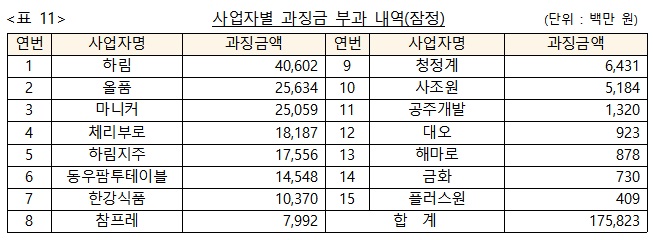
Accordingly, the KFTC provisionally imposed fines totaling 175.823 billion KRW on 15 businesses excluding C.S. Korea, which is in a state of complete capital erosion, and decided to refer 5 companies?Olpum, Hangang Food, Dongwoo Farm to Table, Maniker, and Cherrybro?to the prosecution.
Cho Hong-sun, head of the KFTC Cartel Investigation Bureau, said, “We will impose strong sanctions with a zero-tolerance principle on collusion that recurs despite corrective measures,” and added, “We will strengthen monitoring of livelihood-threatening collusion that increases prices and burdens on households in sectors closely related to daily life, such as food and daily necessities, especially during the COVID-19 pandemic.”
© The Asia Business Daily(www.asiae.co.kr). All rights reserved.

















