Recommendation for Twice-Weekly Proactive Testing Maintained Until April 16
Testing Criteria After the 18th to Be Flexibly Operated Based on Local Infection Situation
No Quarantine Even When Family Members Are Confirmed, Parents Concerned "No Supplementary Plan"
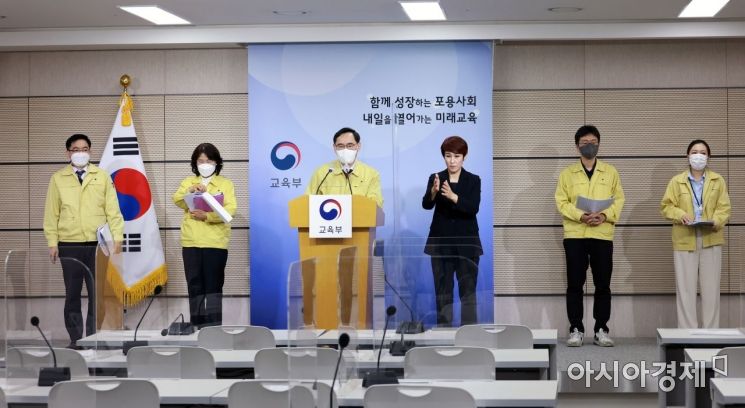
[Asia Economy Reporter Han Jinju] The Ministry of Education has decided to maintain twice-weekly proactive testing using rapid antigen test kits before school attendance until April 16, and to ease it to once a week starting from April 18.
On the 16th, the Ministry of Education announced that proactive testing will continue in April, providing kits for twice-weekly testing for students until the second week of April (16th), and from the 18th, kits will be distributed once per week. Depending on the infectious disease situation by region, starting after April 18, the frequency of testing can be flexibly applied by metropolitan and provincial superintendents of education. In April, 42.9 million kits will be distributed with a total investment of 104 billion KRW.
The quarantine authorities predicted that the peak of the spread will continue for the next one to two weeks and then gradually decrease, and the Ministry of Education also decided to maintain the twice-weekly testing standard only until the second week of April considering the workload such as dividing testing tools.
Jung Jong-cheol, Vice Minister of Education, said, "Experts expect the peak period to last about a week to ten days and then gradually decline," adding, "Since special vigilance is needed until mid-April, proactive self-diagnosis testing will continue in the current manner until the second week of April, and thereafter will be adjusted to once a week in line with the downward trend, with flexible operation according to regional situations. This is the core of this decision."
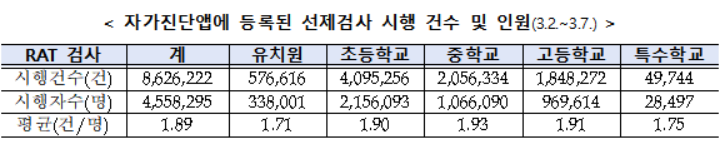 Number of Preemptive Test Self-Diagnosis App Entries by School Level from March 2 to 7 (Data from Ministry of Education)
Currently, twice-weekly proactive testing is recommended, but if there is a confirmed case within the family, testing must be done every other day, and if there is a confirmed case in the same class, testing up to three times a week at two-day intervals is required, causing inconvenience to parents. Since the start of the semester, student confirmed cases have surged, with 334,979 cases reported from April 8 to 14, averaging 47,854 cases per day. This is a 64.4% increase in daily average confirmed cases compared to the first week of the semester.
Concerns among parents are also high regarding the fact that from the 14th, students can attend school without quarantine even if a cohabiting family member is infected. The Ministry of Education and quarantine authorities recommended passive monitoring with PCR testing three days after a cohabiting family member is confirmed positive and rapid antigen testing on days 6 to 7, but they have no plans for additional measures.
Director Ryu said, "In meetings with the Ministry of Food and Drug Safety and the Korea Disease Control and Prevention Agency, we received opinions that even with about a three-day incubation period, PCR test results can detect about 50% of confirmed cases, and since proactive testing is done twice a week, it is sufficient to filter cases," adding, "We will continue with the current quarantine guidelines."
The Ministry of Education plans to continue distributing kits for proactive testing until April. However, if infections spread in specific schools or regions after the 18th, superintendents of education may recommend twice-weekly testing at their discretion. Conversely, even if confirmed cases decrease, kits will be distributed to allow once-weekly testing. There is also a possibility of flexible operation of proactive testing standards by region, such as recommending testing only for symptomatic individuals.
Ryu Hye-sook, Director of Student Support at the Ministry of Education, said, "Rapid antigen test kits will be distributed until April, and since the downward phase is expected from the 3rd to 4th week of April, adjustments will be made thereafter."
She added, "It is expected that securing quantities or budgets to distribute two kits per student in the 3rd to 4th week of April will not be easy for metropolitan and provincial offices of education. We also plan to secure kits for once-weekly testing and will distribute them unless there are major changes. There may be cases where flexible or fluid decisions are made by region."
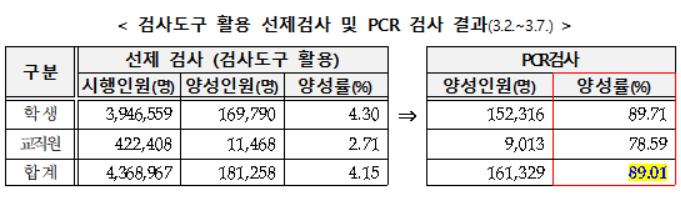 Number and Rate of Positive Cases from Preliminary Tests and PCR Tests from March 2 to 7 (Source: Ministry of Education)
The Ministry of Education analyzed the linkage between self-diagnosis app responses recording proactive testing results and PCR test results held by the Korea Disease Control and Prevention Agency, finding a positive predictive value of about 89%. The Ministry judged that early detection of 160,000 confirmed cases was effective in preventing the spread of COVID-19 in schools.
During the first week of the semester (March 2?7), a total of 3,946,559 students entered their proactive testing results into the self-diagnosis app, among whom 169,790 tested positive on rapid antigen test kits (positivity rate 4.3%). The number of individuals confirmed positive by PCR testing was 152,316, with a positivity rate of about 89.71%. The overall positivity rate including staff was 89.01%.
Regarding concerns about false positives, where negative cases are reported as positive, Park Young-jun, Epidemiological Investigation and Analysis Officer at the Korea Disease Control and Prevention Agency, responded, "It is important to note that 160,000 potentially infectious students did not enter schools," adding, "To minimize false positives, repeated testing, symptom checks, and adherence to quarantine rules within schools are realistic approaches."
There are also calls for improvement as the number of proactive tests conducted in kindergartens and special schools is low. The number of proactive tests in kindergartens (1.71 tests) and special schools (1.75 tests) is lower than the average (1.89 tests). Director Ryu said, "Since it was the first week of the semester and testing numbers were low in kindergartens and special schools, we will consider this and analyze follow-up results further."
© The Asia Business Daily(www.asiae.co.kr). All rights reserved.
![Clutching a Stolen Dior Bag, Saying "I Hate Being Poor but Real"... The Grotesque Con of a "Human Knockoff" [Slate]](https://cwcontent.asiae.co.kr/asiaresize/183/2026021902243444107_1771435474.jpg)


















