Last Quarter Vacancy Rate Hits Record High of 10%
Myeongdong Soars 42.4%P in 3 Years
Investment Yield Rises 0.45%P to 1.83%
Land Prices Increased Despite Declining Rental Income
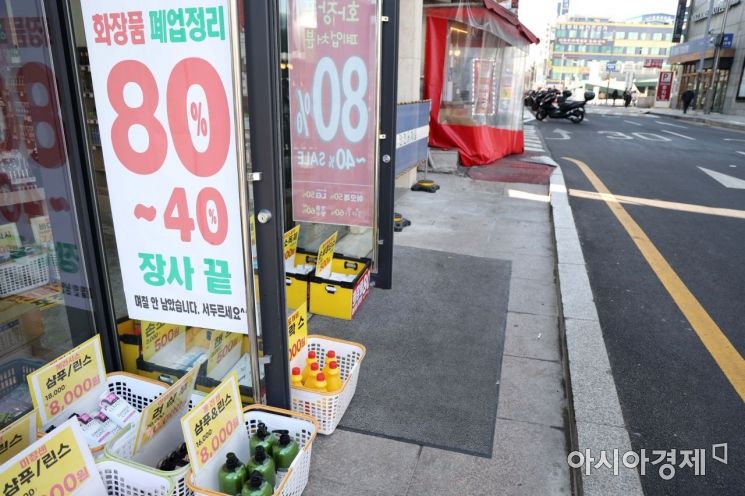 On the 8th, as the spread of COVID-19 continues, a store near Dongdaemun Design Plaza in Seoul is holding a clearance sale due to closure. Photo by Mun Ho-nam munonam@
[Asia Economy Reporter Kangwook Cho] Despite the rising vacancy rates in commercial properties amid the prolonged COVID-19 pandemic, investment returns have shown signs of recovery. Although rental income has decreased, asset values have increased due to rising land prices.
According to the Korea Real Estate Board's Commercial Lease Trend Survey on the 16th, the vacancy rate for medium-to-large commercial properties in Seoul reached 10.0% in the fourth quarter of last year, marking the highest level since related statistics began in 2013. The vacancy rate increase was particularly significant in downtown areas including Gwanghwamun, Namdaemun, and Myeongdong. Notably, Myeongdong's vacancy rate surged dramatically from 7.7% in the fourth quarter of 2018 to 50.1% in the fourth quarter of last year, a 42.4 percentage point increase over three years. This indicates that half of the commercial spaces are vacant due to a decline in foot traffic and tourists. The vacancy rate in the Gangnam area slightly decreased to 10.3% from 11.5% in the second quarter of last year.
On the other hand, investment returns have been rising, recovering to pre-pandemic levels. The nationwide investment return rate for medium-to-large commercial properties was 1.83% in the fourth quarter of last year, up 0.45 percentage points from 1.38% a year earlier. During the same period, Seoul's rate increased by 0.53 percentage points from 1.53% to 2.06%, showing a larger rise. In particular, Gangnam's investment return rate rose from 1.56% to 2.29%, a 0.73 percentage point increase in one year, whereas the downtown area saw a smaller increase from 1.23% to 1.34%, a 0.11 percentage point rise, highlighting a growing gap between regions.
This is interpreted as reflecting heightened expectations for capital gains such as land price increases. Due to the government's successive high-intensity regulations, asset owners have shifted their focus from the housing market to commercial real estate, leading to an influx of investment demand and resulting in increased asset values. Investment returns combine rental income and capital gains, so even if vacancy rates rise and rents fall, returns can be maintained if asset values increase. In fact, nationwide land prices rose by 4.17% last year, an increase from 3.68% the previous year. Seoul land prices also increased by 5.31%, higher than the previous year's rise of 4.80%.
© The Asia Business Daily(www.asiae.co.kr). All rights reserved.

















