[Asia Economy Reporter Lee Jung-yoon] Due to the spread of COVID-19, the Chinese stock market plummeted, leading to a decline in the domestic stock market as well.
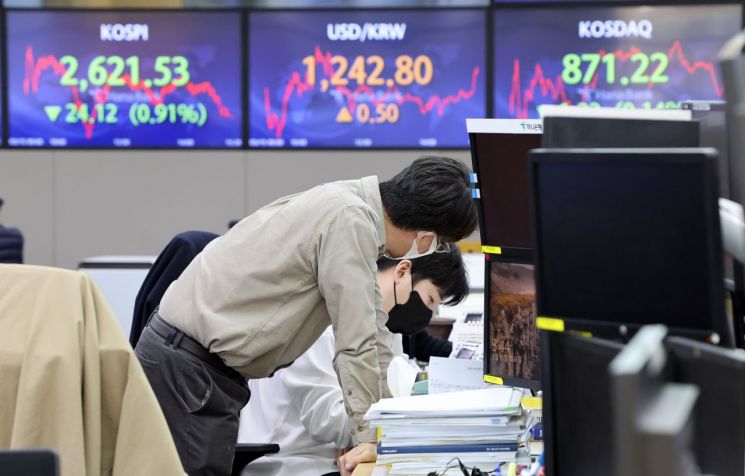
On the 15th, the KOSPI closed at 2,621.53, down 0.91% (24.12 points) from the previous trading day. The KOSPI, which started lower, fell to 2,615.42 around 10:58 a.m. as foreigners poured out sell orders. Foreigners net sold 673.3 billion KRW, pulling the index down. In contrast, individuals and institutions net bought 606.4 billion KRW and 37.9 billion KRW, respectively.
As the Chinese stock market showed weakness that day, foreign selling continued in the domestic market. Due to the COVID-19 impact, cities such as Shenzhen in Guangdong Province, China, were locked down, causing the Chinese stock market to decline. Additionally, the People's Bank of China announced the dollar-yuan central parity rate at 6.3760 yuan, up 0.4% from the previous session, which also influenced the market. As of 2:57 p.m., the Shanghai Composite Index fell 4.88%, and by 3 p.m., the Hong Kong Hang Seng Index plunged 6.28%. However, the KOSPI reduced its losses as China's industrial production for January-February increased by 7.5% year-on-year. Retail sales during the same period rose 6.7% compared to the previous year.
Seo Sang-young, a researcher at Mirae Asset Securities, explained, "It appears that the decline in the Chinese stock market had the greatest impact. If China enforces economic lockdowns due to the spread of COVID-19, it could become an issue of economic slowdown, which would lead to a decrease in exports to China, negatively affecting the domestic stock market."
Furthermore, concerns about interest rate hikes by the U.S. Federal Reserve (Fed) and existing issues such as oil prices also negatively impacted the domestic stock market. The Federal Open Market Committee (FOMC) is expected to raise interest rates by about 0.25 percentage points this week. Jung Da-woon, a researcher at Ebest Investment & Securities, stated, "Overall, considering the macroeconomic situation, there are no positive factors for our stock market."
Among the top market capitalization stocks, LG Chem recorded the largest drop, falling 3.94%. This was followed by SK Hynix (-3.02%), LG Energy Solution (-1.1%), Samsung Electronics (-1%), Hyundai Motor (-0.91%), Samsung SDI (-0.81%), Kakao (-0.48%), and NAVER (-0.46%). Samsung Biologics (1.5%) and Kia (0.58%) showed upward trends.
By sector, machinery (-3.23%), transportation and warehousing (-2.88%), construction (-2.54%), chemicals (-2.02%), and steel & metals (-1.92%) declined. Medical precision (4.01%), banking (3.82%), pharmaceuticals (0.46%), and finance (0.45%) showed gains.
On the same day, the KOSDAQ index closed at 871.22, down 0.14% (1.22 points) from the previous session. Foreigners and institutions net sold 40.3 billion KRW and 23.8 billion KRW, respectively, while individuals net bought 65 billion KRW.
Among the top market capitalization stocks, HLB showed strong performance, rising 8.13%. Studio Dragon, EcoPro BM, and Cheonbo also rose by 1.32%, 1.27%, and 0.97%, respectively. On the other hand, Wemade (-3.78%), Pearl Abyss (-3.57%), Celltrion Pharm (-2.32%), Celltrion Healthcare (-2.29%), L&F (-1.46%), and Kakao Games (-0.14%) recorded declines.
© The Asia Business Daily(www.asiae.co.kr). All rights reserved.

















