The presidential election is over, but the 'election waste' disposal problem remains
Every election period faces a massive waste crisis
Estimated 28,000 tons of carbon emissions from this year's presidential and local elections alone
Equivalent to the amount absorbed by 3.1 million pine trees in one year
Experts say "Reducing waste generation is the most urgent solution"
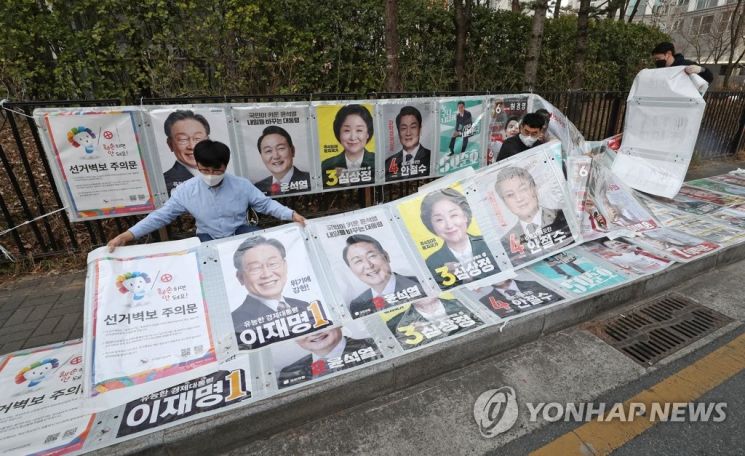 On the morning of the 10th, officials from the Jung-gu Office in Daejeon were removing election posters posted around Daehung-dong, Jung-gu. / Photo by Yonhap News
[Asia Economy Reporter Lim Juhyung] The 20th presidential election has ended, but the 'aftermath' remains. This is because the countless campaign materials and ballots used during the election campaign period, so-called 'election waste,' need to be disposed of. In South Korea, thousands of tons of election waste are generated during every major and minor election, but measures to collect and recycle this waste remain insufficient. Environmental groups are urging the establishment of plans to conduct elections in a more eco-friendly manner.
How much election waste was generated in this presidential election? According to the recent data released by the National Election Commission titled "The 20th Presidential Election in Numbers," a total of 400 million campaign materials were issued, including 290 million booklet-type campaign brochures, 970,000 braille brochures, and 108.5 million leaflet-type brochures. Additionally, about 44 million ballots were used, and a total of 1.18 million outdoor campaign materials were posted.
The amount of paper used to produce this volume of campaign materials is enormous. For example, if the ballots were stacked one by one, the height would reach 4,400 meters, which is eight times the height of Lotte World Tower (123 floors, 554 meters). In length, it would be 11,880 km, reaching from Seoul to New York and still leaving about 880 km remaining.
Election posters, commonly seen on building walls or fences, were posted in a total of 84,884 locations. These posters are formed by connecting the election posters of 14 candidates. If these posters were gathered and laid out in a line, the total length would be 848 km, which is much longer than the round-trip distance from Seoul to Busan (about 800 km).
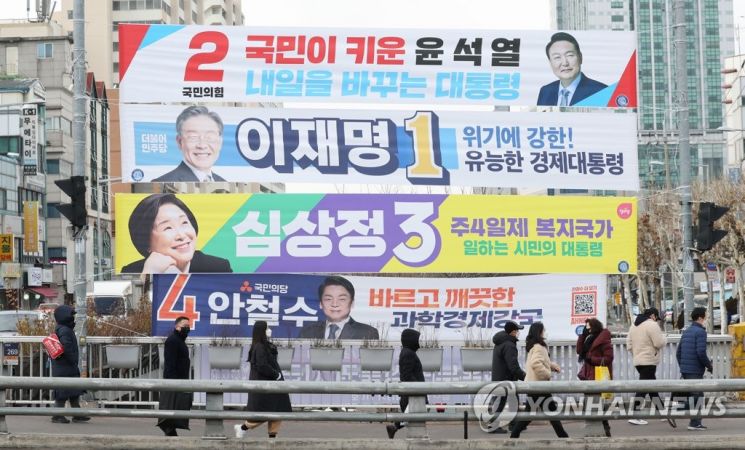 Campaign banners promoting presidential candidates hung on the streets during the presidential election campaign period. The banners are known to be made of materials that are difficult to recycle. / Photo by Yonhap News
This is not the first time controversy has arisen over election waste. According to a survey conducted by the environmental group Green Korea United in collaboration with the Climate Change Action Research Institute, during the 19th presidential election in 2017, a total of 52,545 campaign banners were used, and the weight was estimated to be several thousand tons.
The election promotional material waste generated in this presidential election is also estimated to approach about 5,000 tons. The carbon emissions (CO2e) produced while generating 5,000 tons of waste were calculated to be a total of 7,312 tons (t).
On June 1, the 8th nationwide simultaneous local elections will be held, and another fierce election battle is expected. Moreover, since local elections have many more competing candidates than presidential elections, the number of campaign materials is expected to increase further. Green Korea United predicts that 20,772 tons of CO2e will be emitted from the upcoming local elections alone.
Combining the CO2e emissions from both the presidential and local elections amounts to 28,884 tons. To naturally absorb this level of carbon, about 3.1 million 30-year-old pine trees would need to absorb it over one year.
Citizens raised critical voices, pointing out that while the climate crisis is emerging as a major political issue, the political sphere remains indifferent to election waste.
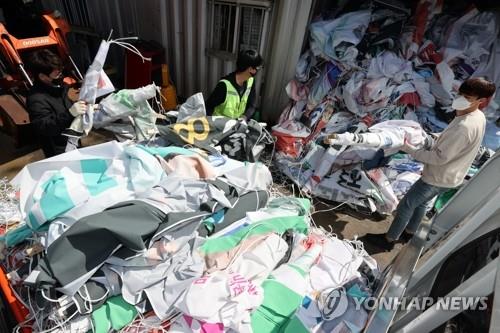 Election campaign material waste generated during the election campaign period of the April 7 by-election last year. / Photo by Yonhap News
A 20-something office worker, Mr. A, said, "I thought a lot of waste would be generated seeing the campaign materials hung all over the streets during the election campaign period, but I didn't realize the waste would be produced at this scale." He criticized, "Presidential candidates discuss climate crisis measures in TV debates, but who can trust them when they create such massive amounts of waste during election campaigns?"
Another office worker, Mr. B (31), said, "Not only campaign materials but also election promotional banners and booklets are left on the streets after the presidential election, which looks unsightly." He expressed frustration, saying, "This happens every election; isn't a solution needed?"
According to Article 276 of the current Public Official Election Act, those who install campaign materials or facilities for election campaigns must remove them without delay. The collected waste is recycled into other products such as shopping bags and miscellaneous goods through local governments. In this regard, the Ministry of Environment distributed the "Guidelines for Separate Collection of Election Printed Materials and Recycling of Used Campaign Banners" in 2020 and established measures for recycling election banners.
However, some point out that these measures alone cannot completely handle the overflowing election waste.
Green Korea United stated in an official announcement on its website on the 14th, "Although the Ministry of Environment conducted a pilot project for recycling election banners in 2018, even when reusable shopping bags made from used banners were provided free of charge, there was little demand from citizens, making distribution difficult." They added, "During the 21st general election, recycling of used banners accounted for only 23.5% of the total, and this was limited to producing multipurpose pouches, fan covers, and cleaning sacks."
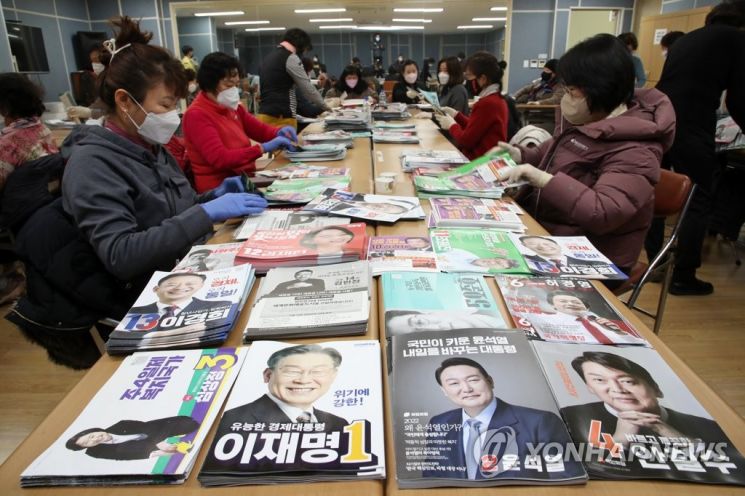 Last month, employees and volunteers at an administrative welfare center in Gwangju were working on sending out booklet-type election publicity materials. During this presidential election period, a total of 400 million copies of election publicity materials were sent out. / Photo by Yonhap News
In the National Assembly, an amendment to the election law aimed at preventing a 'waste crisis' after elections is currently pending. On August 31 last year, Assemblyman Jo Jeong-hoon of the Transition Korea party introduced a partial amendment to the election law. The bill stipulates that if all household members who receive election brochures apply for electronic election brochures, printed booklet-type election brochures will not be delivered to that household. The purpose is to reduce election waste by focusing more on online campaign materials than paper booklets.
Meanwhile, Assemblyman Eom Taeyoung of the People Power Party proposed an amendment to the election law in July last year to change the fabric used for election campaign banners to a structure that is easier to recycle.
Assemblyman Eom explained the reason for proposing the bill at the time, saying, "The enormous amount of discarded used banners during elections causes resource waste and environmental pollution. With the presidential and local elections approaching, I will lead environmental protection and an eco-friendly election culture through this amendment."
Experts suggest that while establishing a 'circular economy' that recycles waste is important in the long term, the priority should be on reducing waste generation itself.
Heo Seung-eun, team leader of the Green Society Team at Green Korea United, explained, "We need to save resources and consider recycling at the production stage, but what must be done immediately is to reduce waste generation. After reduction measures, reuse, recycling, and resource recovery should be implemented sequentially."
She added, "Responsibility in the public sector must be further strengthened," emphasizing, "What the Ministry of the Interior and Safety should do is not to support recycling policies but to amend the election law to prohibit the use of campaign banners and similar materials as is currently done."
© The Asia Business Daily(www.asiae.co.kr). All rights reserved.



















