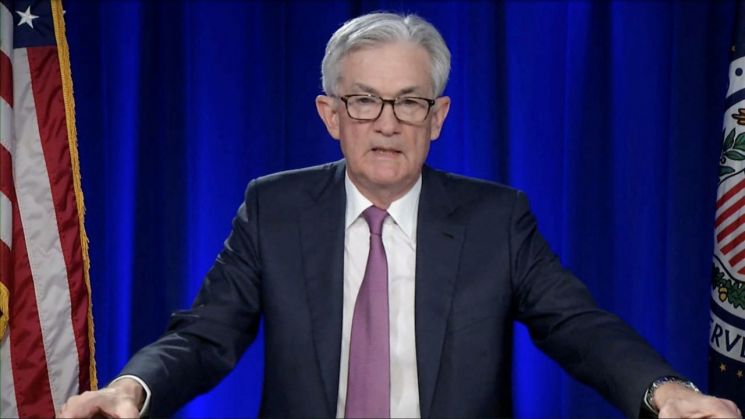
 Jerome Powell, Chairman of the U.S. Federal Reserve (Fed), is speaking at an online press conference held after the Federal Open Market Committee (FOMC) regular meeting on January 26 (local time). At this event, Chairman Powell indicated that "there is considerable room to raise interest rates," signaling a rate hike in March. [Image source=Yonhap News]
The Bank of Korea forecasted that the inflation trends in the United States and the Euro area will remain at high levels for the time being but will peak this year and then shift to a downward trend.
In a report titled 'Review of Major Issues Related to Global Inflation' released on the 15th, the Bank of Korea's foreign exchange operations department stated, "Inflation is expected to vary somewhat by region depending on proximity to recently heightened geopolitical risks, inflation conditions, and the level of economic recovery."
According to the Bank of Korea, institutions such as JP Morgan predict that with the easing of durable goods demand?which had driven price increases due to the resumption of economic activities?and the stabilization of goods prices, overall inflation will peak in the first half of this year and then decline.
However, the Financial Times (FT) projected that in the United States, despite the reversal to a downward trend in inflation, the level will remain above the inflation target of 2% through 2023.
During the COVID-19 pandemic, household consumption capacity increased significantly due to reduced service consumption and fiscal subsidies, and there is also a possibility that the recent substantial increase in corporate profits may lead to wage increases with a time lag.
The Bank of Korea explained that inflation in the Euro area is expected to remain high this year due to geopolitical risks but is likely to converge within the European Central Bank (ECB)'s inflation target range next year.
Recently, rising commodity prices have acted as a direct short-term inflationary factor, especially in countries such as Germany and Italy.
In the short term, increases in commodity prices such as crude oil, natural gas, and grains, along with the resulting production cost burdens, may also affect core inflation and act as a factor raising overall inflation in the Euro area.
Concerns have also been raised that the rapid policy shifts by central banks worldwide since last year could lead to economic slowdown or recession in the future.
The Bank of Korea stated, "Markets expect major central banks' monetary policies to focus on responding to high inflation for the time being," adding, "Going forward, responses are expected to vary depending on the development of geopolitical risks, the intensity and persistence of inflation, and macroeconomic conditions."
© The Asia Business Daily(www.asiae.co.kr). All rights reserved.

















