School Closures in Shanghai City, Home to World's No.1 Shanghai Port, Due to COVID-19 Spread
All Tier-1 Cities in China on High Alert Over Resurgence... Q1 Economic Growth Rate Negatively Impacted
[Asia Economy Beijing=Special Correspondent Jo Young-shin] Shenzhen, Guangdong Province, which has the third-largest cargo volume in China with Shenzhen Port, was abruptly locked down on the 14th. Additionally, Shanghai, home to Shanghai Port?the largest in China and the world for import and export cargo?has entered a state of high alert as COVID-19 spreads, issuing school closure orders. Since both Shanghai and Shenzhen ports are transshipment hubs, concerns are growing over a second logistics crisis originating from China.
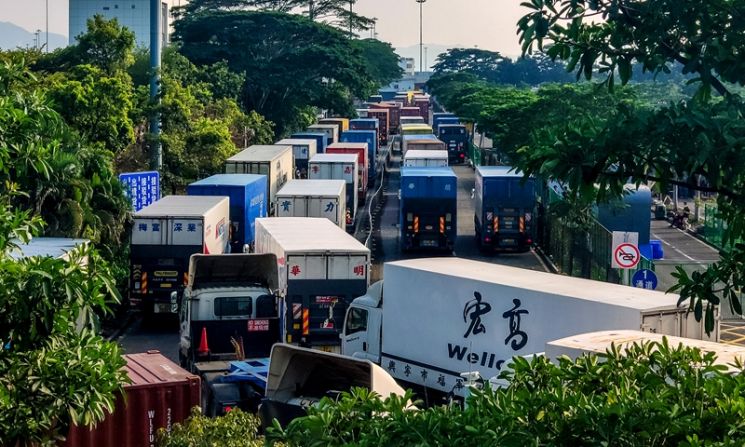
Health authorities in Shenzhen city announced a seven-day lockdown from the 14th to the 20th, prohibiting residents from going outside. This is the first time since the pandemic that a first-tier Chinese city (Beijing, Shanghai, Guangzhou, Shenzhen) has been locked down.
State-run Xinhua News Agency, citing the National Health Commission (NHC), reported that all business activities except those related to water, electricity, fuel, gas, telecommunications, and food?industries closely tied to citizens' daily lives?will be temporarily suspended. Since the 15th of last month, Shenzhen has recorded a total of 432 infections.
All transportation except port truck transport (public buses and subways) has been halted, and all city residents are prohibited from leaving Shenzhen unless they have a negative nucleic acid test certificate within 24 hours.
The NHC has made exceptions for logistics sectors such as Shenzhen Port transportation, but since the entire city is locked down, import and export customs clearance procedures are inevitably operating abnormally. Shenzhen Port ranks among the top three ports in China, handling 2.4 million TEUs monthly.
Shenzhen Port is already suffering from congestion. The port authorities have established four closed loops (isolated spaces separated from the outside world) around the port to separate container truck drivers traveling to and from Hong Kong. Drivers are swapped within these closed loops.
Shanghai, which operates Shanghai Port handling approximately 4 million TEUs monthly, is also on high alert. As of the 13th, 432 confirmed cases have been reported in Shanghai. In response to the worsening situation, Shanghai's education authorities abruptly ordered the closure of elementary, middle, high schools, and kindergartens on the 12th. Fudan University in Shanghai implemented campus lockdown measures starting at 8 p.m. on the 13th.
Additionally, all bus terminal operations will be temporarily suspended starting the 14th. This move is interpreted as an effort to prevent the influx of outsiders and leaves open the possibility of a full lockdown of Shanghai if the situation worsens.
Consequently, concerns are mounting over a second global logistics crisis originating from China. In August last year, the closure of Ningbo-Zhoushan Port (Meishan Terminal) in Zhejiang Province, China's second-largest port, due to COVID-19 spread, paralyzed the global logistics system. In terms of monthly cargo volume, Shanghai Port handles nearly twice as much as Ningbo Port. Considering Shenzhen Port also handles about 2.4 million TEUs monthly, there is a risk that over 6 million TEUs of cargo could become congested.
This is expected to negatively impact ocean freight rates. The Shanghai Containerized Freight Index (SCFI) peaked at 5109.60 in early January but declined to 4625.06 as of the 11th. The downward trend in ocean freight rates may reverse and begin rising again.
China’s first-quarter economic growth is also under threat. Besides Shanghai and Shenzhen, Beijing and Guangzhou are experiencing a resurgence of COVID-19, with some residents under control measures. Guangzhou, Shenzhen, and Dongguan are all located in Guangdong Province. Last year, Guangdong’s gross domestic product (GDP) reached 12.437 trillion yuan (approximately 2415 trillion Korean won). Beijing and Shanghai each joined the 4 trillion yuan (777 trillion Korean won) club last year as major cities.
A source in Beijing said, "The spread of COVID-19 in major cities is an unsettling development for Chinese authorities, who have set a growth target of 'above 5.5%' this year," adding that if the epidemic continues to spread, it could adversely affect economic growth.
© The Asia Business Daily(www.asiae.co.kr). All rights reserved.

















