PCR Testing Capacity Reached Limit... Personal Self-Test Kit Results Not Accepted
Treatment Prescriptions Available Immediately for Positive Cases Aged 60 and Over
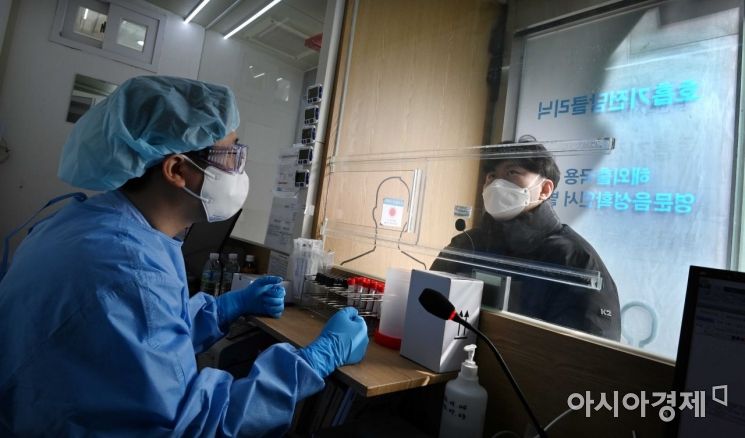 On the 3rd of last month, medical staff at the respiratory specialty clinic set up at Hana ENT Clinic in Yeoksam-dong, Gangnam-gu, Seoul, are treating patients with respiratory diseases separated by partitions. / Photo by Joint Press Corps
[Asia Economy Reporter Jo In-kyung] Starting from the 14th, if a professional rapid antigen test conducted at local clinics or hospitals shows a positive result, the individual will be recognized as a confirmed COVID-19 case without the need for a separate polymerase chain reaction (PCR) test. Accordingly, if a positive result is confirmed through a professional rapid antigen test at any of the 7,588 respiratory-specialized clinics and designated respiratory medical institutions nationwide, patients can receive treatment, consultation, and prescriptions immediately without undergoing additional PCR testing at public health center screening clinics.
The quarantine authorities decided to recognize the results of professional rapid antigen tests due to the recent surge in confirmed cases, which has made it difficult to handle the overwhelming number of PCR tests alone. As testing capacity reached its limit, delays occurred in notifying confirmed cases, which in turn caused cascading delays in home isolation and prescription of treatments. To accelerate the process of treatment, consultation, prescription, and isolation, the PCR step will be omitted.
In particular, high-risk groups aged 60 and above will be able to receive prescriptions for the oral antiviral treatment 'Paxlovid' immediately upon testing positive on the rapid antigen test. However, other prescription candidates such as immunocompromised individuals in their 40s and 50s must still receive a positive diagnosis through PCR testing as before.
This measure applies only to professional rapid antigen tests conducted by medical personnel; results from rapid antigen tests performed individually at home or at screening clinics will not be recognized. If an individual tests positive on a personal rapid antigen test, they must undergo PCR testing at a clinic, hospital, or screening clinic to confirm infection.
Omitting the PCR test is expected to somewhat affect the reported number of new confirmed cases. Currently, about 94.7% of those who test positive on rapid antigen tests are confirmed positive by PCR as well. Some individuals who are not infected with COVID-19 but receive a 'false positive' result on the rapid antigen test may be included in the confirmed case count.
Son Young-rae, head of the Social Strategy Division at the Central Disaster and Safety Countermeasure Headquarters, stated, "The positive predictive value of professional rapid antigen tests has significantly increased, and therefore, this measure will be implemented for the next month (until April 13), during which the epidemic is expected to peak and then decline." Afterward, the decision to extend the implementation will be made based on trends in PCR testing volume and changes in the positive predictive value of rapid tests.
According to the quarantine authorities, currently an average of 50 rapid antigen tests are conducted per clinic or hospital per day. If demand increases and the number of tests per site rises to 100, up to 700,000 rapid antigen tests could be conducted nationwide daily. The daily announced number of new COVID-19 confirmed cases will be the total of positive results from both PCR and rapid antigen tests.
© The Asia Business Daily(www.asiae.co.kr). All rights reserved.

















