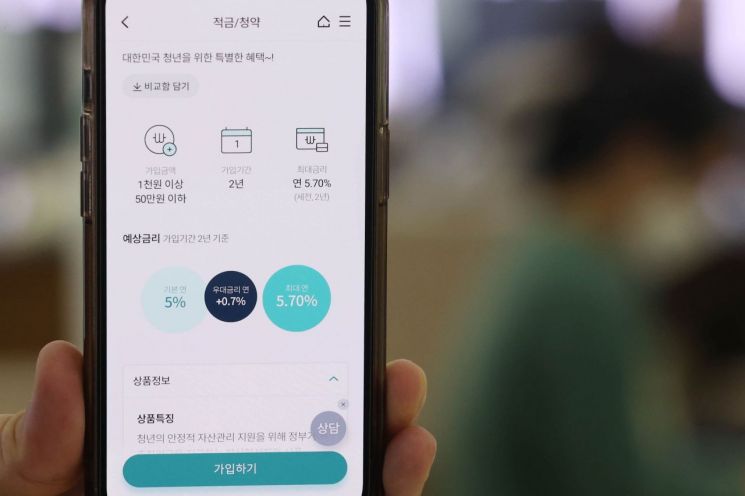
[Asia Economy Reporter Hwang Sumi] As President-elect Yoon Seok-yeol's campaign promise of the 'Youth Leap Account' draws attention, concerns are also emerging about fairness issues regarding budget allocation and those excluded from the support target.
The Hope Savings and Leap Account are youth asset-building support policies from the current government and President-elect Yoon, respectively. Both products target young people aged 19 to 34 with earned or business income.
The Leap Account has a broader eligibility range. Hope Savings limits eligibility to those with an annual income of 36 million KRW or less, but anyone who is a youth can join the Leap Account.
There are differences in benefits based on annual income. For those earning 24 million KRW or less annually, the maximum monthly deposit is capped at 300,000 KRW, and they can receive up to 400,000 KRW per month in government support. For those with an annual income exceeding 24 million KRW but not exceeding 36 million KRW, the personal deposit limit is increased to 500,000 KRW, but government support is reduced to a maximum of 200,000 KRW per month. For those earning more than 36 million KRW annually, government support is limited to a maximum of 100,000 KRW per month. If annual income exceeds 48 million KRW, government support does not apply; instead, tax exemption and income deduction benefits are provided.
The government support for the Leap Account is much greater than that for Hope Savings. Hope Savings offers government benefits up to 456,000 KRW over two years, whereas the Leap Account provides up to 57.54 million KRW over ten years.
However, one cannot subscribe to both products simultaneously. According to President-elect Yoon's campaign pledge book, the Leap Account "prevents overlapping subscriptions and support with similar programs funded by the government." Therefore, Hope Savings subscribers cannot join the Leap Account.
This has raised concerns that the policy intent of the Leap Account, which is youth asset formation, could be undermined. From last month to early this month, 2.9 million people applied to subscribe to Hope Savings. Particularly, since most subscribers are low-income youth, there are worries that they might be excluded.
Regarding this, according to a domestic economic newspaper report on the 11th, President-elect Yoon's team is considering ways to allow Hope Savings subscribers to switch to the Leap Account.
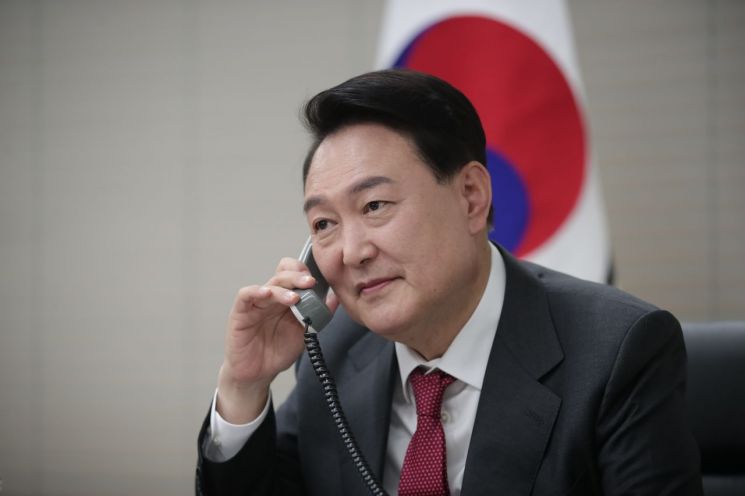 President-elect Yoon Suk-yeol is making a phone call with Japanese Prime Minister Fumio Kishida at the People Power Party headquarters in Yeouido, Seoul on the morning of the 11th.
 [Image source=Yonhap News]
The problem lies in the budget. The financial sector points out that if the pledge is implemented as is, an astronomical budget will be required, necessitating some adjustments.
According to Statistics Korea, as of July last year, there were about 6.3 million employed people aged 20 to 34. Even if all of them subscribe to the Leap Account and receive the minimum monthly support amount of 100,000 KRW, the annual budget required would be 7.56 trillion KRW. This exceeds 1% of this year's total national budget of 607 trillion KRW.
The industry expects that most of the 2.9 million people who chose Hope Savings will switch to the Youth Leap Account. In this case, even assuming the minimum government support of 100,000 KRW per person, 34.8 trillion KRW would be needed. Considering the increase in subscribers, the financial sector predicts that more than 80 trillion KRW will be required over ten years, including actual interest and support amounts.
The financial sector states that if government funds are injected as promised, there would be no major issues, but if the government faces difficulties in securing funds and demands high interest rates from commercial banks, it would inevitably become a burden.
Given the large support amounts, concerns about fairness controversies have also been raised. Even within the youth group, those who are unemployed do not receive support, which is criticized as excluding relatively more vulnerable individuals from assistance.
There could also be income reversal phenomena among youth due to the support. A youth with an annual income of 24 million KRW receives 400,000 KRW monthly, totaling 4.8 million KRW annually, raising their yearly income to 28.8 million KRW, whereas a youth earning 26 million KRW annually receives 200,000 KRW monthly, totaling 2.4 million KRW annually, making their total annual income 28.4 million KRW, which is less.
President-elect Yoon's team has not yet commented on securing specific support funds.
© The Asia Business Daily(www.asiae.co.kr). All rights reserved.


















