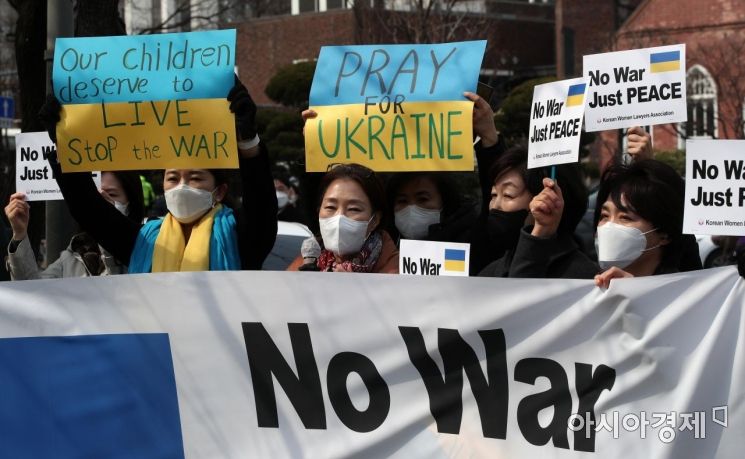
 Officials from the Korean Women Lawyers Association are holding a press conference condemning Russia's invasion of Ukraine near the Russian Embassy in Jung-gu, Seoul on the 7th. Photo by Hyunmin Kim kimhyun81@
[Asia Economy Sejong=Reporter Dongwoo Lee] As Russia's invasion of Ukraine takes on the characteristics of a global trade war, the industrial sector has gone on high alert. Concerns are growing that if the situation prolongs, the risk of a global supply chain collapse and soaring raw material prices will inevitably impact not only companies operating locally but also the domestic real economy.
On the 12th, the Ministry of Trade, Industry and Energy analyzed and disclosed a list of 500 items subject to export control measures imposed by Russia on unfriendly countries including South Korea. This includes 219 export-prohibited items such as semiconductor devices and integrated circuits (ICs) controlled by the Russian Customs Service, and 281 export-restricted items managed by export permits from five ministries including the Russian Ministry of Industry and Trade and the Ministry of Natural Resources and Environment. These are retaliatory measures against sanctions imposed by the United States and the European Union (EU) on Russia.
Earlier, on the 11th (local time), the United States strengthened sanctions against Russia by revoking Russia's Permanent Normal Trade Relations (PNTR) status and banning imports of Russian products such as vodka, seafood, and diamonds. The EU also announced its fourth round of sanctions, including a ban on imports of Russian steel, a ban on exports of European luxury goods to Russia, and the removal of Russia's Most Favored Nation status at the World Trade Organization (WTO).
As global supply chains become unstable, the upward trend in raw material prices is showing signs of prolongation.
The price of West Texas Intermediate (WTI) crude oil traded the previous day closed at $109.33 per barrel, up $3.31 from the previous day, and Brent crude rose $3.34 to $112.67 per barrel, maintaining high oil prices. On the same day, the average nationwide gasoline price in South Korea rose by 16.10 won to 1,955.07 won per liter, with prices in Seoul and Jeju surpassing 2,000 won.
Global credit rating agency Moody's recently warned that the prolonged Ukraine crisis could disrupt semiconductor supply. Palladium and neon gas are raw materials essential for semiconductor production, with Russia accounting for 44% of global palladium supply and Ukraine responsible for 70% of global neon gas supply. Nickel prices are also surging. According to the Korea Resources Information Service, as of this day, nickel prices stood at $42,995 per ton, rising more than 70% compared to the end of last month before Russia invaded Ukraine. This is due to growing concerns over supply disruptions from Russia, the world's fifth-largest nickel producer.
The rise in raw material prices is becoming a burden on the domestic real economy. The Korea Customs Service reported that export value (provisional customs clearance basis) from the 1st to the 10th of this month was $18.7 billion, a 14.9% increase compared to the same period last year, while the trade deficit widened to $1.39 billion from $1.157 billion in the same period a year ago. The cumulative deficit from January to the 10th of this month reached $5.29 billion.
Although monthly export values have increased year-on-year for 16 consecutive months from November 2020 to last month, imports have risen more sharply due to the impact of rising international oil and energy prices. In fact, among the top 10 import items this month, energy-related imports such as gas (87.0%), petroleum products (46.3%), crude oil (43.6%), and coal (57.3%) have increased significantly.
The government plans to strengthen support for companies affected by the prolonged Ukraine crisis and closely monitor the supply chain to carefully observe market conditions. The government stated, "We will closely monitor the forward and backward supply chains and, considering market conditions, review stabilization measures such as prohibiting hoarding, operating joint inspection teams, and emergency supply-demand adjustments if necessary."
© The Asia Business Daily(www.asiae.co.kr). All rights reserved.


















