Bank of Korea Releases Monetary and Credit Policy Report
Possibility of Prolonged Inflation
Stagflation Concerns Still Uncertain
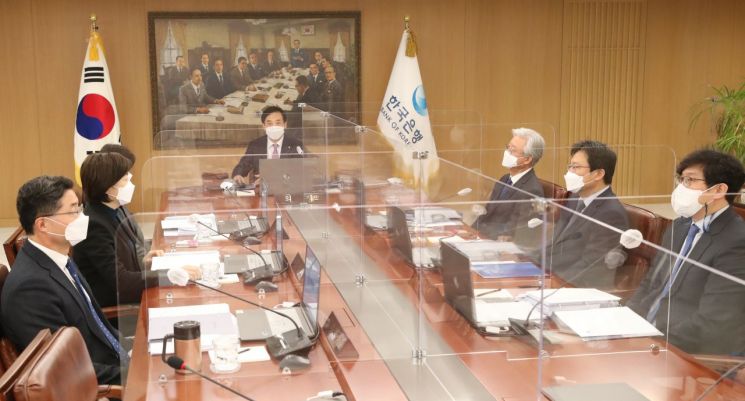 Lee Ju-yeol, Governor of the Bank of Korea, is presiding over the Monetary Policy Committee's main meeting on the monetary policy direction for February 2022, held on the morning of the 24th of last month at the Bank of Korea in Jung-gu, Seoul.
 [Image source=Yonhap News]
The Bank of Korea warned that the upward trend in energy and food prices continues due to the Ukraine crisis, indicating a possibility of prolonged high inflation. Although the Bank raised the base interest rate three times since August last year, it assessed that the effect on price stabilization was relatively weak. Consequently, there is analysis suggesting that the timing of further base rate hikes could be brought forward.
On the 10th, through the Monetary Policy Report (March 2022) approved at the Monetary Policy Committee meeting, the Bank of Korea explained, "Domestic inflation is also continuing at a high rate exceeding the target level," and added, "We need to be cautious as there is a high possibility of being exposed to upward risks due to the Ukraine crisis."
According to the Bank of Korea, although the Omicron variant is spreading rapidly recently, economic activity recovery continues in major countries, and prices of goods and services are steadily rising. In the United States, retail sales in January this year increased by 3.8% compared to the previous month, maintaining a favorable trend despite high inflation conditions. In particular, wages and housing costs have high price rigidity, so the ripple effects may last longer than expected.
As the global economy continues its recovery trend and global inflationary pressures increase, major central banks have repeatedly indicated that they will actively pursue normalization of monetary policy. The U.S. Federal Reserve (Fed) explicitly mentioned the possibility of a rate hike in March at its January meeting. Accordingly, domestic and international financial markets are experiencing increased volatility in interest rates and stock prices, with long-term market interest rates rising and stock prices declining.
However, the Bank of Korea explained that the possibility of stagflation, where economic slowdown and inflation occur simultaneously, is not high at the moment. Park Jong-seok, Deputy Governor of the Bank of Korea, said, "We are not forecasting stagflation," and added, "Since the global economy is recovering centered on the United States, inflationary pressures have increased, but it will not come together with an economic recession."
The Bank of Korea expects that the speed of monetary policy normalization in major countries and changes in market participants' expectations regarding this will continue to affect the domestic financial market. They explained that if the speed of monetary policy normalization in major countries accelerates faster than expected, the volatility of financial markets could significantly increase, so it is necessary to carefully monitor related risk factors.
Regarding domestic exports, although they have rapidly increased since the second half of 2020, it is expected that the growth rate will gradually slow if the center of economic improvement shifts from goods to services. The global supply disruptions caused by the prolonged Ukraine crisis are pointed out to negatively affect exports by causing difficulties in raw material procurement for Korean export companies, which are highly dependent on overseas sources.
However, the Bank of Korea assessed that unless global shocks such as armed conflicts between major powers or domestic and international supply chain disruptions occur, the possibility of exports showing sluggishness below the existing trend is not high.
The Bank of Korea explained that if the U.S. interest rate hike magnitude or the strength of the dollar exceeds market expectations, capital outflow pressure could increase and external financing conditions could deteriorate. It pointed out that if financial market instability spreads, especially among vulnerable emerging countries, it could also affect Korea's foreign exchange and financial markets.
In this situation, the Bank of Korea emphasized that it will operate monetary policy to stabilize the inflation rate at the target level (2%). The Bank stated, "The timing of additional base rate adjustments will be carefully judged while closely examining the development of COVID-19, the ripple effects of base rate hikes, changes in major central banks' monetary policies, accumulated risks of financial imbalances, and trends in growth and inflation."
© The Asia Business Daily(www.asiae.co.kr). All rights reserved.

















