Establishment of the Large-Medium Enterprise Win-Win Committee... Promotion of Polarization Resolution
Expressed Intention to Apply Differential Minimum Wages by Region and Industry
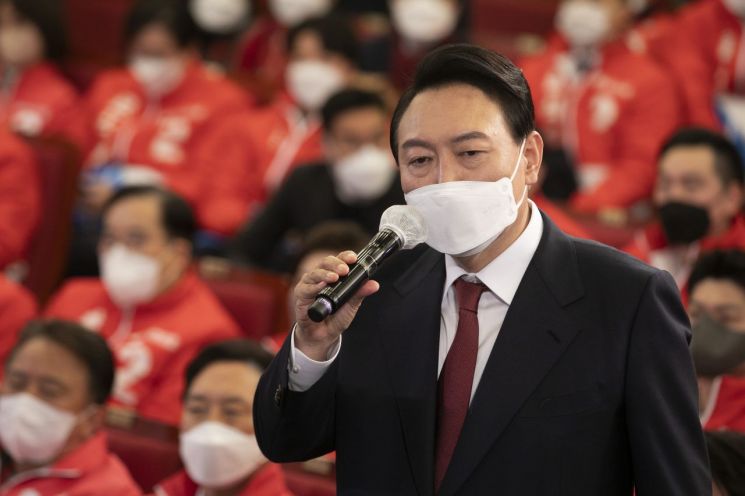
[Asia Economy Reporter Kim Bo-kyung] With Yoon Seok-yeol, the People Power Party candidate, winning the 20th presidential election, significant changes are expected in policies for small and venture businesses. President-elect Yoon has highlighted major pledges such as cooperation between large and small businesses and expanding flexibility in working hours.
Yoon's small business pledge carries the slogan "Providing a growth engine to 6.89 million small businesses and happy jobs to 17 million workers." The policy is designed to improve the management environment of small businesses while fostering cooperative relationships with large corporations.
First is the flexible reform of the 52-hour workweek system. He expressed his intention to supplement the uniform 52-hour workweek by expanding working hour flexibility and guaranteeing workers' choices. This includes extending the unit period for extended and flexible working hours to a monthly basis or longer, based on labor-management agreement. He stated that while maintaining total working hours, an environment will be created to flexibly respond to fluctuations in workload.
President-elect Yoon has also consistently advocated for reforming the minimum wage system. He pledged to apply differentiated minimum wages by region and industry, considering the payment capacity of small businesses.
He plans to actively consider introducing a delivery price linkage system so that small businesses do not bear the unilateral burden of raw material price increases and can receive fair prices.
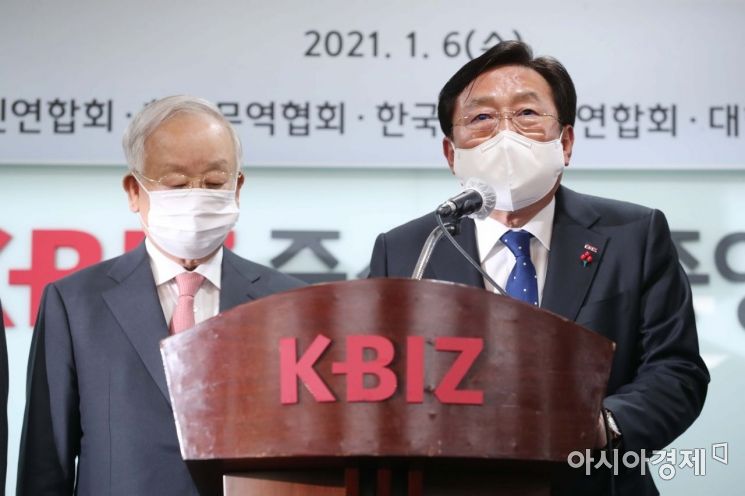 At a press conference held at the Korea Federation of Small and Medium Business in Yeongdeungpo-gu, Seoul, regarding the enactment of the Serious Accidents Punishment Act, Kim Ki-moon, chairman of the Korea Federation of Small and Medium Business, is speaking. Photo by Moon Ho-nam munonam@
Additionally, to resolve the polarization between large and small businesses, he promised to establish a presidential direct cooperation committee with a private joint committee character, appointing a representative from the small business sector as the chairman. In response, the Korea Federation of SMEs commented, "This will serve as an institutional foundation for establishing a culture of coexistence between large and small businesses and resolving polarization."
He also announced plans to improve the business succession system to help small businesses continue growing as excellent long-lived companies and to preserve jobs in small businesses.
To raise the welfare level and working environment of small business workers to that of large corporations, he intends to encourage sharing of large corporations' welfare infrastructure with small businesses.
Regarding venture and startup policies, Yoon proposed ▲introducing multiple voting rights for unlisted venture companies ▲fostering new industries through regulatory innovation and bold support ▲significantly expanding scale-up tailored financial support and research and development (R&D) support ▲and nurturing one million digital talents.
In a recent policy inquiry response to presidential candidates from the Korea Startup Forum, Yoon’s side stated, "Regulations are a cancerous presence that hinders social development," and added, "We will establish a dedicated regulatory impact analysis organization to review regulations that obstruct job creation from the ground up."
He also said, "The main agents of innovative economic growth are the private sector," and "The government should provide tax, financial, and institutional support to foster a new industry ecosystem and nurture the necessary talents."
© The Asia Business Daily(www.asiae.co.kr). All rights reserved.
![Clutching a Stolen Dior Bag, Saying "I Hate Being Poor but Real"... The Grotesque Con of a "Human Knockoff" [Slate]](https://cwcontent.asiae.co.kr/asiaresize/183/2026021902243444107_1771435474.jpg)

















