Brent Oil Hits 14-Year High
Energy-Dependent Industries on Alert
New Russian Energy Sanctions Deliver Direct Blow
Fuel Costs Rise for Aviation and Shipping
Korean Air Q4 Fuel Expenses Up 128% YoY
Refining Sector Watches War Prolongation Closely
Concerns Over Demand Shrinkage Amid Petroleum Price Hikes
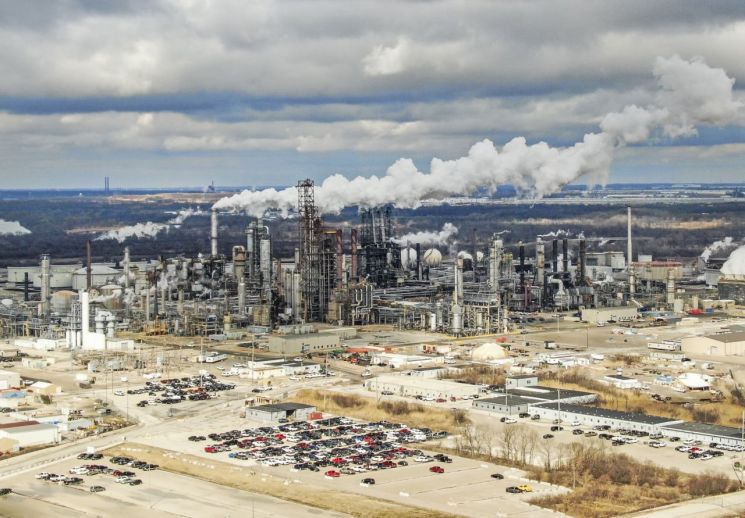 A photo taken by drone on the 7th (local time) of the ExxonMobil refinery near Joliet, Illinois, USA. (Image source=EPA Yonhap News)
[Asia Economy Reporters Moon Chaeseok and Yoo Hyunseok] International oil prices have surged past $130 per barrel for the first time in 14 years, triggering an emergency alert across domestic industries heavily reliant on crude oil imports. The burden of soaring raw material costs combined with a sharp rise in energy prices has already disrupted this year's business plans. Particularly, depending on whether additional energy sanctions against Russia are imposed, an 'oil shock'-level impact seems inevitable, raising serious concerns about severe damage to the entire domestic economy.
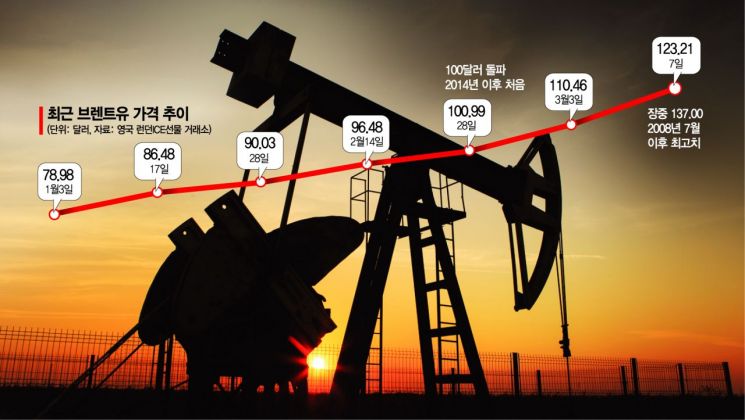
On the 7th (local time), the April West Texas Intermediate (WTI) crude oil price closed at $119.40 per barrel on the New York Mercantile Exchange, marking the highest closing price since September 2008. During the session, it surged 12.81% to reach $130.50 per barrel. At the same time, May Brent crude oil on the London ICE Futures Exchange closed at $123.21 per barrel, up $5.10 (4.32%) from the previous day. It also hit an intraday high of $137.00, up 15.99%, setting a new record since July 2008.
The cost burden on industries with the highest crude oil dependency among OECD member countries is expected to increase sharply. According to the Korea National Oil Corporation, Russian crude accounted for 5.6%, or 53.74 million barrels, of domestic crude oil imports last year.
The aviation and shipping industries are on high alert. Fuel costs are considered significant fixed expenses, accounting for 20-30% of cost of goods sold in aviation and 15-25% in shipping. In fact, Korean Air spent 589.1 billion KRW on fuel costs in the fourth quarter of last year, when oil prices began to rise, marking a 128.2% increase compared to the same period the previous year. Annually, this amounted to 1.8 trillion KRW, a 44.3% increase from 2020. A Korean Air official explained, "Considering statistical data and market conditions, we plan to implement hedging and other risk management measures."
HMM also spent 681.4 billion KRW on fuel costs, which accounted for 15.5% of its cost of goods sold totaling 4.3941 trillion KRW through the third quarter of last year. Since oil prices began to surge from December last year, it is expected that these companies' fuel expenses in the first quarter of this year have increased further. A shipping industry official said, "Although it varies depending on whether bulk carriers or container ships are the focus, rising fuel costs are a negative factor for the shipping industry."
The petrochemical industry, which produces petroleum products from crude oil, is also expected to face significant impacts. A petrochemical industry official said, "Combining government and private refiners' crude oil reserves amounts to about 200 days' supply. While there is a low possibility of factory shutdowns due to immediate naphtha supply disruptions, if the war prolongs, production costs will rise, reducing product cost competitiveness and causing bigger problems."
The refining industry is closely monitoring the duration of the war. While rising oil prices increase the value of crude oil reserves, resulting in inventory valuation gains, sustained price surges increase uncertainty, potentially leading to petroleum product price hikes and demand contraction. This worst-case scenario could prompt emergency measures such as lowering operating rates. The refining margin, which is the core profitability indicator for refiners and calculated by subtracting crude oil costs and transportation expenses from petroleum product prices, has also sharply declined.
A refining industry official said, "Since contracts made in January will cover supplies until April, even if refiners want to reduce operating rates, it will be difficult without securing storage space for the inventory." Another official added, "Although the volatility in oil prices caused by the war has led to a short-term sharp decline in refining margins, it remains to be seen whether this trend will lead to an overall decrease in petroleum product demand."
© The Asia Business Daily(www.asiae.co.kr). All rights reserved.
![Clutching a Stolen Dior Bag, Saying "I Hate Being Poor but Real"... The Grotesque Con of a "Human Knockoff" [Slate]](https://cwcontent.asiae.co.kr/asiaresize/183/2026021902243444107_1771435474.jpg)












