As international oil prices continue their high-flying trend, hovering above $130 per barrel, renewable energy is gaining renewed attention. There is a growing sentiment that, in the long term, energy sources such as offshore wind power must be sought to replace fossil fuels amid the decarbonization movement.
According to the business community on the 9th, major domestic steelmakers such as POSCO, Hyundai Steel, and SeAH Steel are identifying wind power-oriented steel products as future growth engines this year and are expanding market supply.
The surge in international oil prices is reigniting the previously dormant enthusiasm for renewable energy sources like wind power. Wind power projects in Europe and the United States are returning to a boom phase, and domestically, an 8GW-scale wind farm is being developed in Sinan-gun, Jeollanam-do. This year, the government has declared the year as the starting point for carbon neutrality and is pushing for a 'one-stop' permit system for solar and wind power generation. There are also plans to enact special legislation for wind power technology development and installation.
Renewable energy sources such as wind power are known to secure economic feasibility when oil prices exceed $100 per barrel. With recent oil prices soaring to unprecedented levels, wind power gains a comparative economic advantage over fossil fuels. One offshore wind turbine rated at 8MW to 9MW uses approximately 1,500 to 2,300 tons of steel. Considering that the price of thick steel plates is around 1.1 million KRW per ton, about 2.5 billion KRW worth of steel is required.
According to the Global Wind Energy Council (GWEC), the current global offshore wind market size is about 6.1GW, but it is expected that 65GW of new offshore wind power capacity will be installed by 2025. In particular, the Korean government has set a goal to build 12GW of offshore wind power capacity by 2030 and become one of the world's top five powers in this sector. The domestic offshore wind market size is still only about 0.1GW.
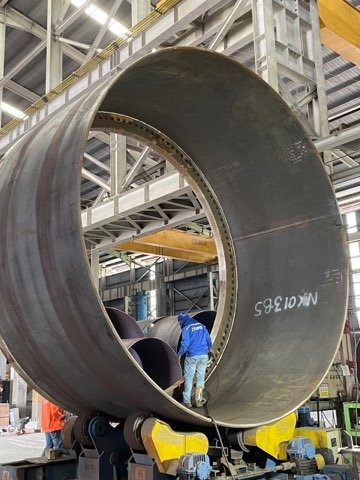
Steelmakers are expecting to expand steel supply for towers and substructures that produce wind power electricity. POSCO is accelerating global collaboration in the wind power industry. It is cooperating with Ørsted, the world's leading offshore wind power company based in Denmark, to supply steel required for the construction of the Incheon offshore wind power complex and to participate in green hydrogen production using wind power. POSCO has agreed to supply 160,000 tons of its thick steel plate brand 'Greenable Wind' for wind tower manufacturing to CS Wind, the global No. 1 wind tower manufacturer based in Korea. Since 2015, the cumulative steel supplied to CS Wind has exceeded 1 million tons.
Hyundai Steel is continuing to supply thick steel plates for offshore wind power to the UK, Taiwan, and India, while expanding the development and supply of specialized thick steel plate materials for offshore wind power. It is also participating in the Jeju Hallim offshore wind power project, a 100MW offshore wind farm constructed by Hyundai Engineering & Construction in the waters near Suwon-ri, Hallim-eup, Jeju. In this project, Hyundai Steel will supply about 12,000 tons of steel pipe materials used for the substructures of the power generation facilities and pin piles that support the structures.
SeAH Steel plans to expand its business area into the renewable energy sector as a new source of revenue. There is great anticipation that large-scale energy projects such as the UK wind farm 'Hornsea 3' project will be continuously secured. In August last year, SeAH Steel announced a large-scale investment of about 400 billion KRW in a monopile production plant (foundation structures supporting the base of wind turbines) in the UK, marking the full-scale entry into the offshore wind structure overseas market. The plant is expected to begin full-scale commercial production in the first quarter of next year.
© The Asia Business Daily(www.asiae.co.kr). All rights reserved.

















