Development of Aluminum Containers for Aircraft Cargo Holds
"Researched by salvaging and dismantling discarded imported parts"
Ministry of Land, Infrastructure and Transport to Approve Type Certification, FAA Certification Also Planned
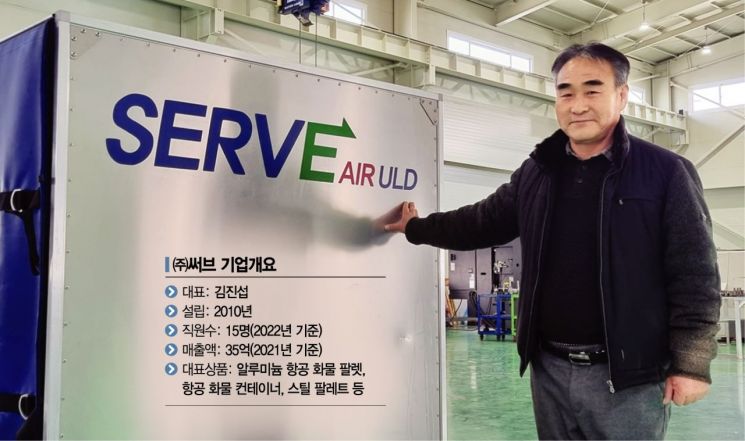 After 9 years of development, CEO Kim Jin-seop of Serve, who is on the verge of domestic production of air cargo containers, poses next to the container he personally developed.
 [Photo by Kwak Min-jae]
[Asia Economy Reporter Kwak Minjae] About a 10-minute drive northwest by car from the Samsung Electronics Pyeongtaek Plant located in Godeok Industrial Complex leads to Eoyeon Hansan General Industrial Complex in Cheongbuk-eup, Pyeongtaek-si, Gyeonggi Province. There is a small and medium-sized aviation parts company, Seobeu Co., Ltd. (CEO Kim Jinseop), which has localized aviation cargo pallets that were previously entirely dependent on imports. Seobeu, which has been producing aluminum aviation pallets since 2020 and supplying them to domestic low-cost carriers (LCCs), is now on the verge of localizing aluminum aviation containers (AKE).
When visiting the Seobeu factory on the 4th, employees were busy assembling aluminum parts. They were stacking processed parts on silver aluminum sheets and fastening them with rivets (metal fasteners used to join metal materials).
An aviation container is an aviation part assembled from materials such as aluminum, designed to fit the cargo hold of an aircraft. It carries bulky cargo, including passengers' travel suitcases. Although it looks like a simple aluminum container, it is one of the components attached to the aircraft by rollers. It is important to make it light while being strong enough to bear the weight. The aviation container must precisely meet the specifications of the top surface area (2007mm × 1534mm), bottom surface area (1534mm × 1562mm), and height (1626mm). Due to the nature of aviation parts, any deviation from the exact specifications could lead to major accidents. This is why it must pass stringent standards to obtain part certification.
Kim Jinseop, CEO of Seobeu, said, "Before founding the company, I worked as a site manager at a pallet company, which gave me the experience to venture into aviation container manufacturing. Meeting international standards was not easy, and before I knew it, nine years had passed while working tirelessly."
It is remarkable that a small company with only 15 employees and 4 R&D personnel has achieved this. The unit load device (ULD) market, including aviation containers, is dominated by long-established and large companies like Norway's Nordisk. Since there were no domestic development cases, there was no one to teach them, and reference materials were extremely scarce. CEO Kim said, "After extensive inquiries, I found out that discarded parts from foreign companies supplying domestic airlines could be purchased at scrap yards. I bought discarded parts, cut them open to study the materials, sizes, angles, and thicknesses one by one, and if I couldn't buy parts, I made them myself while focusing on technology development."
After nine years of research, Seobeu's aviation container is now on the verge of receiving the Ministry of Land, Infrastructure and Transport's (MOLIT) ‘Aircraft Loading Equipment Technical Standard Type Approval (KTSO)’. The MOLIT certification applied for in 2020 passed the load test by the Aviation Safety Technology Institute in February last year, and the design and production approvals are currently in the final stages. FAA certification from the U.S. Federal Aviation Administration will proceed after MOLIT approval. CEO Kim said, "The U.S. and Korea have signed an Aviation Safety Agreement (BASA), which builds high trust between the two countries, and MOLIT approval and FAA certification are quite similar. Just as we received FAA certification for aviation pallets two years ago, we are optimistic about aviation container certification."
Although localization is imminent, CEO Kim still faces another barrier: market development. Large domestic airlines already have business relationships with foreign companies, and overseas airlines are reluctant to purchase products from lesser-known small and medium-sized enterprises.
Fortunately, the situation eased somewhat three months ago when Seobeu signed a contract to supply 100 aviation pallets to Air Incheon. CEO Kim said, "We are gradually gaining recognition for our technology, receiving inquiries for quotations from Jeju Air, which has introduced cargo-only aircraft. Our ultimate goal is to enter the overseas private aviation market, including the U.S."
© The Asia Business Daily(www.asiae.co.kr). All rights reserved.
![Clutching a Stolen Dior Bag, Saying "I Hate Being Poor but Real"... The Grotesque Con of a "Human Knockoff" [Slate]](https://cwcontent.asiae.co.kr/asiaresize/183/2026021902243444107_1771435474.jpg)
















