[Asia Economy New York=Special Correspondent Joselgina, Reporter Lee Hyunwoo] Economic experts watching the soaring international oil prices are growing increasingly concerned. The rapid rise in oil prices, the tightening moves by central banks including the Federal Reserve (Fed), and Russia's military threats targeting Eastern Europe all vividly recall the nightmares of the 1970s.
There is also a flood of analyses predicting a recurrence of ‘stagflation’?a combination of stagnant growth and soaring inflation?similar to the oil shock era. Past cases in 1990, 2000, and 2008, when oil prices doubled over the course of a year, all triggered tsunamis in the global economy, serving as warnings that cannot be ignored.
◇"The Only Way to Stop Putin" Oil Export Ban Consideration Sparks Oil Price Surge
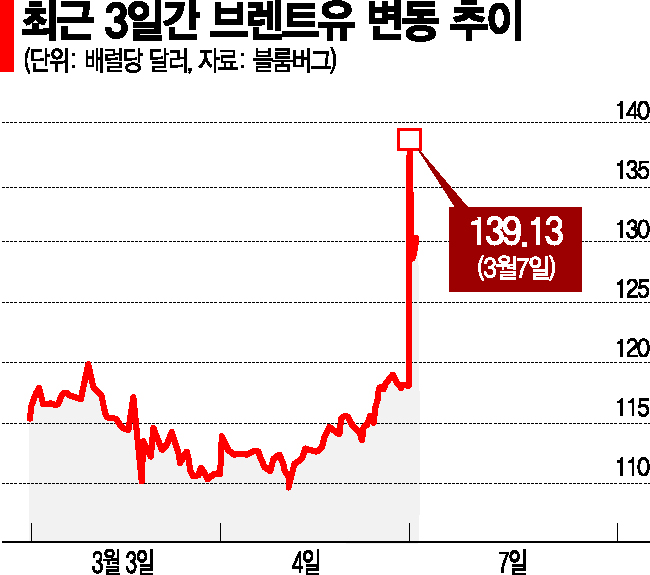
On the 6th (local time), as news confirmed that the United States and the European Union (EU) are finally considering an oil export ban against Russia, which invaded Ukraine, international oil prices surpassed $130 per barrel. Brent crude soared to the $139 per barrel range, with intraday gains reaching as high as 18%. Compared to about $68 a year ago, prices have more than doubled. West Texas Intermediate (WTI) crude also rose from around $63 a year ago to briefly exceed $130 during the trading session.
So far, the Biden administration in the U.S. has shown reluctance to impose energy sanctions despite criticism that sanctions without an ‘energy embargo’ are full of holes (Time magazine). This is because they judged that the damage to the U.S. and its allies would be greater than the impact on Russia. Russia, the world’s second-largest oil exporter, accounts for 11% of global exports. There were concerns that energy sanctions could only cause international oil prices and fuel prices in various countries to skyrocket. The Biden administration, already under political pressure due to inflation at its highest level in 40 years, had no reason to take unnecessary risks against Russia ahead of the November midterm elections. Europe, which depends on Russia for 40% of its natural gas imports, was in a similar position.
However, after failing to stop Russian President Vladimir Putin’s moves despite successive sanctions, it is now understood that the U.S. and its allies are closely examining ways to block Russian oil exports. Scott Sheffield, CEO of Pioneer Natural Resources, said, "The only way to make Russia stop the war by itself is to block exports of Russian oil and natural gas."
Additionally, Russia’s obstruction of the restoration negotiations for the Iran nuclear deal (JCPOA - Joint Comprehensive Plan of Action) has also partially contributed to the surge in international oil prices. Previously, Russia warned that if Western sanctions related to the Ukraine invasion were not lifted, it could derail the Iran nuclear deal. However, Helima Croft, an analyst at RBC Capital, pointed out, "Some expect the Iran nuclear deal to lower soaring international oil prices, but this is too small to offset the disruption caused by Russia."
◇"A Third Oil Shock May Come" Fear of Stagflation
It is only a matter of time before international oil prices surpass $200 per barrel. Lee Sun Harris, Chief Economist at Bank of America (BoA), predicted, "If 5 million barrels of Russian oil exports are cut off, oil prices could rise to $200 per barrel, slowing global economic growth."
Daniel Yergin, Vice Chairman of market intelligence firm IHS Markit, mentioned the 1973 first oil shock caused by Middle Eastern oil producers cutting supply in retaliation against the U.S. and the West, and the 1978 oil price surge following the Iranian Revolution, warning that "a crisis worthy of being called the ‘third oil shock’ could come."
Especially considering the slow economic recovery after the pandemic and inflation in major countries, there are growing concerns that such an energy shock would deliver a direct blow to the global economy as a whole. Nicolas Colas, co-founder of DataTrek Research, noted in an investor note, "Looking at past cases where oil prices doubled over a year, it is confirmed that a recession was not far behind."
Above all, the biggest concern is stagflation. According to a global research survey by BoA, the proportion of analysts expecting stagflation to begin within the next 12 months has risen to 30%.
Nuriel Roubini, a New York University professor known as ‘Dr. Doom,’ recently warned in an article, "There is a great concern about global stagflation," adding, "This would be a nightmare scenario for central banks." He said, "They will have to accelerate tightening to curb inflation but slow down to avoid triggering a recession as they did in the 1970s," and predicted, "Governments that have already exhausted ammunition through various stimulus measures during the COVID-19 pandemic will not be able to rely on fiscal policy."
© The Asia Business Daily(www.asiae.co.kr). All rights reserved.












![The Special Connection Between the Statue of Martyr Lee Jun in Jangchungdan Park and Mayor Oh Sehoon ③ [Current Affairs Show]](https://cwcontent.asiae.co.kr/asiaresize/319/2026012110001599450_1768957215.jpg)
