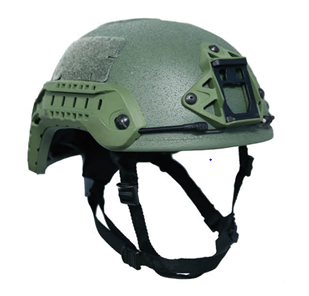
[Asia Economy Military Specialist Yang Nak-gyu] The Army has announced that it will provide 100% of soldiers with new ballistic helmets by 2024. Unlike existing helmets, these are part of the future personal combat system called the ‘Warrior Platform,’ which offers superior ballistic protection and can be equipped with night vision devices. To examine the technology of the new helmets, I visited the manufacturer BMI on the 21st of last month.
Upon entering Jingok Industrial Complex in Namyangju, Gyeonggi Province, factories of various industries stood side by side like matchboxes. Inside the BMI production plant, a scene unlike any other factory caught my eye. Entering the conference room, I saw executives in the middle of a meeting with stacks of ballistic helmets embedded with bullets piled up among them.
BMI began supplying sniper camouflage uniforms to our military in 2018 and provided ballistic vests to special forces last year. Ballistic helmets and vests are classified into nine levels according to standards set by the U.S. Department of Justice’s National Institute of Justice (NIJ). Our soldiers wear ballistic vests rated at Level 3A, which can stop handgun bullets, while special forces receive Level 4 vests capable of stopping armor-piercing rounds.
BMI has also supplied ballistic helmets to special forces operating in the field, as well as overseas deployment units such as the ARC Unit and Hanbit Unit. These helmets boast performance that can stop 9mm FMJ bullets and .44 Magnum rounds. Even if a bullet is lodged on the outer surface, the helmet absorbs the impact internally to protect the soldier’s head. Currently issued helmets only protect against shrapnel.
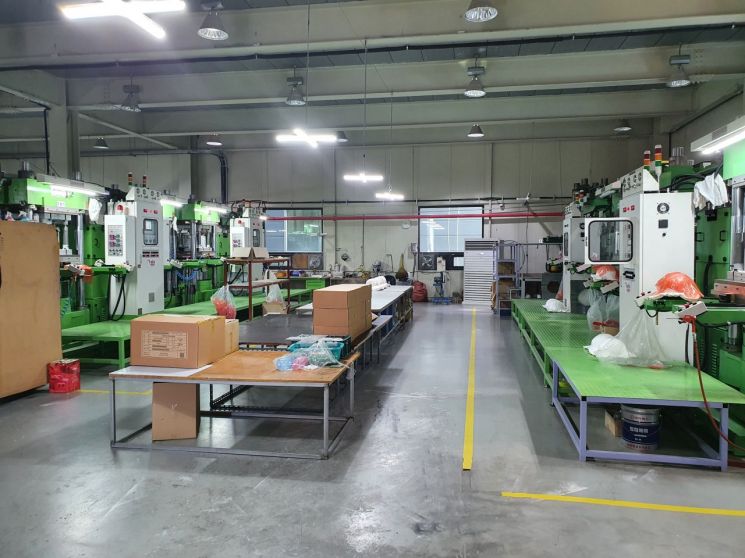
A company representative led me to the first-floor production plant to demonstrate the helmet technology. About ten helmet manufacturing machines stood in the factory. CEO Shim Jeong-hoon said, "Previously, many steps were manual, but now, with proprietary technology, automation has greatly increased, reducing defects and increasing production volume," adding, "This was the secret to delivering 4,500 helmets to the military in just two months."
On one side of the production plant, white fabric was being cut. This white fabric is ultra-high molecular weight polyethylene, layered multiple times and compressed under high heat to form the shape of the ballistic helmet. The helmet’s strength and weight vary greatly depending on the temperature and compression applied.
A BMI official explained, "To create a helmet with high strength yet light weight, the optimal compression strength and temperature must be found," adding, "The helmets produced by BMI currently weigh only 80% of the weight required by the military but have superior strength."
The compressed helmet resembled a white helmet. When touched, it was hard and solid like a ballistic helmet. If a construction safety helmet can withstand a strength level of 1, a motorcycle helmet 10, then a ballistic helmet can endure strength levels exceeding 100. The helmets then underwent painting. To prevent damage from external impacts, a special coating was applied two to three times. This coating also blocks the intense sunlight on the helmet’s exterior, helping soldiers avoid heatstroke. After painting, the helmets were fitted with mounting structures to attach about ten items such as night vision devices, headsets, and lights.
The helmets also incorporated a cable button tightening and loosening technology. This system, commonly used in golf and hiking shoes, allows for four different helmet sizes to be produced while enhancing the fit.
CEO Shim said, "This is one of BMI’s core technologies," showing a 5mm thick sponge. He explained, "This material was developed in-house in 2019," adding, "Installed inside the helmet, it can reduce external impact by more than 50%."
© The Asia Business Daily(www.asiae.co.kr). All rights reserved.


















