Local Tax Research Institute Report... Top 10% Property Tax Burden, 40.5% in 2018 → 56.7% in 2021
Government to Announce Property Tax Relief Measures at Month-End... We Have Punitive Progressive Rates, Overseas Apply Proportional Rates
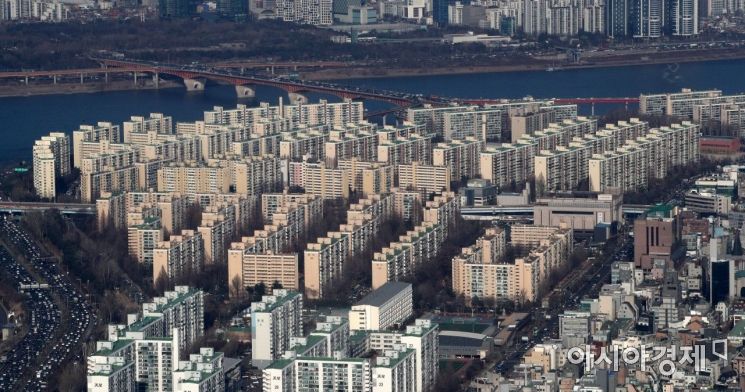
[Asia Economy Sejong=Reporter Kwon Haeyoung] Last year, the top 1% of homeowners by house price among those owning a single home bore about 24% of the total holding tax burden of all single-home owners. This year, with the sharp rise in official land prices, the tax burden on 'single-home real demand households' is also expected to increase significantly, drawing attention to the government's plan to ease the holding tax burden on single-home owners, scheduled to be announced at the end of this month.
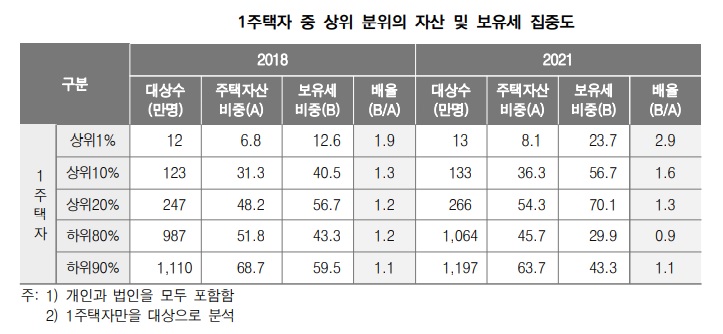
◆Top 1% of Single-Home Owners Pay 23.7% of Holding Tax=According to the report titled 'Redesigning the Holding Tax System to Establish the Role of Property Tax and Comprehensive Real Estate Tax' released on the 5th by the Korea Local Tax Research Institute, the average official price of housing assets held by the top 1% of single-home owners in 2021 was 1.75 billion KRW, accounting for 8.1% of the total assets of all single-home owners. However, their holding tax (property tax + comprehensive real estate tax) accounted for 23.7% of the total tax burden of all single-home owners.
Their share of total housing assets slightly increased from 6.8% in 2018 to 8.1% in 2021, while their share of the holding tax burden nearly doubled from 12.6% to 23.7% during the same period.
The holding tax burden share of the top 10% of single-home owners by house price rose from 40.5% in 2018 to 56.7% in 2021, and for the top 20%, it increased from 56.7% to 70.1%. Conversely, the bottom 90% saw their share of the holding tax burden decrease from 59.5% to 43.3% over the same period.
When expanding the scope to include multi-homeowners, the concentration of holding tax burden became even more pronounced. The top 1% of homeowners by house price bore 42% of the holding tax in 2021, up significantly from 21% in 2018, accounting for nearly half of the total holding tax.
The widening gap in tax burden between high-priced and mid-to-low-priced homes among single-home owners is attributed to the property tax burden cap and the imposition of the comprehensive real estate tax, which cause a sharp increase in tax burden at certain thresholds.
Park Jihyun, Director of Research Planning at the Korea Local Tax Research Institute, explained, "With the recent rapid rise in official prices, the property tax burden is determined more by the tax burden cap than by the tax rate," adding, "Under the policy to strengthen holding taxes, only multi-homeowners and owners of high-priced homes were targeted, while policies actually reduced the tax burden on mid-to-low-priced single-home owners who previously had a low tax burden."
In fact, the government applies different tax burden caps according to official price brackets. The tax burden cap limits the increase in tax so that the holding tax does not surge compared to the previous year. Currently, property tax caps are set at ▲105% for official prices under 300 million KRW ▲110% for 300 million to under 600 million KRW ▲130% for 600 million KRW and above. The comprehensive real estate tax burden cap for single-home owners is 150%. Meanwhile, a special property tax reduction is applied to single-home owners with homes valued at 900 million KRW or less.
◆Government to Announce Holding Tax Relief Measures at Month-End... Overseas Apply Proportional Tax Rates, Not Progressive=As complaints grow that even real demand households are being crushed by taxes due to soaring official prices, the government plans to announce measures to ease the holding tax burden on single-home owners by the end of this month. In line with the Ministry of Land, Infrastructure and Transport's official price announcement on the 22nd, various options are being considered, including ▲reusing the previous year's official price ▲adjusting the tax burden cap ▲payment deferral for the elderly, as announced at the end of last year.
Regarding payment deferral for the elderly, since both ruling and opposition presidential candidates have pledged to defer payments for long-term single-home owners or elderly households, it is highly likely that this will be included in the government's holding tax relief measures. Reusing official prices is seen as a temporary fix, so lowering the tax burden cap is expected to be the fundamental solution.
In this regard, a Ministry of Economy and Finance official said, "We are reviewing all three measures to ease the holding tax burden on single-home real demand households," adding, "Once the presidential transition team is formed after the election, new measures may be included depending on the next president's pledges."
Some argue that the comprehensive real estate tax, which has sparked double taxation controversy, should be integrated with the property tax, and that holding taxes should apply proportional tax rates rather than progressive rates. Progressive tax rates apply higher rates as the taxable base increases, while proportional tax rates apply a single rate regardless of the taxable base. South Korea adopts progressive rates for the comprehensive real estate tax as a punitive measure. However, among countries that have introduced holding taxes, only Denmark applies progressive rates; most countries such as France, Germany, Spain, the Netherlands, and Japan follow a proportional tax rate system.
Among countries that have introduced wealth taxes separately from real estate holding taxes are France, Norway, Switzerland, and Spain. According to the Korea Local Tax Research Institute, these countries introduced wealth taxes not to increase the progressivity of existing holding taxes but rather to complement the existing tax system. For example, in France, one of the taxable assets under the wealth tax is real estate, which is taxed only on net assets after deducting liabilities. Costs such as real estate mortgage loan expenses, acquisition costs, renovation and reconstruction costs, maintenance costs, property tax, and inheritance tax payments are deductible as expenses.
© The Asia Business Daily(www.asiae.co.kr). All rights reserved.
![Clutching a Stolen Dior Bag, Saying "I Hate Being Poor but Real"... The Grotesque Con of a "Human Knockoff" [Slate]](https://cwcontent.asiae.co.kr/asiaresize/183/2026021902243444107_1771435474.jpg)

















