Performance Degradation When GOS Feature Activated
Angry Users Prepare Class Action Lawsuit
Samsung Electronics Initially Claimed
"Safety Measure" but Controversy Grew
Update Provides Performance Priority Option
Apple Battery Gate as a Cautionary Tale
[Asia Economy Reporter Lim Hye-seon] "If Porsche limited its speed to 100 km/h, would you buy it?" (Naver Cafe GOS Class Action Preparation Room)
On the 4th, Samsung Electronics announced its intention to resolve the controversy over the ‘Galaxy S22’ Game Optimizing Service (GOS) by conducting an urgent software update. This is an unusually swift response. The company expressed its determination to proactively address consumer concerns without repeating the Apple iPhone performance degradation issue that escalated into the ‘Battery Gate’ several years ago.
Trigger: Performance Test by Overseas Developers
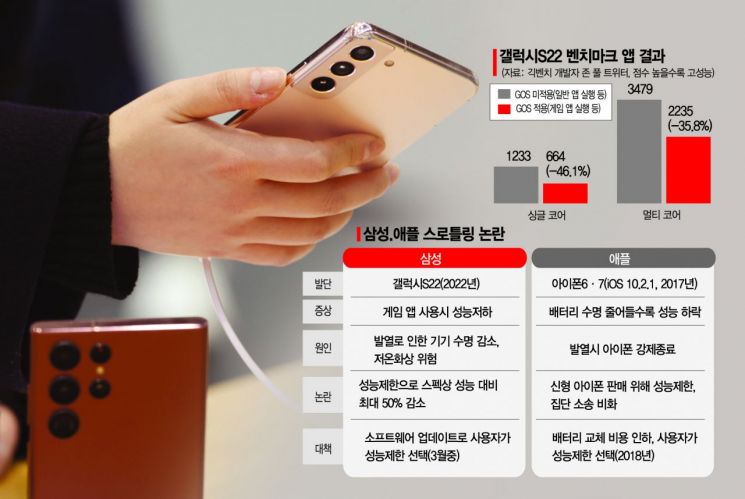
Samsung Electronics equipped the Galaxy S22 with the GOS function to prevent excessive heat generation and battery consumption, which could reduce device lifespan when running high-spec, high-resolution games. GOS automatically activates when an app recognized as a game runs, limiting the performance of the Application Processor (AP) and Graphics Processing Unit (GPU).
Controversy began when several developers from the developer community ‘Geekbench’ released test results showing performance degradation when the GOS function was activated on the ‘Galaxy S22 Ultra.’ The test results, which showed single-core and multi-core performance dropping by -46% and -35.8% respectively when GOS was active, quickly spread through social networking services (SNS) including Twitter.
The controversy intensified because the GOS function was forcibly applied without consumer choice. There were even claims that Samsung’s promotion of the Galaxy S22 as allowing users to enjoy games with ‘the best performance’ was deceptive. Users were not informed about the GOS function, nor was there any way to bypass it. Angry users began gathering on Naver Cafe to prepare for a class action lawsuit.
Software Update Scheduled for March
In the early stages of the GOS issue, Samsung Electronics responded by saying it was a measure for user safety, such as preventing low-temperature burns. High-performance smartphones can generate temperatures above 40 degrees Celsius when using 3D graphics-based games. In severe cases, temperatures can exceed 50 to 60 degrees Celsius, and when the temperature rises beyond a certain level, the device automatically shuts down to protect itself. Prolonged exposure to temperatures above 40 degrees Celsius can cause low-temperature burns. Since low-temperature burns do not cause noticeable symptoms, users who play games for extended periods may suffer burns without realizing it.
Samsung Electronics stated, "The application of GOS is based on the policy of prioritizing consumer safety."
The controversy deepened further when the list of applications on which Samsung forcibly applied the GOS function was revealed. It was pointed out that Samsung was running GOS on a total of about 10,000 apps beyond just high-spec games. Suspicions arose that Samsung deliberately reduced performance to extend battery life and maintain device longevity.
On the night of the 3rd, Samsung Electronics announced through the Samsung Members notice, "To meet the diverse needs of customers, we plan to implement a software update soon that will provide a performance priority option in the Game Booster Lab within the Game Launcher app." Samsung plans to allow users to directly choose whether to use the GOS function within this month.
Unusually Fast Response, Background is Apple
Samsung Electronics’ swift response is to avoid repeating Apple’s ‘Battery Gate’ incident that erupted at the end of 2017.
Apple simultaneously limited the performance of iPhone 6 and iPhone 7 series devices with the iOS 10.2.1 update, but kept it hidden from consumers. Although complaints arose from iPhone users that their devices slowed down after updating iOS, Apple remained silent. A user on the community ‘Reddit’ conducted benchmark tests after updating the OS and claimed that there was a performance difference between iPhones with old batteries and those with new batteries.
After performance tests by specialized media, it was revealed that Apple limited performance as battery life decreased. Apple explained, "When battery performance declines, iPhones may suddenly shut down, so we limited some performance to prevent this," but the controversy intensified. There were accusations that Apple limited the performance of older iPhones through updates to encourage the purchase of new iPhones. Eventually, a series of lawsuits from iPhone users followed. In the U.S., a class action lawsuit worth about 100 trillion won was filed, and in Korea, 300,000 people expressed their intention to participate in lawsuits through the law firm Hannuri.
Ultimately, in 2018, Apple CEO Tim Cook stated, "We will provide an option in the next OS update for consumers to choose whether to reduce performance," bringing the issue to a temporary close. In an interview with ABC News, Tim Cook apologized for not informing consumers about the ‘performance limitation’ feature.
Despite Tim Cook’s apology, Apple’s ‘Battery Gate’ lawsuits continued. In November 2020, Apple paid a settlement of $113 million (approximately 126 billion won) following lawsuits in 34 U.S. states. Lawsuits in Korea are still ongoing.
© The Asia Business Daily(www.asiae.co.kr). All rights reserved.

















