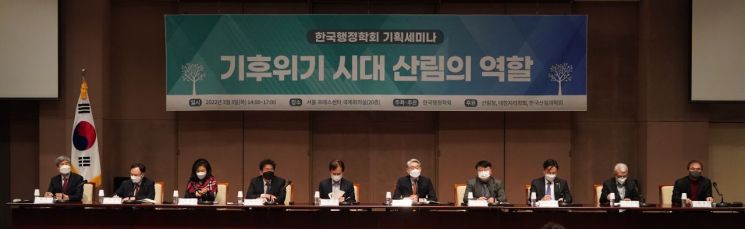
 On the 3rd, the Korean Association for Public Administration held a planned seminar at the Seoul Press Center titled "The Role of Forests in the Era of Climate Crisis: Restoration of the Korean Peninsula Forest Ecosystem and Inter-Korean Forest Cooperation in Response to the Climate Crisis." Discussants attending the seminar shared their opinions on inter-Korean forest cooperation. Provided by the Korea Forest Service
[Asia Economy (Daejeon) Reporter Jeong Il-woong] “Inter-Korean forest cooperation is a non-political and humanitarian project and an urgent important task that cannot be postponed for the sake of our future generations who must live with the forest ecosystem of the Korean Peninsula as their habitat in the era of climate crisis.”
This was the statement made by Choi Byung-am, Commissioner of the Korea Forest Service, at a planned seminar held at the Seoul Press Center on the 3rd.
On this day, the Korean Association for Public Administration held a planned seminar under the theme “The Role of Forests in the Era of Climate Crisis: Restoration of the Korean Peninsula Forest Ecosystem and Inter-Korean Forest Cooperation to Respond to the Climate Crisis.”
The seminar proceeded with an opening address by Won Sook-yeon, President of the Korean Association for Public Administration, a welcoming speech by Choi Byung-am, Commissioner of the Korea Forest Service, a congratulatory speech by Minister Lee In-young of the Ministry of Unification, a keynote lecture by Kim Byung-yeon, Director of the Seoul National University Institute for Peace and Unification Studies, a presentation by Bae Jae-soo, Head of the Future Forest Strategy Research Division at the National Institute of Forest Science, and a discussion session.
In his opening remarks, President Won Sook-yeon emphasized, “Forests are a major carbon sink universally recognized by the international community,” and stressed, “The role of the Korea Forest Service is important in resolving the climate crisis using forests and addressing the issue of forest degradation in North Korea.”
Commissioner Choi Byung-am also appealed the importance of inter-Korean forest cooperation in his welcoming speech. He stated, “Although about 76% of North Korea’s total area is forest, 2.62 million hectares (28% of the total forest area) have been degraded,” and added, “Inter-Korean forest cooperation reflects this reality in North Korea, and it becomes a process where South and North jointly respond to the climate crisis as members of the international community and seek a path of coexistence as a community of destiny called the Korean Peninsula.”
Additionally, Minister Lee In-young of the Ministry of Unification said in his congratulatory speech, “The starting point of a virtuous cycle in responding to the climate crisis on the Korean Peninsula will be inter-Korean forest cooperation,” and “South and North Korea, connected as one in terms of climate, geography, and ecology, can be the optimal partners for forest cooperation.”
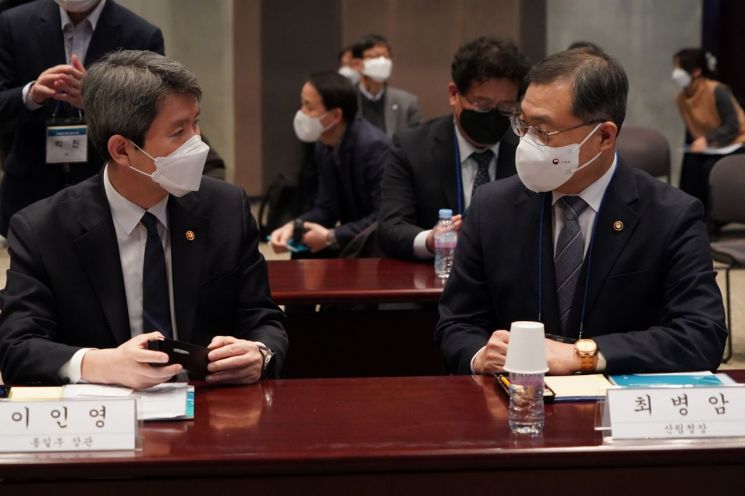 Choi Byung-am, Administrator of the Korea Forest Service (right), and Lee In-young, Minister of Unification (left), are exchanging views on inter-Korean forest cooperation at the seminar "The Role of Forests in the Era of Climate Crisis" on the 3rd. Photo by Korea Forest Service
The seminar also outlined a blueprint for inter-Korean forest cooperation. First, Kim Byung-yeon, Director of the Seoul National University Institute for Peace and Unification Studies, delivered a keynote lecture stating, “Inter-Korean forest cooperation can become a 21st-century strategy where North Korea becomes the ‘Alps of East Asia’ through synergy projects such as greenhouse gas emission trading based on forests, construction of forest tourism complexes combined with North Korea’s traditional culture and history, sports activities and leisure facilities from an educational perspective, and medical tourism combining South Korea’s medical technology with inter-Korean forest tourism resources.”
Alongside this, Bae Jae-soo, Head of the Future Forest Strategy Research Division at the National Institute of Forest Science, presented the ‘REDD+’ project as a cooperation agenda with high acceptability for both South and North Korea, drawing attention by discussing the projected contribution rate to national greenhouse gas reduction targets and specific implementation plans.
The discussion session continued with participation from various stakeholders including academia and related institutions, providing a time to discuss concrete and practical roles and cooperation plans for inter-Korean forest cooperation.
Participants in the discussion included ▲Park Mi-ok, President of the Environmental Administration Research Association of the Korean Association for Public Administration ▲Park Soo-jin, Director of the Asia Center at Seoul National University ▲Professor Park Jin of the Graduate School of International Studies at the Korea Development Institute ▲Woo Soo-young, President of the Korean Forest Science Society ▲Professor Yoo Seung-jik of the Climate Environment Convergence Major at Sookmyung Women’s University ▲Lee Seok-hwan, Vice President of Kookmin University ▲Lee Yong-kwon, Head of the Inter-Korean Forest Cooperation Division at the Korea Forest Service ▲Jung Sung-heon, Chairman of the Korea DMZ Life and Peace Hill ▲Hwang Cheol-soo, President of the Korean Geographical Society (in alphabetical order), who shared their respective opinions.
Lee Yong-kwon, Head of the Inter-Korean Forest Cooperation Division at the Korea Forest Service, representing the government at this event, defined the relationship between South and North Korea as “an important government duty stipulated in the ‘Inter-Korean Relations Development Act’ to promote peace on the Korean Peninsula, realize an inter-Korean economic community, restore ethnic homogeneity, and resolve humanitarian issues such as separated families,” and appealed, “Above all, to understand the role of forests, we should not view forests only from a functional perspective but prioritize the spatial aspect.”
He continued, “Without understanding the forest space, which accounts for nearly 80% of North Korea’s area, policy leaks are inevitable in national governance,” and summarized the panelists’ opinions by stating, “Ultimately, the area where direct and indirect economic value and synergy effects can be generated through forest spatial management will be ‘inter-Korean forest cooperation.’”
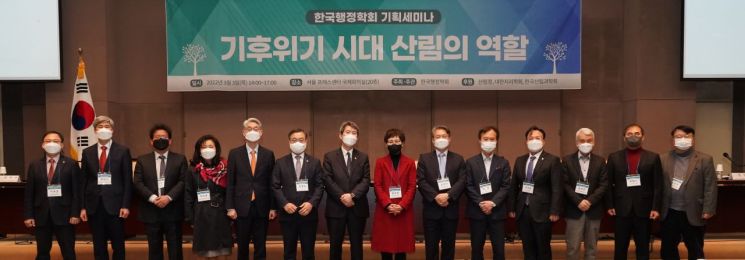 On the 3rd, participants of the planned seminar "The Role of Forests in the Era of Climate Crisis: Restoration of the Korean Peninsula Forest Ecosystem and Inter-Korean Forest Cooperation in Response to the Climate Crisis" are taking a commemorative photo after the seminar. Photo by Korea Forest Service
◆Below is a summary of the main statements made by the panelists at the discussion session
▶Park Mi-ok, President of the Environmental Administration Research Association of the Korean Association for Public Administration: “As a prerequisite for inter-Korean forest cooperation to restore the forest ecosystem of the Korean Peninsula and respond to the climate crisis, South Korea’s carbon emission trading law should be amended to include North Korean projects, and afforestation projects should not be included in North Korea sanctions on humanitarian grounds. Also, carbon trading issues should be included in all inter-Korean cooperation agendas and ‘small-scale projects’ should be promoted to make them feasible, prioritizing the protection and restoration of wetlands, which have been proven as carbon sinks.”
▶Park Soo-jin, Director of the Asia Center at Seoul National University: “An ‘international shared campus’ should be established in the border area between South and North Korea, and based on this, a shared space where government, international, and private organizations responsible for inter-Korean cooperation including the Korea Forest Service, universities, and industries can operate should be created. Above all, essential measures such as efficiently linking the private sector and decision-makers and activating boundary organizations that can connect policy decisions in different fields must be established and implemented.”
▶Professor Park Jin of the Graduate School of International Studies at the Korea Development Institute: “In the sense of expanding the goals of forest policy to the broader framework of environmental and inter-Korean relations improvement, it is necessary to broaden the perspective and scope of forest policy. To this end, efforts to share and transform the internal awareness of the Korea Forest Service’s active role are required.”
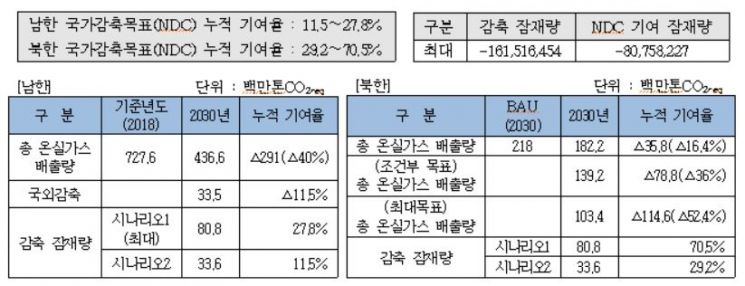 Analysis data on the effects of implementing REDD+ projects in North Korea. Seminar participants anticipated that the potential greenhouse gas reduction from REDD+ projects in North Korea could significantly contribute to the North and South Korea 'Nationally Determined Contribution (NDC)' greenhouse gas reduction targets. Provided by the Korea Forest Service
▶Woo Soo-young, President of the Korean Forest Science Society: “Efforts for efficient forest restoration through inter-Korean cooperation are necessary. In this process, unifying the forest resource survey system of the Korean Peninsula should be considered an important matter to create income and jobs for residents, such as fuelwood forest creation projects for agricultural and mountain village residents, and contribute to greenhouse gas reduction.”
▶Professor Yoo Seung-jik of the Climate Environment Convergence Major at Sookmyung Women’s University: “REDD+ (Reducing Emissions from Deforestation and Forest Degradation Plus, referring to various projects implemented to reduce greenhouse gas emissions caused by deforestation and forest degradation in developing countries) provides a concrete opportunity and direction for mutual ‘win-win’ inter-Korean cooperation projects. To implement this, the Korea Forest Service must simultaneously carry out domestic and international greenhouse gas reductions, and especially establish foundations such as national plans, baseline setting, monitoring, and safeguards.”
▶Jung Sung-heon, Chairman of the Korea DMZ Life and Peace Hill: “In the context of changing international political conditions and ongoing stagnation in inter-Korean relations, comprehensive review and policy formulation to enhance the complex value of the forest ecosystem are important. Above all, the Korea Forest Service must thoroughly prepare for the implementation of inter-Korean forest cooperation by establishing comprehensive plans for ecosystem conservation and value enhancement in the DMZ area and strengthening environmental education in the era of climate crisis.”
▶Hwang Cheol-soo, President of the Korean Geographical Society: “To overcome the new normal environmental crisis, it is necessary to view inter-Korean forest cooperation projects from a new perspective with the recognition of a ‘community of life.’ Also, foundational research to interpret such climate crisis phenomena is needed, and after establishing an integrated SDGs cooperation platform for the Korean Peninsula, I propose a promotion strategy to develop it into a multilateral cooperation mechanism framework.”
© The Asia Business Daily(www.asiae.co.kr). All rights reserved.
![Clutching a Stolen Dior Bag, Saying "I Hate Being Poor but Real"... The Grotesque Con of a "Human Knockoff" [Slate]](https://cwcontent.asiae.co.kr/asiaresize/183/2026021902243444107_1771435474.jpg)


















