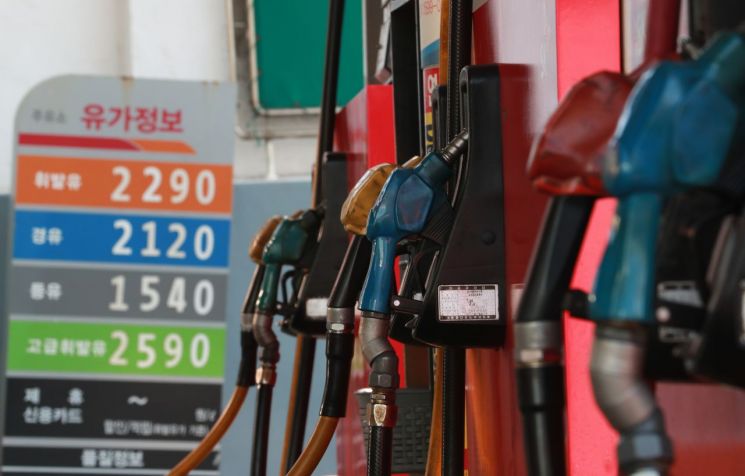
 Due to geopolitical factors such as Russia's invasion of Ukraine, international oil prices have surged, causing domestic fuel prices to rise as well. On the afternoon of the 24th of last month, gasoline was being sold at 2,290 won per liter at a gas station in downtown Seoul.
 [Image source=Yonhap News]
[Asia Economy Reporter Donghoon Jeong] As international oil prices surpassed $110 per barrel (approximately 132,440 KRW), reaching the highest level in over seven years, concerns are rising that consumer damages will become a reality.
On the 2nd (local time), April delivery West Texas Intermediate (WTI) crude oil on the New York Mercantile Exchange (NYMEX) closed at $110.60 per barrel, up 7% ($7.19) from the previous day. This price is the highest in 11 years since May 2011.
Brent crude for May delivery on the London ICE Futures Exchange was trading at $113.26 per barrel (approximately 136,365.04 KRW), up 7.9% ($8.29) as of 7:43 PM (London local time). This is the highest level since June 2014.
Russia's invasion of Ukraine is shaking the prices of various raw materials and resources, including crude oil and natural gas.
The escalation of the war is expected to continue disrupting the crude oil supply chain, which is driving up oil prices. Recently, Russia deployed airborne troops to Kharkiv, Ukraine's second-largest city, and is moving large-scale forces toward the capital Kyiv, intensifying the invasion.
U.S. President Joe Biden hinted at the possibility of sanctions on Russian oil and gas exports, raising concerns about a global oil supply shortage. Russia is the world's third-largest oil producer. However, despite the potential supply shortage, the Organization of the Petroleum Exporting Countries (OPEC) and its allied group including Russia, known as 'OPEC Plus' (OPEC+), decided to increase oil production in April by only 400,000 barrels per day compared to March.
For South Korea, which imports most raw materials including crude oil, companies are expected to face increased cost burdens, making a decline in earnings inevitable. Bloomberg News, citing Morgan Stanley strategist Jonathan Garner and others, reported that "high oil prices will have particularly negative effects on major oil-importing countries such as India, South Korea, and Taiwan." These increased costs for companies are expected to eventually lead to price hikes for individual products and inflation, increasing the burden on consumers.
In fact, the three major tire companies will raise prices by an average of 5%, and up to 10%, starting in March. The companies explained that this decision is due to rising raw material costs such as natural rubber and synthetic rubber, as well as increased maritime freight charges.
The wholesale electricity price (SMP) that Korea Electric Power Corporation (KEPCO) pays to power producers also surged by about 200 KRW on average last month, setting a record high. According to the Korea Power Exchange, the integrated SMP for February was 197.32 KRW/kWh. Compared to the January average SMP of 154.42 KRW, this is a sharp increase of 27.8% in one month. This is the highest since the wholesale electricity market was established in 2001 and surpasses the previous monthly average SMP record of 185 KRW in July 2012. Although electricity rates are frozen for the first quarter, the growing deficit burden means that an increase in electricity rates cannot be ruled out.
Liquefied petroleum gas (LPG) prices will also rise. Domestic LPG importers E1 and SK Gas announced that they will increase the domestic LPG supply price by 60 KRW per kilogram this month. Accordingly, E1's March propane prices for household and commercial use will rise to 1,387.8 KRW per kilogram, and industrial use to 1,394.4 KRW per kilogram. With international grain prices also surging recently, there are concerns that the 'table prices' for ordinary citizens will be directly impacted.
© The Asia Business Daily(www.asiae.co.kr). All rights reserved.
![Clutching a Stolen Dior Bag, Saying "I Hate Being Poor but Real"... The Grotesque Con of a "Human Knockoff" [Slate]](https://cwcontent.asiae.co.kr/asiaresize/183/2026021902243444107_1771435474.jpg)
















