Last Year, New Certified Products Increased by 44%... Expansion of Vegan Zones in the Distribution Industry
[Asia Economy Reporter Eunmo Koo] As vegetarianism gains attention as a lifestyle that realizes ethical values such as animal rights and environmental protection, domestically certified vegan food products are rapidly increasing. With the domestic vegetarian population gradually on the rise, the related industry is also expected to continue its growth trend.
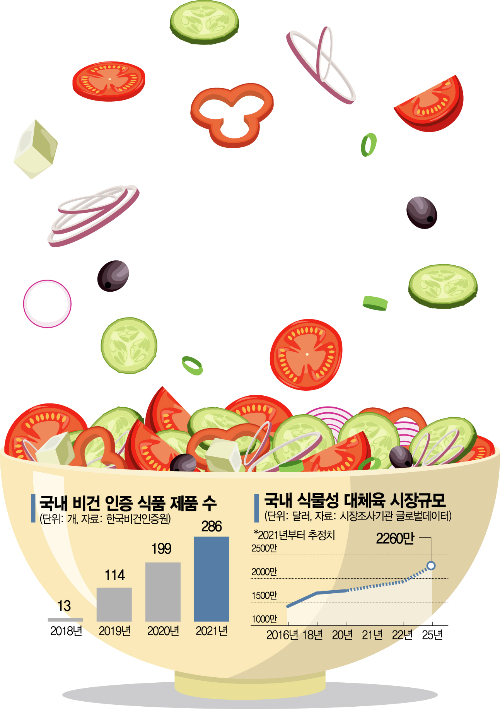
According to the ‘2021 Processed Food Submarket Status’ published on the 2nd by the Ministry of Agriculture, Food and Rural Affairs and the Korea Agro-Fisheries & Food Trade Corporation (aT), the number of products newly certified as vegan by the Korea Vegan Certification Institute last year was 286, a 44% increase from 199 products the previous year.
The number of vegan-certified food products has been increasing every year. Starting with 13 products in 2018, it rose to 114 in 2019, and with 286 newly added last year, the cumulative total reached 612. Vegan foods refer to products that do not conduct animal testing and do not use animal-derived ingredients or animal-origin products.
Vegan foods, which were once simply focused on raw materials, have recently diversified into frozen prepared foods, sauces, seasonings, cheeses, ramen, ice cream, and more, leading to expanded participation from major retailers. E-Mart has partnered with ‘Jiguin Company,’ which sells plant-based alternative meat, to sell the alternative meat product ‘Unlimit,’ and Hyundai Green Food has signed an exclusive sales contract with Canadian vegan dairy company ‘Daiya.’
Convenience stores are also launching various vegan foods in line with trends and increasing sales. According to GS25, sales of vegan foods from January to July last year increased 18 times compared to the same period the previous year, and CU also saw a 15-fold increase during the same period. GS25 plans to expand its vegan food offerings from the current 15 types to about 30 types in the future.
Large supermarkets are also expanding vegan food sales within their stores. E-Mart increased the number of stores operating the ‘Vegetarian Zone,’ which sells products made only from plant-based ingredients, from 20 stores in 2020 to 33 stores last year. Lotte Mart operates a ‘Vegan Specialty Zone’ in its frozen food sections at 70 stores, and Homeplus also runs a ‘Vegan Zone’ gathering vegan products at 52 stores.
The distribution industry views the domestic vegan food market’s growth potential highly, as vegetarianism spreads based on the perception that it realizes ethical values such as animal rights and environmental protection while also being good for health. In particular, attention is focused on the spread of the ‘value consumption’ trend among the MZ generation (Millennials + Generation Z), who have recently emerged as major consumers. According to the Korea Vegetarian Union, the domestic vegetarian population is about 1.5 million and is gradually increasing.
The market size is also growing. According to the UK market research firm GlobalData, the domestic plant-based alternative meat market size was about $17.4 million (210 billion KRW) in 2020, showing a 23.7% growth compared to $14.1 million in 2016, recording an average annual growth rate of 5.6%. This trend is expected to continue steadily, with the market projected to grow to $22.6 million (272 billion KRW) by 2025.
© The Asia Business Daily(www.asiae.co.kr). All rights reserved.

















