[Asia Economy Reporter Hwang Sumi] As the international community strengthens economic sanctions against Russia for invading Ukraine, the impact on Russian citizens is becoming a reality.
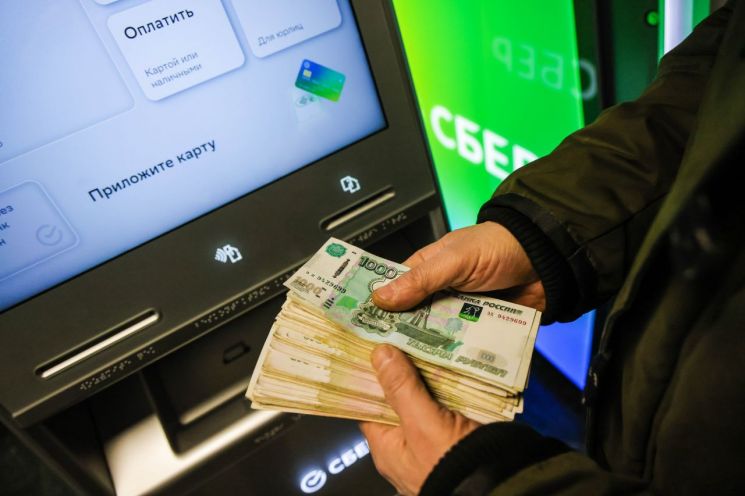
According to AFP and other sources on the 28th (local time), crowds gathered near ATMs across Russia since last weekend, trying to withdraw cash. Russians holding rubles are trying to secure as many dollars as possible.
A citizen in his 20s who tried to use an ATM in Moscow, the Russian capital, expressed dissatisfaction. He told the BBC, "The ATM is completely empty," and added, "I'm afraid we might end up like North Korea or Iran."
Another citizen said, "If I could leave Russia now, I would leave immediately." He explained, "The central bank raised the benchmark interest rate from 9.5% to 20.0%, an increase of 10.5 percentage points, to defend against the ruble's sharp decline," adding, "People who bought houses with bank loans now have significantly more debt to repay."
The ruble's value was around 95 rubles to 1 dollar at the end of last year but has fallen to 75 rubles currently.
Earlier, the United States and the European Union (EU) agreed to exclude Russia from the Society for Worldwide Interbank Financial Telecommunication (SWIFT) payment network and freeze the Russian central bank's foreign currency reserves as a response to Russia's invasion of Ukraine.
Many Russians are also facing difficulties using public transportation. Since banks linked to Google Pay, Apple Pay, and other payment services have been sanctioned, these services are no longer available for paying transportation fares.
On the 28th, the Russian Ministry of Public Transport announced that due to issues with the state-owned VTB Bank, which is under sanctions, payments for buses, subways, and trams may not be processed.
Chris Wipper, head of a consulting firm in Moscow, told the BBC, "Due to trade restrictions and the collapse of the currency value, price increases are expected, leading to panic buying in some grocery stores," and added, "Ultimately, the sanctions are hitting ordinary Russians."
Initially, Russia showed confidence that it could withstand Western economic sanctions for a considerable period, citing its position as the world's fifth-largest foreign exchange reserve holder with $630 billion (approximately 758 trillion won).
However, a significant portion of these funds is held in central and commercial banks in major Western countries such as New York, London, and Berlin, making it difficult to access immediately. Moreover, the Russian central bank holds $12 billion (approximately 14 trillion won) in cash, which is not large compared to other countries' central banks, and with the U.S. Treasury sanctioning the central bank, it is analyzed that this money will also be difficult to use.
© The Asia Business Daily(www.asiae.co.kr). All rights reserved.
![Clutching a Stolen Dior Bag, Saying "I Hate Being Poor but Real"... The Grotesque Con of a "Human Knockoff" [Slate]](https://cwcontent.asiae.co.kr/asiaresize/183/2026021902243444107_1771435474.jpg)











